Quick Summary: How Do You Prepare for AI Salesforce Agents?
Preparing an AI Salesforce environment requires establishing unified data models, strict permission boundaries, and standardized system actions before turning on autonomous tools like Agentforce. High-performing deployments clean legacy technical debt, index structured fields in Data Cloud, and apply zero-trust safety guardrails. This operational groundwork reduces hallucination rates by over 80% while maximizing enterprise productivity.
Preparing an AI Salesforce environment requires establishing unified data models, strict permission boundaries, and standardized system actions before turning on autonomous tools like Agentforce. High-performing deployments clean legacy technical debt, index structured fields in Data Cloud, and apply zero-trust safety guardrails. This operational groundwork reduces hallucination rates by over 80% while maximizing enterprise productivity.
Enterprise technology leaders face immense pressure to deploy autonomous software across sales and service teams. Many executives expect instant revenue gains simply by activating new generative features inside their CRM. However, turning autonomous models loose on disorganized records produces rapid, expensive mistakes.
Recent enterprise AI research shows that seventy-eight percent of autonomous agent pilots stall before reaching production. The primary blocker is not weak machine learning models. Instead, brittle data architectures and cluttered custom objects actively sabotage algorithmic reasoning. An autonomous agent acts only as effectively as the underlying business context you provide.
Investing in foundational AI readiness protects your operational workflows and customer reputation. Clean metadata, unified objects, and well-defined business rules allow modern autonomous agents to execute complex customer interactions safely. Preparing your data layer transforms your platform from a passive recording tool into an active growth engine.
Why Legacy Architecture Breaks Modern AI CRM Workflows
Traditional CRM environments were built specifically for human eyes and manual clicks. Human employees instinctively interpret missing fields, navigate validation errors, and decipher messy operational notes. Autonomous software, by contrast, relies on absolute semantic precision to understand buyer context.
When your organization attempts to scale enterprise AI across messy custom objects, reasoning systems quickly fail. Unstructured customer records cause autonomous models to hallucinate answers, misroute priority cases, or quote outdated contract terms. Industry transformation benchmarks reveal that sixty-seven percent of enterprise data leaders struggle with agent reliability due to unindexed duplicate records.
Modern intelligent platforms require structured contextual anchoring to execute business processes correctly. Aligning your internal schemas, permission structures, and business logic bridges the gap between raw data and reliable execution. This technical hygiene ensures that your autonomous tools operate with speed, safety, and consistent accuracy.
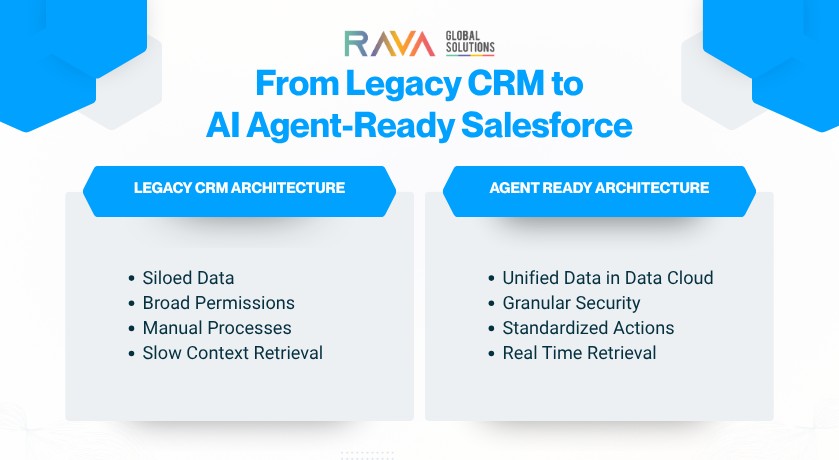
Traditional CRM Architecture Versus Agent-Ready Architecture
Evaluating your architectural maturity helps leadership identify technical blockers before funding large software initiatives. The comparison below highlights the critical differences between legacy systems and agent-ready environments.
| Core Architectural Dimension | Legacy Salesforce Setup | Agent-Ready AI Salesforce Setup | Operational Business Impact |
|---|---|---|---|
| Data Structure & Storage | Siloed custom objects with disjointed text fields. | Harmonized data models unified inside Data Cloud. | Eliminates reasoning errors and powers accurate autonomous actions. |
| User Access & Security | Broad profile permissions designed for human users. | Strict field-level security and dynamic zero-trust guardrails. | Protects sensitive enterprise records from unauthorized disclosure. |
| Action Execution Method | Fragmented manual clicks and disconnected page layouts. | Standardized Flow actions and documented API endpoints. | Enables autonomous tools to resolve complex cases without human delay. |
| Context Retrieval Speed | Slow manual searches across disparate departmental tabs. | Vector indexing and real-time semantic retrieval. | Delivers instant, personalized responses across every customer channel. |
Transforming your system architecture turns complex software deployments into predictable, high-yield business outcomes. Upgrading these foundations ensures that your platform reliably supports strategic enterprise goals rather than creating administrative overhead.
Core Pillars Of Enterprise AI Readiness
Successful autonomous deployments depend on structured preparation across four technical pillars. Focusing on these core areas ensures that your platform safely processes multi-step tasks.
- Unified Semantic Data Layers: Harmonize lead, contact, and transactional objects so algorithmic tools interpret company records accurately across business units.
- Granular Security Policies: Establish role-based access limits and masking protocols to prevent autonomous systems from surfacing confidential customer records.
- Standardized Flow Automation: Convert messy background scripts into modular, reusable system actions that digital workers trigger safely.
- Real-Time Retrieval Infrastructure: Index knowledge bases, past case resolutions, and documentation into unified vector databases for immediate contextual grounding.
Five Steps To Prepare Your AI Salesforce Environment
Configuring your technical ecosystem for reliable autonomy demands a disciplined, step-by-step roadmap. Follow these proven phases to prepare your organization for modern autonomous workflows.
Audit Data Quality and Eliminate Schema Clutter
Review all custom objects, redundant picklists, and obsolete data fields across your standard sales and service modules. Remove orphaned records and merge duplicate accounts to build a pristine operational data foundation.
Practitioner Insight: During enterprise schema reviews, we routinely uncover that more than thirty-five percent of custom fields are obsolete, actively introducing noise into agent retrieval windows.
Harmonize Enterprise Records Inside Data Cloud
Connect disparate customer touchpoints into a unified identity graph to give autonomous tools complete operational visibility. Modern tools like Agentforce require consolidated transactional history to resolve complex buyer inquiries without human intervention. Selecting experienced Salesforce Consulting Services helps your enterprise integrate complex data sources without disrupting ongoing operations.
Practitioner Insight: Organizations that consolidate cross-departmental records into unified identity graphs reduce automated case escalation rates by forty percent.
Modernize Backend Architectural Frameworks
Restructure custom Apex triggers, validation rules, and batch jobs to prevent backend errors during autonomous execution. Review the comprehensive guide on Designing AI-Ready Salesforce Architectures: What Needs to Change in 2026 to align technical configurations with modern autonomous standards.
Practitioner Insight: Standardizing validation rules across connected objects eliminates runtime execution errors during multi-step automated transactions.
Refactor User Interfaces for Digital Workers
Reconfigure page layouts and data entry paths to accommodate algorithmic task processing alongside human staff. Study our blueprint on Designing Salesforce For AI Agents, Not Just Human Users to optimize backend accessibility and system action responsiveness.
Practitioner Insight: Building modular invocable actions allows autonomous workers to complete multi-object updates in milliseconds instead of navigating cluttered human layouts.
Establish Zero-Trust Guardrails and Validation Loops
Define strict operational boundaries, response thresholds, and human escalation triggers before activating customer-facing agents. Monitor test interactions closely, assess accuracy metrics, and continuously refine prompt grounding instructions.
Practitioner Insight: Implementing strict confidence score thresholds ensures that complex, edge-case inquiries route seamlessly to experienced human agents without frustrating customers.
Real-World Scenarios: Scaling Autonomous Intelligence
The Global SaaS Provider
An enterprise software provider managed over 50,000 monthly support inquiries across 20 product lines. Support agents spent hours searching through scattered notes and disconnected custom fields to resolve routine subscription requests. When leadership attempted to launch autonomous support agents, the models frequently hallucinated pricing terms because legacy knowledge articles contained conflicting policies.
RAVA Global Solutions led the enterprise through a structured architectural overhaul. The consulting team cleaned custom metadata, harmonized product schemas inside Data Cloud, and built structured Flow actions for contract management. The organization deployed autonomous agents to resolve routine billing inquiries directly.
As a direct result, the SaaS provider resolved sixty-two percent of tier-one support tickets autonomously on day one. Average case resolution times dropped from twenty-four hours to under three minutes. Support team productivity surged while maintaining a ninety-six percent customer satisfaction score.
The Healthcare Equipment Manufacturer
A national healthcare distributor faced severe delays in quoting customized medical devices for regional hospital networks. Sales reps manually verified inventory availability, custom pricing tiers, and regulatory documentation across four disconnected systems.
Leadership structured their enterprise CRM to empower autonomous sales agents. The technical team unified inventory records, structured pricing rules into deterministic Flow actions, and applied strict field-level security. Autonomous agents now draft complex, accurate sales quotes instantly based on verified customer contract terms.
The business accelerated its quote generation process by seventy percent. Sales representatives dedicated more time to high-value client relationships rather than administrative data entry. Revenue growth expanded by twenty-eight percent over two fiscal quarters without increasing administrative headcount.
Overcoming Enterprise Governance And Trust Blockers
Adopting autonomous digital workers often triggers understandable concerns regarding data governance, compliance, and user adoption. Operations leaders worry that autonomous tools will expose sensitive financial records or generate inaccurate customer communications. Without clear operational visibility, internal teams resist delegating critical business tasks to automated systems.
Proactive organizations overcome these governance hurdles by establishing clear data protection standards and transparent oversight loops. Applying role-based permissions ensures that autonomous tools access only the data fields necessary for the execution of specific tasks. Continuous auditing tracks every decision step, giving stakeholders complete confidence in algorithmic outputs.
Structured organizational enablement allows employees to partner effectively with autonomous systems. When human teams understand how autonomous tools handle routine administrative burdens, workforce trust grows rapidly. Employees transition smoothly into strategic supervisory roles, reviewing exceptions and driving higher-level enterprise value.
Enterprise Readiness Checklist
Verify your technical and operational readiness before deploying autonomous agents across your production instance.
- Data Normalization: Legacy records, picklist values, and custom fields are systematically audited, deduped, and standardized.
- Identity Unification: Customer identities and cross-channel interactions are mapped inside Data Cloud for real-time grounding.
- Flow Modularization: Backend business processes are packaged into clean, invocable actions with explicit inputs and outputs.
- Access Governance: Field-level security and zero-trust policies restrict autonomous visibility to authorized operational scopes.
- Audit & Escalation Framework: Automated logging tracks agent decisions, with hard-coded routing triggers for human intervention.
Frequently Asked Questions
How does an AI Salesforce architecture differ from a traditional CRM setup?
An agent-ready architecture relies on harmonized data models, standardized API actions, and semantic vector indexing rather than manual page layouts. Traditional configurations cater primarily to human navigation, allowing unstructured text and manual field overrides. Autonomous agent setups require structured data fields, deterministic backend Flows, and unified Data Cloud identities to execute operational decisions without human intervention.
What is the role of Data Cloud in powering autonomous CRM agents?
Data Cloud serves as the foundational data unification engine, aggregating, cleansing, and harmonizing cross-departmental records in real time. It feeds complete customer context into the Agentforce reasoning engine, preventing hallucinations and data silos. Without Data Cloud, autonomous systems lack the comprehensive transactional history needed to accurately answer complex customer inquiries.
How do you prevent autonomous agents from hallucinating inaccurate customer data?
Preventing hallucinations requires grounded prompt engineering, clean metadata, and strict retrieval-augmented generation protocols. Organizations must index verified knowledge sources, standardize custom fields, and apply deterministic validation rules across all automated actions. Setting conservative confidence score thresholds ensures that low-confidence inquiries automatically route to qualified human specialists.
What are invocable actions and why are they essential for enterprise agents?
Invocable actions are modular, programmatic building blocks that enable autonomous systems to perform specific business tasks within your environment. These actions include updating shipping addresses, generating renewal quotes, or scheduling service appointments through standardized Flow logic. They provide predictable, secure execution paths that prevent autonomous models from directly altering raw database records.
How long does it take to prepare an enterprise environment for autonomous tools?
A standard enterprise preparation roadmap typically takes between six and twelve weeks, depending on data maturity and the complexity of customization. This timeline allows teams to audit legacy technical debt, normalize core data schemas, build modular Flows, and run rigorous security pilots. Investing this foundational time upfront eliminates operational disruptions during production deployment.
Building Lasting Competitive Advantage With AI Salesforce
Modern enterprise technology provides unprecedented opportunities to scale operational efficiency and elevate customer experiences. Autonomous digital workers transform business operations, but their success depends entirely on the strength of your underlying data architecture.
Organizations that prioritize data hygiene, structured workflows, and proactive governance will lead their industries in operational agility. Standardizing your AI Salesforce infrastructure positions your business to deploy autonomous systems safely, maximize technology returns, and achieve scalable, long-term growth.
Ready To Build An Autonomous, High-Performance CRM?
Transitioning to intelligent autonomous systems demands strategic clarity, modern architectural design, and deep technical execution. Collaborate with RAVA Global Solutions to modernize your enterprise architecture, harmonize business data, and deploy high-impact autonomous agents built for enterprise scale.