What Is the Future of Enterprise Integration?
Enterprise integration connects disparate software systems, data lakes, and workflows across an organization. Today, modern integration combines application programming interfaces, event-driven streaming, autonomous AI agents, and workflow automation into a unified digital nervous system. This approach eliminates operational silos, orchestrates business logic in real time, and turns static data into immediate, revenue-generating action.
Enterprise integration connects disparate software systems, data lakes, and workflows across an organization. Today, modern integration combines application programming interfaces, event-driven streaming, autonomous AI agents, and workflow automation into a unified digital nervous system. This approach eliminates operational silos, orchestrates business logic in real time, and turns static data into immediate, revenue-generating action.
Every enterprise leader reaches a critical juncture where growth outpaces visibility. You watch your teams manually transfer customer data across incompatible systems. Meanwhile, brittle point-to-point connections break during peak transaction windows. These operational blind spots drain company resources and slow down executive decisions.
True digital leadership demands a resilient ecosystem that responds to market shifts immediately. Achieving modern enterprise integration requires moving beyond simple database-to-database connections. Organizations now need intelligent ecosystems that perceive changes, evaluate risks, and trigger instant actions.
The Core Shifts Driving Modern Connectivity
Legacy middleware stacks can no longer handle the massive volume and speed of modern business applications. Recent enterprise research shows that 84% of IT leaders report integration challenges directly stall their generative AI and automation initiatives. Traditional batch file transfers leave your business operating on hours-old data.
[Legacy Point-to-Point] ──> High Friction ──> Brittle, Costly Maintenance
[Modern Event + AI Grid] ──> Real-Time Data ──> Autonomous Business Outcomes
Companies that rely on brittle integrations struggle to scale their operations efficiently. In contrast, modern architecture connects enterprise systems through standardized, reusable endpoints. Teams can explore dedicated MuleSoft Consulting Services to replace outdated custom code with robust, scalable integration blueprints.
- Frictionless Connectivity: Standardized API contracts eliminate the need for custom point-to-point maintenance.
- Instant Signal Propagation: Event brokers publish live business updates to all departments simultaneously.
- Autonomous Decision Loops: Intelligent agents analyze complex operational signals and execute resolutions safely.
Comparing Enterprise Integration Paradigms
Understanding your architectural options helps you choose the right foundation for scalable growth. The table below outlines how modern ecosystems contrast with traditional middleware models.
| Architectural Dimension | Legacy Middleware Stack | Modern Event-Driven Grid | Autonomous AI Ecosystem |
|---|---|---|---|
| Data Processing Model | Scheduled nightly batch jobs | Real-time asynchronous events | Continuous live contextual reasoning |
| Integration Style | Custom point-to-point links | Reusable, API-led interfaces | Dynamic agent-to-API orchestration |
| System Adaptability | Rigid changes requiring recoding | Decoupled and flexible producers | Self-tuning workflows and self-healing |
| Operational Trigger | Manual or timer-based inputs | Live event signals and topics | Goal-driven business prompts |
| Failure Recovery | Manual restarts and repairs | Automated dead-letter reprocessing | Intelligent self-correcting error flows |
Building the Autonomous Digital Core
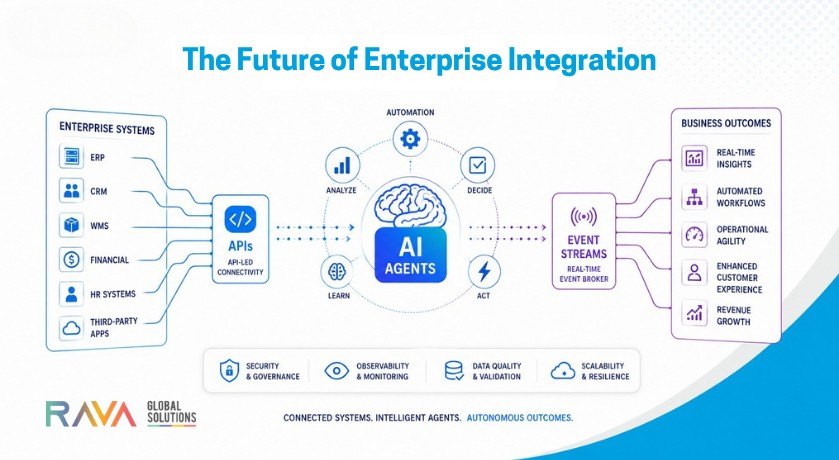
Modern architectures succeed by layering distinct connectivity patterns into one cohesive framework. First, universal endpoints expose core backend capabilities as reusable digital building blocks. These interfaces establish strict governance and data consistency across disparate applications.
Next, real-time message streams notify your ecosystem the moment critical business activities happen. To master real-time messaging, review Event-Driven Architecture in MuleSoft: What You Need to Know for deep architectural insights. This approach ensures your systems respond instantly rather than waiting for slow, scheduled batch scripts.
Finally, autonomous software agents leverage these interfaces to complete multi-step workflows. Discover how organizations are Bridging The Gap To The Autonomous Enterprise: Why MuleSoft Is The Key to operationalizing proactive problem-solving. This convergence creates a self-operating business engine that executes complex operations safely.
Step-by-Step Modernization Framework
Transforming your IT landscape requires a disciplined, value-focused delivery methodology. Follow this sequential roadmap to modernize connectivity without interrupting daily business operations.
Audit and Catalog Enterprise Endpoints
Map every application, legacy database, and third-party SaaS platform across your organization. Document undocumented data exchanges and retire high-maintenance point-to-point scripts.
Practitioner Insight: In our enterprise implementations, we found that consolidating shadow APIs first reduces integration security vulnerabilities by over 40%.
Establish a Layered API-Led Architecture
Organize your integration layer into system, process, and experience endpoints. System endpoints unlock core data, while process endpoints cleanly orchestrate business rules.
Practitioner Insight: Keeping system interfaces strictly decoupled from user-facing applications prevents backend core changes from breaking your customer portals.
Implement Real-Time Event Brokers
Deploy high-throughput event backbones to publish state changes as they occur. Upstream systems publish transactions instantly without waiting for downstream acknowledgments.
Practitioner Insight: Always configure robust dead-letter queues early to isolate invalid payloads without stalling your primary data queues.
Deploy Goal-Oriented AI Agents
Connect autonomous agents to governed APIs using secure authentication controls. Give agents explicit parameters to run workflows, resolve alerts, and update records.
Practitioner Insight: Restricting AI agents to pre-approved API schemas ensures enterprise data privacy while preventing unpredictable execution paths.
Real-World Scenarios and Case Proof
A North American medical supply distributor faced severe operational bottlenecks. Peak seasonal spikes routinely crashed their inventory synchronization pipelines, leaving warehouse workers with outdated stock data. Furthermore, sales teams regularly made fulfillment promises on backordered critical products.
RAVA Global Solutions designed an event-driven framework paired with governed APIs. The team decoupled the warehouse management database from front-facing sales portals using real-time message queues. Then, an autonomous integration agent monitored inventory thresholds and automatically rerouted shipments to alternative fulfillment hubs.
The business outcomes appeared immediately across operations:
- Zero Sync Delays: Stock counts synchronized across 14 distribution hubs in under 200 milliseconds.
- Order Errors Dropped by 73%: Real-time stock visibility eliminated fulfillment errors and backorder miscommunications.
- Automated Exception Handling: Autonomous workflows resolved 65% of supply disruptions without requiring manual human oversight.
Avoiding Critical Integration Pitfalls
Many enterprise initiatives struggle because organizations treat integration modernization as a basic software upgrade rather than a business architecture shift. Teams often wrap messy legacy scripts in modern wrappers without addressing underlying data quality issues. This bad habit spreads bad data across your enterprise faster.
Another common risk stems from over-automating broken workflows. Automating an inefficient process only multiplies errors at scale. Instead, refine and simplify your core business logic before introducing autonomous agents.
- Skipping Schema Governance: Inconsistent data models create parsing failures across downstream systems.
- Neglecting Rate Limiting: High-frequency event publishers can easily overwhelm and crash legacy backend databases.
- Overlooking Observability: Without distributed transaction tracing, isolating pipeline failures turns into a time-consuming guessing game.
Frequently Asked Questions
What is the difference between an API and an event-driven architecture?
An API uses synchronous, request-response communication where a client requests data and waits for a reply. An event-driven architecture uses asynchronous messaging where systems publish notifications immediately, allowing downstream applications to consume data without locking system resources.
How do AI agents use APIs in enterprise workflows?
AI agents use APIs as functional toolsets to safely execute real-world operations. When an agent analyzes an operational scenario, it calls pre-configured API endpoints to retrieve contextual data, update records, or trigger business workflows within defined security boundaries.
Why is MuleSoft widely adopted for autonomous enterprise integration?
MuleSoft provides a unified platform that combines API management, real-time message mediation, and automated workflows. Its standardized, reusable asset model allows enterprises to expose core systems safely while maintaining enterprise security, governance, and full operational observability.
What are the security risks of connecting AI models to core enterprise systems?
Connecting AI models to core databases introduces risks, including data leakage, unauthorized prompt injection, and unverified data modifications. Organizations prevent these vulnerabilities by routing all agent interactions through secured, role-based APIs with strict rate limits and validation policies.
When should an organization switch from batch ETL to real-time integration?
An organization should switch from batch processing when stale data directly causes customer service delays, inventory errors, or missed revenue opportunities. Real-time integration provides immediate visibility into operational metrics, helping businesses act before problems escalate.
Transform Your Enterprise Architecture
Modernizing your connectivity layer unlocks the full value of your enterprise data, customer portals, and AI systems. RAVA Global Solutions partners with leadership teams to design resilient, scalable integration strategies that drive lasting operational agility. Contact our solution architects today to build a connected, autonomous enterprise ecosystem.