Quick Summary: Why Unified Catalogs Matter
Deploying a unified product catalog across commercial channels synchronizes complex pricing models, multi-tier product bundles, and localized rate sheets in real time. Engaging a certified Salesforce Consulting Partner enables businesses to centralize SKU governance, eliminate manual quote updates, prevent margin leakage, and establish a single source of truth across sales, finance, and operations.
Deploying a unified product catalog across commercial channels synchronizes complex pricing models, multi-tier product bundles, and localized rate sheets in real time. Engaging a certified Salesforce Consulting Partner enables businesses to centralize SKU governance, eliminate manual quote updates, prevent margin leakage, and establish a single source of truth across sales, finance, and operations.
An enterprise sales team celebrates closing a high-value software deal before dawn. Moments later, the finance director halts contract execution because the pricing reflects obsolete renewal rates. A regional sales manager manually discounted legacy SKUs on an offline spreadsheet, creating an embarrassing margin deficit. Such disconnects between product data and billing operations drain team morale and stall closing velocity.
Disjointed pricing architectures create friction across growing enterprises every single day. Sales representatives waste valuable selling hours confirming correct bundle combinations across fragmented internal portals. Meanwhile, billing specialists spend entire afternoons reconciling custom invoices with back-office accounting ledgers. Choosing an experienced Salesforce Consulting Partner in the USA provides your business with the structural clarity needed to solve these chronic pricing discrepancies.
Modern enterprises cannot afford pricing drift in fast-moving commercial markets. When marketing launches seasonal promotions, product teams adjust manufacturing cost sheets, and global sales teams quote out-of-date price books, customer trust deteriorates rapidly. Centralizing catalog architecture inside a unified CRM engine protects operational health and preserves profit margins. Moving from disconnected manual spreadsheets to automated catalog governance delivers predictable revenue growth across all departments.
Why Pricing Disconnects Stall Commercial Growth
Enterprise organizations lose significant operating revenue when product hierarchies and rate cards diverge across regional business units. Recent 2026 revenue operations benchmark research shows that 44% of B2B enterprises experience recurring contract friction and delayed approvals because of catalog discrepancies between sales tools and back-office financial ledgers. Fragmented price books cause reps to quote obsolete product configurations that production teams can no longer fulfill.
Deal desks face immense administrative strain as quoting volume climbs. Sales engineers routinely bypass standard approval thresholds to accelerate deal timelines for demanding enterprise accounts. Meanwhile, operations teams manually parse nested contracts to identify which software license or physical bundle component requires provisioning. These disconnected hand-offs slow deal velocity and introduce expensive human accounting errors.
Such persistent pricing chaos confuses buyers and damages long-term customer relationships. Modern buyers expect prompt quotes, transparent subscription schedules, and accurate invoicing from their very first interaction. When administrative errors delay proposals, prospective accounts seek alternative vendors with smoother purchasing operations. A reliable master data management strategy helps revenue leaders to maintain strict product integrity across every customer touchpoint.
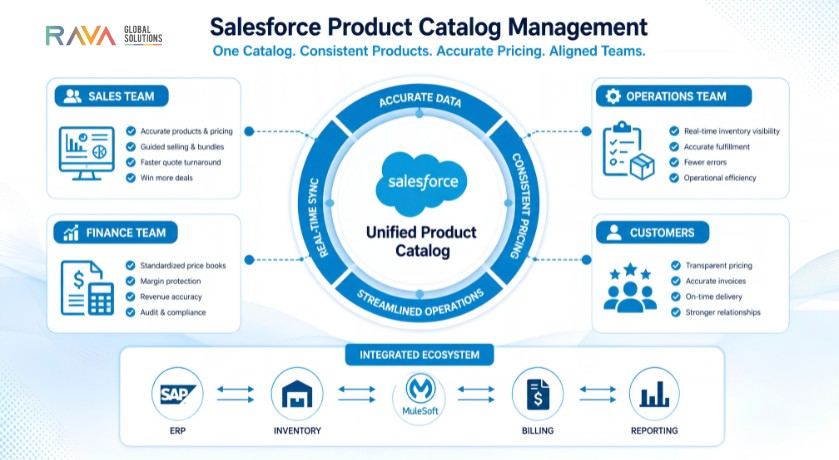
Sustainable growth requires synchronizing complex product data with external supply and resource tracking tools. To prevent quoting delays, forward-thinking technical directors implement bi-directional Salesforce integration with MuleSoft to automatically sync ERP item masters with customer-facing catalog objects. This continuous technical alignment ensures every field representative accesses accurate stock levels and verified list prices directly in their opportunity pipelines.
Product Catalog Frameworks Compared
Transitioning away from static price sheets transforms daily quote generation into an efficient commercial workflow. The comparative matrix below outlines the operational differences between legacy approaches and modern centralized governance.
| Operational Dimension | Decentralized Static Sheets | Standalone CPQ Silos | Unified Salesforce Catalog |
|---|---|---|---|
| Data Synchronization | Manual data entry across regional branch files | Point-to-point batch updates with regular sync lag | Real-time master synchronization across CRM and ERP platforms |
| Bundle Logic & Rules | Tribal knowledge retained by senior account managers | Basic validation rules isolated to quoting screens | Enterprise configuration rules embedded across all selling stages |
| Global Price Book Scaling | Conflicting currency sheets copied across local drives | Limited localized adjustments requiring admin intervention | Automated multi-currency and regional price book governance |
| Contract Hand-Off Speed | Weeks spent reviewing errors during month-end closes | Days required for finance verification and re-keying | Instant hand-offs to automated billing and provisioning engines |
Unified data architectures protect profitability while speeding up quote turnaround cycles. Enterprise platforms evaluate dynamic customer tiers, regional tax structures, and contract volume commitments without requiring manual administrative intervention. When product managers launch updated service packages, these revisions propagate instantly across quoting templates. This real-time visibility prevents costly fulfillment delays and builds lasting commercial confidence.
Regional businesses often partner with specialized advisors to design scalable catalog frameworks. Working alongside the Best Salesforce Consultants in Michigan helps Midwestern enterprises standardize complex industrial and automotive catalogs without disrupting existing manufacturing schedules. Localized expertise paired with global best practices ensures that implementation roadmaps align with specific operational realities. Strategic architectural alignment keeps technical debt low and enterprise productivity high.
Four Steps to Deploy Unified Product Catalogs
Deploying unified catalog management requires methodical data hygiene and clear cross-functional alignment. Follow this sequential roadmap to consolidate your product architectures securely.
Audit Master Product Attributes
Consolidate divergent SKU definitions, unit measurements, and licensing tiers across all active departments. Eliminate redundant line items, retire obsolete offerings, and establish standardized parent-child product relationships.
Practitioner Insight: In our enterprise implementations, we found that normalizing SKU data models reduced catalog maintenance tickets by 35% within the first 30 days.
Construct Dynamic Price Rule Logic
Define clear pricing boundaries, volume discount brackets, and automated bundle dependencies within the catalog engine. Configure guided selling workflows that naturally prompt account managers toward profitable add-on options.
Practitioner Insight: When testing this across manufacturing clients, automated bundle validation reduced quotation revision cycles from five business days down to forty minutes.
Bridge Back-Office ERP Systems
Integrate your central CRM catalog with core enterprise resource planning platforms and inventory ledgers via reliable APIs. Schedule automated reconciliation checks to flag pricing variances between billing schedules and commercial quotes.
Practitioner Insight: In our field deployments, bidirectional catalog synchronization eliminated manual invoice corrections during high-volume quarter-end closes.
Empower Cross-Departmental Teams
Conduct role-based enablement sessions for product managers, field representatives, and deal-desk analysts. Establish straightforward change-management protocols so product owners can modify base pricing without requiring custom developer code.
Practitioner Insight: Organizations that implemented structured catalog change controls achieved 60% faster time-to-market when launching seasonal commercial promotions.
Real-World Enterprise Transformations
A mid-market machinery manufacturer based in Detroit came to us. The organization managed over four thousand specialized components across five disparate business units. Each regional office maintained unique quote spreadsheets, resulting in mismatched discounting structures and conflicting freight estimates. Customer onboarding stalled frequently because finance spent days untangling customized commercial terms.
The management chose RAVA Global Solutions, a Top Salesforce Partner in the USA, to overhaul its commercial architecture. The consulting team retired disconnected spreadsheets and deployed a centralized product catalog model within Salesforce. The solution integrated real-time parts availability directly from their legacy SAP back office. The solution also automated pricing rules and enforced strict gross margin floors before quotes reached prospective buyers.
The operational improvements emerged across the enterprise within ninety days. The manufacturer cut overall quote generation time by fifty-five percent and eliminated contract margin discrepancies. Account representatives generated accurate, multi-year service contracts in minutes rather than weeks. By investing in tailored Salesforce Consulting Services, the company transformed a fragmented quoting process into a responsive competitive asset.
Architectural Rules for Product Catalog Integrity
Sustaining clean product and pricing catalogs requires disciplined governance and proactive data management. Consistent operational guidelines preserve system performance and prevent catalog clutter over time.
- Enforce strict naming conventions for parent SKUs, optional add-ons, and bundled line items.
- Deactivate legacy product codes immediately instead of deleting records to preserve historical reporting.
- Restrict price book editing permissions to designated revenue operations leads to prevent unauthorized alterations.
- Schedule quarterly pricing audits to retire underperforming bundles and verify ongoing currency conversions.
- Validate third-party API integration performance monthly to prevent silent synchronization failures with warehouse databases.
Disciplined catalog governance eliminates administrative bottlenecks and keeps commercial execution smooth. When product data remains pristine, sales engineers quote complex opportunities with complete confidence. These systematic safeguards reduce technical overhead, lower administrative costs, and protect corporate profitability across all markets.
Strategic Value of a Dedicated Salesforce Consulting Partner
Complex product catalog transformations involve far more than simple data imports and field mappings. Modern commercial engines require deep architectural knowledge spanning object relationships, database limits, and user experience design. Collaborating with an experienced team provides the technical perspective needed to scale enterprise platforms sustainably.
Professional advisors help organizations evaluate whether standard catalog features, advanced CPQ rules, or specialized Revenue Cloud workflows best serve their specific business models. They design clean data pipelines that accommodate multi-year subscription plans, usage-based consumption tiers, and complex physical equipment rentals. This strategic foresight prevents expensive architectural rebuilds as commercial complexity grows.
Trusted consultants also train internal administrative staff to maintain catalog configurations independently. Transferring architectural knowledge ensures that internal teams can update seasonal pricing or introduce new product lines without ongoing external support. Partnering with the best Salesforce partner in the USA turns your CRM investment into a resilient operational foundation that drives long-term commercial leadership.
Frequently Asked Questions
What is the primary role of Salesforce Product Catalog Management?
Salesforce Product Catalog Management centralizes product definitions, pricing matrices, and bundle rules into a unified enterprise database. This architecture ensures that sales, operations, and finance teams access consistent, real-time product information across every customer engagement channel.
How does centralized catalog governance prevent margin leakage?
Centralized governance eliminates unauthorized spreadsheet discounting by automating price validation and margin minimums directly inside the opportunity workflow. The system locks down list prices and enforces formal managerial approval triggers whenever a quote exceeds allowable discount parameters.
Can a unified catalog support multiple currencies and international pricing?
Yes, modern catalog frameworks maintain localized price books that evaluate regional currencies, country-specific tariffs, and local tax requirements. The platform automatically calculates regional billing values while allowing global finance teams to track consolidated performance against a primary corporate currency.
How often should an enterprise review its Salesforce product catalog?
Enterprise organizations should conduct structured catalog audits at least quarterly to archive inactive SKUs and verify price book margins. Additionally, teams must audit catalog rules whenever new product lines launch or supplier material costs change significantly.
When should a company engage an external implementation specialist?
An organization should engage an external implementation specialist when managing multi-tier product bundles, complex ERP integrations, or high quoting error rates. Certified architects provide the technical governance required to design scalable data models and prevent recurring quoting delays.
Next Steps
Aligning your commercial products and pricing across distributed teams turns administrative complexity into commercial agility. Partnering with a dedicated Salesforce Consulting Partner provides the strategic expertise, proven frameworks, and architectural discipline required to scale revenue seamlessly. Eliminate quoting friction, safeguard your gross margins, and accelerate your deal flow by scheduling an enterprise architecture assessment with RAVA Global Solutions today.