
Quick Summary: How Do You Select Software For Multiple Branches?
Selecting multi-branch healthcare systems requires evaluating cross-facility data synchronization, centralized patient records, unified multi-resource scheduling, and granular role-based access permissions. A robust platform consolidates revenue cycle reporting across all branches while preserving site-level operational autonomy, strict regulatory compliance, and predictable long-term scalability without compounding integration fees.
Selecting multi-branch healthcare systems requires evaluating cross-facility data synchronization, centralized patient records, unified multi-resource scheduling, and granular role-based access permissions. A robust platform consolidates revenue cycle reporting across all branches while preserving site-level operational autonomy, strict regulatory compliance, and predictable long-term scalability without compounding integration fees.
Operating multiple outpatient locations brings operational complexity. When healthcare networks add branches, administrative blind spots multiply fast. Disconnected systems force administrative staff to reconcile fragmented spreadsheets, while clinicians waste billable hours chasing missing patient histories across scattered locations.
Forward-looking healthcare groups resolve this friction by deploying modern Clinic Management Software that unifies distributed facilities under a single database architecture. A unified digital operational backbone bridges the gap between headquarters oversight and daily front-desk workflows. Practice leaders can then standardize patient journeys, safeguard revenue capture, and eliminate duplicated administrative labor across every facility.
The Scaling Paradox: Why Legacy Systems Break Across Branches
Expanding from a single flagship facility into a regional network completely changes administrative requirements. What worked smoothly inside one location falls apart when multiple branch managers pull reports from disconnected databases. Regional operations directors struggle to gain real-time visibility into practitioner utilization, inventory burn rates, and branch revenue leakage.
Industry data from regional healthcare administrative benchmarks shows that multi-facility practices lose up to 18 percent of their net collections annually to uncoordinated billing cycles, chart duplication, and missed appointment recalls. When clinical teams lack instant cross-branch chart access, patient wait times increase, and care consistency drops. Fragmented records also create significant compliance liabilities under contemporary data privacy frameworks.
Solving this scaling problem requires moving past temporary software patches. Practice leaders must evaluate how their platform handles concurrent user volumes, multi-tax accounting, and centralized appointment booking. A thoughtful assessment guarantees that your software investment supports aggressive branch expansion instead of choking operational growth.
Core Evaluation Matrix: Single-Site Systems Versus Multi-Branch Platforms
Evaluating operational systems requires a close look at enterprise capabilities. The table below outlines how basic setups differ from mature multi-location enterprise architectures:
| Operational Dimension | Disconnected Single-Site Applications | Enterprise Multi-Location Platforms | Executive Impact |
|---|---|---|---|
| Patient Record Architecture | Isolated charts per location; duplicates common. | Unified Master Patient Index (MPI) with instant sync. | Eliminates chart fragmentation and diagnostic blind spots. |
| Scheduling Engine | Localized calendars with no cross-facility views. | Global calendar matrix with dynamic practitioner allocation. | Maximizes doctor utilization across regional clinical sites. |
| Revenue Cycle & Billing | Fragmented accounts receivable and manual branch audits. | Centralized corporate billing with automated regional tax splits. | Accelerates cash collections and reduces administrative overhead. |
| Access Governance | Basic single-tier login credentials per terminal. | Granular role-based permissions with location tenancy. | Guarantees strict HIPAA, GDPR, and localized regulatory compliance. |
| Data Analytics | Delayed static exports requiring manual consolidation. | Real-time consolidated dashboards with branch-drill filters. | Equips directors with immediate operational visibility. |
The Multi-Location Software Buyer Checklist
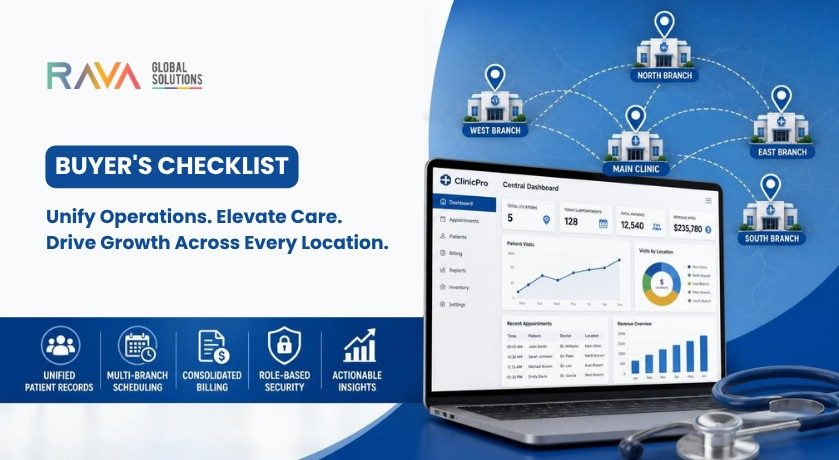
1. Unified Patient Records And Master Indexing
Your software must link patient records across all locations using a single Master Patient Index. When a patient visits your suburban branch on Tuesday and your downtown center on Friday, both care teams need identical chart histories. Fragmented charts waste clinical time and increase the risk of prescribing contraindicated medications.
Demand platforms that automatically merge duplicate entries using robust national identity numbers or phone verification. Your clinical specialists must review past consultation notes, pathology results, and treatment plans without calling another clinic desk. Seamless data mobility ensures high clinical standards across your entire brand footprint.
2. Global Multi-Resource Scheduling Engines
Coordinating visiting specialists across several clinical sites presents serious logistical challenges without centralized scheduling. Your booking engine must display practitioner availability across all physical branches on a single administrative screen. Front-office coordinators should be able to book a patient for a diagnostic scan at one center and a follow-up consultation at another.
Centralized appointment management prevents double-booking while optimizing room and equipment utilization rates. Automated SMS and WhatsApp appointment reminders must integrate directly into this calendar to reduce no-show rates across every branch. Efficient scheduling balances patient footfalls and protects daily practice income.
3.Granular User Permissions And Role Governance
Managing hundreds of employees across multiple facilities introduces data security risks. A reliable enterprise architecture requires strict, role-based access controls tied to individual locations. A front-desk receptionist in one clinic should only view local scheduling queues, while the regional medical director retains full clinical oversight across all centers.
When choosing between cloud vs on-premise clinic software, cloud-native architectures deliver significantly faster role provisioning and automated security policy distribution across distributed facilities. Centralized permission controls help prevent internal data breaches and maintain regulatory compliance. Granular access governance protects sensitive patient records without interrupting everyday branch operations.
4. Consolidated Financials And Split-Billing Intelligence
Consolidated financial oversight is non-negotiable for growing practice groups. Your platform must process complex revenue splits, corporate health plans, and direct patient payments without manual bookkeeping. It should handle unique merchant accounts for individual branches while rolling up financial summaries into a single executive ledger.
Look for automated claims scrubbers that validate insurance coverage eligibility before the patient enters the consultation room. Automated pre-authorizations lower claim denial rates and protect regular practice cash flow. Centralized accounts receivable tracking prevents overdue collections from slipping through the cracks between disparate regional locations.
5. Standardized Clinical Protocols And Formulary Control
Maintaining service quality requires standardized clinical documentation templates across every department. Whether a patient sees a senior consultant or a junior associate, their digital health record should reflect the same documentation standards. Standard clinical note structures improve medical auditing and elevate clinical governance across your organization.
Centralized formulary management keeps your pharmacy operations lean and transparent. The system should alert physicians when they prescribe out-of-stock medications and automatically recommend approved alternatives. Coordinated inventory control prevents expired medications from accumulating in quiet storage closets across regional branches.
Architectural Deployment: Infrastructure Evaluation
Clinical IT leaders must decide where their core patient database lives. While on-premises servers historically offered a sense of physical possession, they present costly scaling hurdles for expanding clinic networks. Running independent servers at every facility requires dedicated on-site IT technicians, expensive hardware replacements, and complicated nightly backup scripts.
Cloud architectures remove this regional maintenance overhead by hosting patient data inside certified, enterprise-grade cloud environments. Software updates, compliance patches, and security configurations deploy instantly across every connected branch terminal without causing workflow downtime. Modern cloud networks also enable rapid onboarding, allowing new branches to launch in days rather than months.
Data synchronization speeds between physical branches and central servers must remain near instantaneous. Slow connections frustrate desk staff, lengthen patient queues, and cause record conflicts during peak hours. Prioritize vendors that guarantee high uptime Service Level Agreements backed by automated failover mechanisms.
Implementation Blueprint: Rolling Out Multi-Site Platforms
Rolling out an enterprise platform across multiple branches requires a phased, disciplined deployment methodology:
- Cleanse Legacy Data Repositories: Audit and deduplicate legacy patient lists, fee schedules, and supplier records before migrating a single file. Eliminate outdated patient profiles and systematically archive closed accounts. Practitioner Insight: In our multi-site clinic implementations, clearing legacy database anomalies prior to migration cuts post-launch support tickets by nearly 45 percent.
- Standardize Core Master Lists: Define uniform service charges, diagnostic codes, prescription templates, and inventory naming conventions across the whole enterprise. Prevent individual branch managers from inventing custom billing codes that disrupt consolidated analytics. Practitioner Insight: Establishing fixed service catalogs before system configuration prevents balance sheet reconciliation errors during annual financial audits.
- Conduct Iterative Pilot Launches: Deploy the new architecture inside a single representative clinic before launching across your complete branch network. Refine user permission templates, adjust appointment buffers, and resolve training bottlenecks during this controlled pilot phase. Practitioner Insight: Piloting the platform in one high-volume branch surfaces front-desk operational hurdles that never appear during simulated boardroom software demonstrations.
- Execute Structured Role-Based Training: Deliver role-specific instruction for front-desk personnel, attending doctors, billing officers, and center managers. Practical sandbox environments help staff build muscle memory before interacting with real patients. Practitioner Insight: Training staff on real-world edge cases like cross-branch refunds and emergency walk-ins reduces front-desk wait times significantly during launch week.
- Activate Real-Time Executive Dashboards: Turn on executive tracking views immediately after branch onboarding to monitor patient flow, collection trends, and system adoption rates. Identify struggling branches early to deliver timely operational coaching. Practitioner Insight: Tracking daily active user metrics across clinics highlights user adoption gaps long before they hurt monthly collection targets.
Vendor Interrogation: Essential Questions Before Signing
Healthcare leaders often encounter polished product demonstrations that hide major multi-location workflow limitations. Avoid costly vendor lock-in by asking targeted operational questions during your evaluation:
- Does your patient indexing framework maintain a single medical record per individual, or does it spawn separate files per clinic?
- How does your platform handle localized internet drops at individual branch locations during daily consultations?
- What specific Application Programming Interfaces (APIs) exist to connect third-party laboratory systems, radiology archives, and accounting platforms?
- Can our executive team generate consolidated and branch-specific financial balance sheets without relying on external spreadsheet calculations?
- How do you structure pricing tiers as our group opens additional clinical sites, adds doctors, or scales concurrent administrative staff?
Prudent directors recognize that choosing clinic management software demands looking beyond flashy presentation decks. You are choosing a strategic technology partner that will support your organization for the next decade. Complete transparency on system limitations matters far more than empty sales promises.
Real-World Case Study: Unifying Regional Care
A prominent specialty care provider operating five diagnostic clinics struggled with severe administrative disconnects. Each branch ran a disconnected local database, forcing head-office accountants to spend five working days each month manually compiling balance sheets. Worse, patients traveling between locations frequently underwent repeated intake procedures and duplicated lab tests.
The executive board partnered with RAVA Global Solutions to consolidate their disparate operations into a unified enterprise infrastructure. The migration connected their five locations through a shared Master Patient Index, centralized appointment scheduling, and automated corporate billing.
Within four months of deployment, cross-branch patient intake times fell from twelve minutes to under two minutes per visit. Billing reconciliation errors dropped by 74 percent, and centralized inventory monitoring saved the practice thousands in expired supplies. Clear visibility allowed leadership to open two new branch locations the following year without expanding corporate administrative headcount.
Frequently Asked Questions
What Is The Difference Between Single-Site And Multi-Location Clinic Software?
Single-site software handles scheduling, charting, and billing for one independent facility with local records. Multi-location platforms connect multiple physical sites into a single database, enabling unified patient histories, cross-clinic scheduling, and consolidated corporate financial reporting.
How Does Enterprise Software Prevent Duplicate Patient Records Across Locations?
Modern platforms use an automated Master Patient Index to match incoming demographics against existing records using unique identifiers like national identity numbers, phone numbers, and biometric checks. This matching logic flags potential duplicates before it creates a second file.
Can Centralized Practice Systems Handle Different Tax Rules Across Branch Cities?
Yes, sophisticated platforms support multi-entity financial structures that calculate localized municipal, state, or regional taxes per location. The software applies correct tax calculations automatically during checkout while feeding data cleanly into unified balance sheets.
What Happens To Multi-Branch Operations If A Local Clinic Loses Internet Access?
Enterprise-grade cloud systems offer hybrid offline-caching layers or mobile hotspot failovers that let front-desk staff check in patients and capture clinical notes locally. Once connectivity returns, the system automatically reconciles local transactions with the cloud database.
How Long Does It Typically Take To Roll Out Software Across Multiple Facilities?
A structured deployment for a three-to-five-location clinic group generally spans four to twelve weeks. This timeline covers master database cleanup, role-based permission mapping, third-party lab integrations, and hands-on staff training across every operational unit.
Accelerate Your Practice Network Growth
Expanding your healthcare network should build long-term enterprise value, not administrative chaos. By choosing a solution that standardizes workflows, simplifies clinical coordination, and delivers real-time corporate oversight, you position your practices for profitable growth. Your staff avoids repetitive administrative tasks, and your patients enjoy consistent, high-quality care across every location.
Take control of your growing practice network with tools built specifically for enterprise healthcare operations. Discover how our scalable Clinic Management Software can streamline multi-site operations, protect margins, and elevate care delivery across all your facilities. Schedule a discovery consultation with our systems architects today to build your practice on a solid, future-proof operational foundation.