Legacy infrastructure often creates a silent bottleneck for digital growth. Many IT teams struggle with high maintenance costs and underutilized server capacity, which drain annual budgets. Serverless integration changes this dynamic entirely by moving the management burden away from your internal team.
Quick Answer
Serverless integration with MuleSoft optimizes costs by removing the need for manual server provisioning. It scales automatically to handle spikes in demand, ensuring your systems remain responsive. This approach works best for event-driven workflows, bursty traffic patterns, and microservices. It allows businesses to focus on code rather than infrastructure.
Serverless integration with MuleSoft optimizes costs by removing the need for manual server provisioning. It scales automatically to handle spikes in demand, ensuring your systems remain responsive. This approach works best for event-driven workflows, bursty traffic patterns, and microservices. It allows businesses to focus on code rather than infrastructure.
Escaping the Trap of Legacy Infrastructure
Traditional integration models force your team to manage servers even when traffic is low. You essentially pay for capacity that sits idle during off-peak hours. This inefficiency reduces your operational margin and slows deployment cycles.
Moving toward a modern architecture requires a shift in how you view resource consumption. By leveraging event-driven patterns, you ensure that your infrastructure consumes power only when a specific task requires it. This operational efficiency is no longer optional; it is a necessity for staying competitive in 2026.
As enterprises face these hurdles, serverless integration emerges as the clear architectural evolution. It allows your developers to build resilient applications without worrying about server maintenance or patch cycles.
Why Serverless Architecture Redefines Enterprise Efficiency
Modern enterprise ecosystems rely on speed and agility to stay ahead of the market. Recent 2026 industry data shows that cloud-native adoption now powers over 75% of high-performing enterprise workflows. When you pair serverless functions with MuleSoft, you eliminate the complexity of managing physical or virtual servers.
It allows your team to trigger integration processes only when specific business events occur. You stop paying for idle time, which directly improves your overall profit margins. Organizations that adopt this model often report a significant reduction in total cost of ownership.
Transitioning to this model requires a strategic mindset rather than a simple platform update. By planning your architecture for elasticity, you prepare your systems for unpredictable market changes.
Contrasting Traditional Hosting With Serverless Agility
The shift to serverless requires a change in mindset regarding how your data flows. The table below outlines how this modern approach outperforms traditional infrastructure models in key operational areas.
| Feature | Traditional Infrastructure | Serverless MuleSoft Approach |
| Scaling | Manual or Predictive | Automatic/On-Demand |
| Pricing | Fixed Monthly Fees | Consumption-Based |
| Management | Server Patching Required | Fully Managed/Zero Ops |
| Efficiency | High Idle Cost | High Resource Utilization |
This comparison highlights why many organizations are moving away from fixed capacity. While traditional models offer control, they rarely provide the speed modern consumers demand.
Real-World Scenarios: From Document Processing to Burst Management
You might wonder how this applies to your specific business environment. Consider these two scenarios where serverless architecture creates immediate, measurable value.
Handling Peak Traffic Spikes
Imagine a retail company launching a massive flash sale that attracts thousands of concurrent users. Traditional servers often crash under the weight of these sudden, massive traffic bursts. A serverless MuleSoft implementation scales instantly to handle these requests without requiring manual intervention from your team.
Optimizing MuleSoft Intelligent Document Processing
Data extraction from invoices or complex contracts often happens in highly unpredictable intervals. By using MuleSoft intelligent document processing, you can trigger automated extraction flows only when a new document arrives. This removes the need for a server to run 24/7 just to watch for incoming files, significantly lowering your energy footprint.
Accelerating Value Through MuleSoft Salesforce Integration Services
Integration serves as the backbone of your CRM strategy. Effective MuleSoft Salesforce Integration Services require more than just connecting two endpoints. You need a strategy that accounts for how data moves between systems without incurring expensive technical debt.
A serverless approach excels here by creating lightweight, efficient connectors for your Salesforce objects. These functions remain dormant until your CRM initiates a specific action, ensuring a cleaner integration layer. This setup is easier to maintain and much faster to update than legacy connections.
When your architecture remains lean, your business can iterate faster on new features. This agility helps you respond to customer needs before your competitors do.
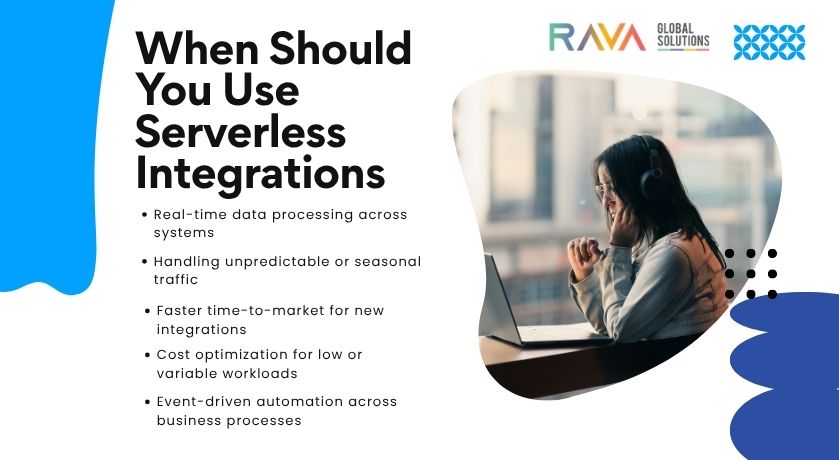
When Should You Use Serverless Integrations
Not every system needs serverless. But in the right context, it becomes a competitive advantage.
Use Serverless When You Need:
- Real-time data processing across systems
- Handling unpredictable or seasonal traffic
- Faster time-to-market for new integrations
- Cost optimization for low or variable workloads
- Event-driven automation across business processes
For example, an eCommerce platform handling flash sales benefits from automatic scaling. A financial service processing transaction alerts needs real-time triggers.
If your system reacts to events rather than schedules, serverless is a strong fit.
When Serverless Might Not Be Ideal
Clarity matters more than hype. There are cases where serverless is not the best choice.
Avoid Serverless If You Have:
- Long-running processes that require persistent compute
- Predictable, constant workloads where fixed infrastructure is cheaper
- Heavy legacy dependencies with tight coupling
- Strict latency requirements with cold start sensitivity
Understanding this boundary helps avoid unnecessary complexity. The goal is not to replace everything. It is to optimize where it matters.
Partnering for Long-Term Digital Success
Implementing these strategies requires a guide who understands both the technical and business impact. Choosing the right MuleSoft partner in Michigan ensures you follow proven architectural patterns from day one. You gain access to deep expertise that helps you avoid common pitfalls in cloud deployments.
The best MuleSoft service providers in the USA provide more than just technical support. They offer strategic guidance, architectural reviews, and ongoing optimization that grow with your business. RAVA Global Solutions specializes in building these exact, sustainable connections.
We focus on long-term architecture rather than quick, brittle fixes that fail under pressure. If you are looking for the best MuleSoft partner in the USA to lead your transformation, we are ready to assist.
Frequently Asked Questions
What makes a great MuleSoft service provider?
The best MuleSoft service provider in the USA offers more than technical support. They act as strategic partners, providing architectural reviews and ongoing system optimization. Look for a partner with proven experience in your specific industry and technical stack.
How does MuleSoft Intelligent Document Processing improve efficiency?
This solution automates the reading and categorization of unstructured data. It extracts key information from PDFs or images and inputs that data directly into your CRM. You reduce manual data entry and human error by implementing this automated pipeline.
Why is a Michigan-based partner beneficial for US companies?
A local partner offers better alignment on communication and time zone consistency. Working with a MuleSoft partner in Michigan ensures your team has access to support during your standard business hours. This proximity fosters a collaborative environment that speeds up project timelines.
How do I start with MuleSoft Salesforce Integration Services?
Begin by auditing your current data silos and identifying manual processes. Define the business outcomes you want to achieve, such as faster lead conversion or automated order entry. A professional Mulesoft service provider in the USA can then map these requirements to a serverless architecture.
Is serverless integration right for every business?
Serverless works best for event-driven tasks and fluctuating workloads. Some monolithic applications may still require traditional server setups for consistent, high-volume processing. An expert assessment helps determine if your specific use case benefits from the scalability of a serverless model.
Empower Your Digital Transformation
Building a scalable, efficient integration layer takes careful planning and the right guidance. You deserve a partner who focuses on your long-term success rather than a one-time transaction. If you want to optimize your infrastructure and unlock the power of your data, RAVA Global Solutions is ready to help.
Let’s define your integration strategy together. Reach out to our team to discuss your architecture goals and see how we can streamline your path forward.