Despite having a top-tier sales team, a tireless marketing engine, and a dedicated customer support team, your customers still encounter conflicting emails, support representatives asking questions already addressed by the sales team, and personalized offers arriving three days too late. This friction is not a personnel issue; it is the invisible barrier of the data silo. When your tools do not communicate effectively, your brand appears disorganized, and your revenue suffers.
The 2026 Data Mandate
In 2026, fragmented data is the great obstacle to AI adoption and ROI. Unifying your customer data through Salesforce Architecture, facilitated by MuleSoft Salesforce Integration Services, establishes a Single Source of Truth. It enables your business to operate in real-time, resulting in a 60% increase in efficiency and a 40% boost in revenue from personalization.
In 2026, fragmented data is the great obstacle to AI adoption and ROI. Unifying your customer data through Salesforce Architecture, facilitated by MuleSoft Salesforce Integration Services, establishes a Single Source of Truth. It enables your business to operate in real-time, resulting in a 60% increase in efficiency and a 40% boost in revenue from personalization.
The Cost of the Silo Tax in a 2026 Economy
Data silos are no longer merely an IT inconvenience; they pose a direct threat to your bottom line. Recent 2026 research from the IBM Institute for Business Value reveals that while companies are investing billions in AI, only 33% of these initiatives achieve their ROI targets. The primary cause? Poor data availability and quality are the reasons, says 53% of executives. When your data is confined to separate “islands”—CRM, ERP, and legacy marketing tools—your AI lacks a solid foundation to build upon.
As a top Salesforce Partner in the United States, we observe this “Silo Tax” manifesting as wasted advertising expenditure, customer churn, and operational inefficiencies. Organizations that address this issue through architectural unification are experiencing a 57% increase in effective customer insights. In the 2026 landscape, the victors are not those with the most data, but those who can seamlessly transfer data between platforms. Transitioning from “trapped data” to “fluid intelligence” is the sole path to surpassing competitors who are still manually reconciling spreadsheets.
Why Customer Data Silos Inhibit Business Growth?
Most organizations collect substantial amounts of customer data. The challenge lies not in data collection but in integration.
According to Salesforce research, over 70% of customers expect companies to understand their needs across various channels. Businesses cannot fulfill this expectation if systems operate independently.
Data silos typically arise when companies deploy distinct tools for different departments. Over time, these disconnected systems generate several issues:
- Inconsistent customer records
- Duplicate data across platforms
- Delayed reporting and insights
- Poor coordination between teams
A unified data architecture resolves these issues by connecting every customer interaction into a single ecosystem.
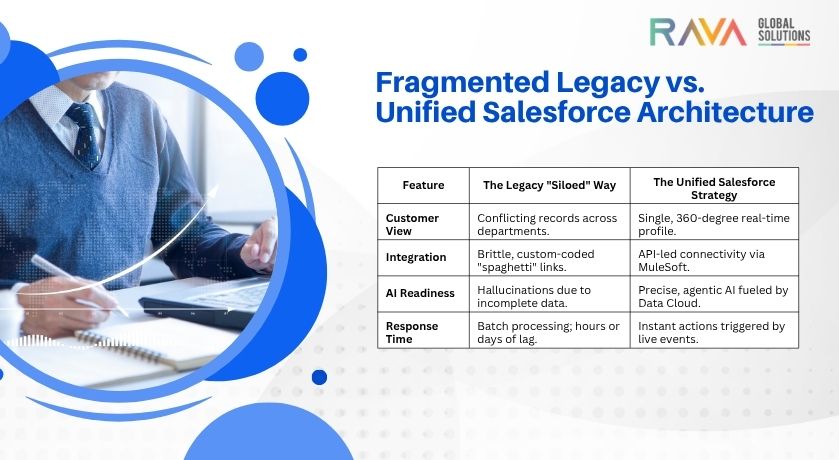
Fragmented Legacy vs. Unified Salesforce Architecture
| Feature | The Legacy “Siloed” Way | The Unified Salesforce Strategy |
| Customer View | Conflicting records across departments. | Single, 360-degree real-time profile. |
| Integration | Brittle, custom-coded “spaghetti” links. | API-led connectivity via MuleSoft. |
| AI Readiness | Hallucinations due to incomplete data. | Precise, agentic AI fueled by Data Cloud. |
| Response
Time |
Batch processing; hours or days of lag. | Instant actions triggered by live events. |
Real-World Scenario: The Manufacturing Modernization
A mid-sized manufacturing firm based near Rochester Hills, Michigan, faced challenges in delivering a cohesive customer experience. While their sales team utilized Salesforce, their fulfillment and inventory management systems resided within a 15-year-old legacy ERP system. This disparity led sales representatives to inadvertently sell out-of-stock items, resulting in a 12% customer churn rate and dissatisfied customers. The firm required more than basic synchronization; they sought the expertise of a professional Salesforce Consulting Partner in the USA to bridge the gap.
By implementing MuleSoft Salesforce Integration Services, the firm established direct connectivity between its legacy ERP and Salesforce. Consequently, upon the placement of an order, inventory levels are instantaneously updated across all platforms. The sales team can monitor shipping statuses without departing from their CRM, and marketing automatically suppresses “buy now” advertisements for customers with pending support tickets. Within six months, the firm reduced its data reconciliation workload by 80% and enhanced customer lifetime value by 22%.
Building a Robust Architecture for 2026
Unifying data transcends mere consolidation into a single repository; it entails ensuring seamless communication among all data sources. Our approach prioritizes creating an “Integrative Backbone” that accommodates both current requirements and anticipated advancements in artificial intelligence. It necessitates a paradigm shift in the perception of technology stacks—transforming them from a collection of disparate tools into a cohesive, dynamic ecosystem.
- API-Led Connectivity: Utilize MuleSoft to unlock legacy data and make it accessible as secure, reusable building blocks for any application.
- Real-Time Data Streams: Transition from “batch” data processing to real-time data streams, ensuring that marketing and sales teams have immediate visibility into actions.
- Governance as Code: Automate data masking and privacy compliance directly within your pipelines to meet the requirements of 2026 regulations.
- Agentic AI Foundation: Prepare your data for “Agentforce” and other autonomous tools that necessitate high-quality, deduplicated feature sets.
Indicators of Data Silo Issues
Many companies fail to recognize data fragmentation until it negatively impacts revenue and customer experience.
Operational Warning Signs
- Multiple teams maintain separate customer databases.
- Reports necessitate manual data consolidation.
- Sales teams lack visibility into marketing engagement.
Customer Experience Indicators
- Customers repeat information across departments.
- Support agents lack purchase history visibility.
- Marketing sends irrelevant campaigns.
Recognizing these signals early enables organizations to prioritize data architecture improvements.
RAVA Global Solutions: Your Guide Through Data Uncertainty
Navigating the intricacies of enterprise architecture requires more than technical proficiency; it requires a partner who understands your local business challenges. As the premier Salesforce partner in the United States, RAVA Global Solutions provides the strategic oversight required to transform “disorganized data” into a competitive advantage. We transcend mere software implementation; we architect roadmaps that enable Michigan businesses to scale without the customary challenges of digital transformation.
Our team, recognized as one of the best, specializes in Salesforce Consulting Services that prioritize measurable ROI over technical superficiality. Whether you are grappling with legacy technical debt or embarking on a novel AI initiative, we provide the “calm expertise” necessary to achieve success on the first attempt. By emphasizing process transparency and long-term partnership, we ensure that your Salesforce investment becomes the most valuable asset within your organization.
Frequently Asked Questions
What distinguishes Data Cloud from MuleSoft?
Consider Salesforce Data Cloud as a centralized repository that organizes and consolidates data into a unified profile. MuleSoft functions as a high-speed data transportation network that facilitates data movement between the repository and all your other external systems. Concurrently, they enable you to ingest data from any source and act on it in real time across your entire business ecosystem.
How long does it take to observe ROI from data unification?
While a comprehensive digital transformation is a continuous process, most organizations witness measurable gains in operational efficiency within three to six months. By partnering with a Salesforce Consulting Partner in the United States, you can prioritize “quick-win” use cases, such as automated reporting or real-time inventory synchronization, which immediately reduce labor expenses and enhance customer satisfaction.
Why is data unification crucial for AI agents?
Artificial intelligence (AI) capabilities depend on the data it can access. If data is isolated, AI agents may encounter “blind spots,” resulting in inaccurate responses or failed automations. A unified architecture ensures that AI has a comprehensive, deduplicated, and high-quality feature set, which is the primary success factor for agentic AI initiatives in 2026.
Can MuleSoft integrate with my existing “on-premise” legacy systems?
Yes, that is a core strength of MuleSoft Salesforce Integration Services. It offers pre-built connectors for popular legacy applications and enables the development of custom APIs for niche systems. It enables you to modernize your customer experience without replacing your entire backend infrastructure simultaneously.
Why should I choose a Michigan-based Salesforce consultant?
Collaborating with the best Salesforce Consultants in Michigan provides the advantage of proximity and localized industry expertise. We comprehend the region’s specific regulatory and economic environment. It allows us to provide more personalized, hands-on Salesforce Consulting Services than global firms may offer, with a higher level of dedicated support.
Next Steps
Your data should be your greatest asset, not your foremost obstacle. By breaking down the barriers between your systems, you empower your team to deliver the seamless experience your customers now anticipate. The future of your business lies in unification—ensure your architecture is ready to handle the load.
Consult with a Salesforce Architect and Unify Your Data Today!