Enterprise integration solutions often fail before you write the first line of code. Legacy systems crumble under the demands of modern data, while IT teams struggle to connect fragmented cloud applications. Selecting the wrong integration partner leads to delayed timelines, blown budgets, and rigid architectures that stifle business growth. These challenges become even more significant as organizations invest in enterprise AI and seek to scale innovation across complex digital ecosystems.
How to Choose the Best MuleSoft Service Provider in the USA?
To select the best MuleSoft partner in the USA, evaluate their certified developer pool, proven API governance models, and long-term support infrastructure. The ideal provider must align your technical systems with your commercial business objectives. They should offer tailored integration strategies that scale alongside your evolving corporate needs, while supporting broader API integration services for USA initiatives and digital transformation goals.
To select the best MuleSoft partner in the USA, evaluate their certified developer pool, proven API governance models, and long-term support infrastructure. The ideal provider must align your technical systems with your commercial business objectives. They should offer tailored integration strategies that scale alongside your evolving corporate needs, while supporting broader API integration services for USA initiatives and digital transformation goals.
Establishing True Strategic Authority
Modern digital transformation demands more than basic data connectivity. Recent industry research indicates that 89% of enterprise decision-makers struggle with data silos across their multi-cloud environments. This fragmentation stalls artificial intelligence initiatives, limits the effectiveness of enterprise AI integration solutions, and reduces overall operational efficiency.
Choosing the best MuleSoft service provider USA transforms these disconnected endpoints into a unified digital ecosystem. Elite providers implement robust security frameworks, scalable API designs, and scalable governance frameworks from day one. This proactive methodology ensures your business assets remain agile, compliant, and ready for future technological shifts. With its trusted MuleSoft consulting services, RAVA Global Solutions builds these foundational connections to ensure sustainable enterprise growth.
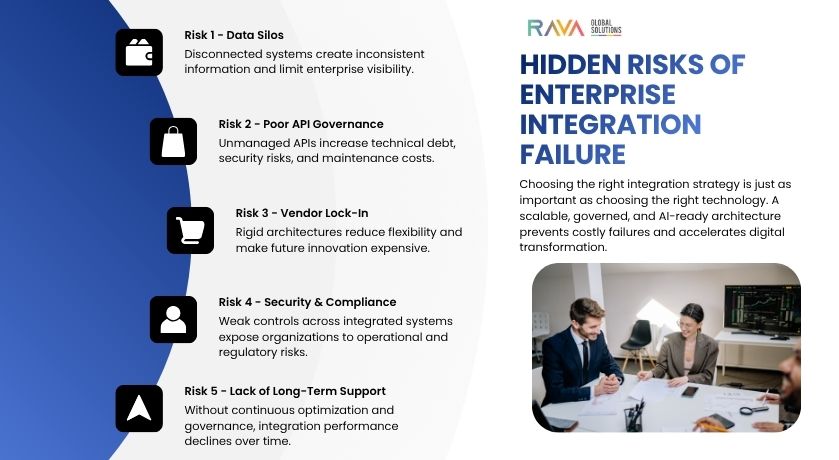
Hidden Risks of Enterprise Integration Failure
Many enterprise integration initiatives fail not because of technology limitations, but because critical risks remain unaddressed during planning and implementation. Understanding these underlying structural challenges allows executive teams to safeguard their engineering investments before deployment begins.
Data Silos and Inconsistent Information
Disconnected applications often create isolated pools of information across departments. These stubborn data silos limit operational visibility, delay executive decision-making, and drastically reduce the effectiveness of enterprise integration solutions. Without a unified pipeline, your automated systems end up processing conflicting records, stalling daily production workflows.
Poor API Governance
Without clear governance policies, organizations quickly struggle to manage API sprawl, version control, and security requirements. Over time, this uncontrolled expansion creates massive technical debt and increases your ongoing maintenance costs. A lack of centralized oversight also makes it incredibly difficult for internal developers to discover and safely reuse existing code assets.
Vendor Lock-In and Rigid Architectures
Many organizations adopt rigid integration models that are exceptionally difficult to scale, modify, or extend over time. A lack of architectural flexibility can prevent businesses from responding quickly to changing market demands or new competitive threats. This structural stagnation forces your brand to rely on expensive, custom workarounds whenever your business model needs to evolve.
Security and Compliance Vulnerabilities
As sensitive corporate data moves continuously across cloud and on-premise environments, your systemic security risks increase exponentially. Weak access controls and inconsistent compliance practices can expose organizations to severe regulatory penalties and operational liabilities. Securing every single connection point requires an intentional, platform-wide approach to data protection.
Lack of Long-Term Support
Integration success does not simply end once your engineering team completes the initial software deployment phase. Organizations that fail to invest in proactive MuleSoft Managed Services often experience rapid performance degradation, governance challenges, and rising operational costs over time. Continuous optimization is mandatory to keep your digital infrastructure running at peak efficiency.
Partnering with the best MuleSoft service provider in the USA helps organizations proactively address these risks through scalable architectures, strong governance frameworks, and continuous optimization. Furthermore, our MuleSoft Integration Services help enterprises eliminate data silos, streamline workflows, and improve system interoperability across hybrid and multi-cloud environments.
Technical Comparison Table
| Evaluation Metric | Traditional Vendor Model | RAVA Global Solutions Approach |
|---|---|---|
| Architectural Focus | Point-to-point connections | AI-first integration architecture |
| Data Strategy | Static data pipelines | AI-ready data fabric for multi-cloud enterprises |
| Delivery Framework | Isolated project delivery | Continuous API governance and lifecycle support |
| Value Realization | Slow incremental updates | Accelerated time-to-market with reusable assets |
| AI Readiness | Limited support for AI initiatives | Integration foundations that support analytics, automation, and future digital transformation initiatives. |
Defining Strategic Integration Value Through Our MuleSoft Integration Services
True integration success focuses on business outcomes rather than just connecting software. The best MuleSoft partner in the USA designs systems that lower your long-term total cost of ownership. They establish centralized governance centers to safely empower your internal development teams. This strategic approach turns IT from a cost center into a primary driver of market innovation.
Organizations pursuing API integration services in the USA require seamless access to trusted data across applications, clouds, and business functions. Without a well-defined strategy, even the most advanced automation initiatives can struggle to deliver measurable value.
Real-World Integration Success
A major logistics corporation recently faced severe supply chain delays due to siloed tracking applications. Their internal teams could not sync real-time shipping data across their legacy on-premise systems and new cloud platforms. This visibility gap resulted in missed delivery deadlines and declining customer satisfaction scores.
The organization collaborated with RAVA Global Solutions to design a modern API-led connectivity framework. This scalable architecture synchronized critical shipping data streams into a single operational view, creating a stronger foundation for future enterprise innovation and scalability. As a result, the client reduced system latency by 45% within the first quarter of deployment.
Navigating Your Selection Journey
The selection process requires a deep look into how a vendor handles complex data ecosystems. Avoid providers who offer rigid, one-size-fits-all contracts that do not account for your specific industry regulations. Instead, prioritize partners who emphasize architectural transparency, iterative delivery milestones, and a long-term strategy.
RAVA Global Solutions aligns engineering precision with your specific commercial goals to ensure lasting integration success. By combining integration expertise, MuleSoft consulting services, and enterprise integration solutions, organizations can create a scalable digital foundation that drives innovation for years to come.
RAVA Global Solutions provides an AI-ready data fabric for multi-cloud enterprises and an AI-first integration architecture. We also combine MuleSoft consulting services, enterprise integration solutions, and long-term MuleSoft managed services to help organizations build scalable, future-ready integration ecosystems. Contact our experts at 734-664-3482 to discuss your integration strategy and accelerate business transformation.