Your AI will not fail because the model is weak. It will fail because the business cannot trust what the model sees, what it triggers, or what it changes.
In 2026, that is the real dividing line between companies that automate with confidence and companies that create faster chaos.
Quick Answer
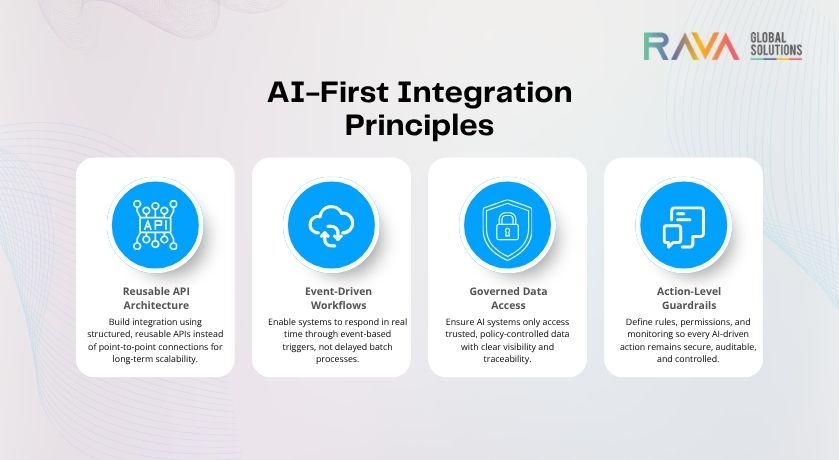
Design MuleSoft around reusable APIs, governed data access, event-driven workflows, and action-level guardrails. Just move beyond simple APIs to a mesh of event-driven architectures and MuleSoft intelligent document processing. Build for real-time context, not point-to-point speed. When systems, documents, and decisions move through a single trusted integration layer, AI can operate at its best. You will see accuracy, control, and scale.
Design MuleSoft around reusable APIs, governed data access, event-driven workflows, and action-level guardrails. Just move beyond simple APIs to a mesh of event-driven architectures and MuleSoft intelligent document processing. Build for real-time context, not point-to-point speed. When systems, documents, and decisions move through a single trusted integration layer, AI can operate at its best. You will see accuracy, control, and scale.
Why AI-First Integration Strategy Matters Now?
Autonomous operations are moving from pilot mode to boardroom priority. MuleSoft’s 2026 Connectivity Benchmark finds that 96% of leaders agree AI agent success depends on seamless integration. In contrast, only 54% have centralized governance in place.
At the same time, Salesforce reports that 84% say their data strategies need major overhauls to enable AI.
That gap matters because AI no longer writes drafts or summarizes notes. It now routes cases, updates records, reads documents, and triggers workflows across CRM, ERP, service, finance, and operations.
When the rubber meets the road, integration becomes the control tower, not the plumbing.
What Does An AI-First Integration Strategy Really Mean?
An AI-first integration strategy does not mean plugging a model into Salesforce and hoping for the best. It means designing MuleSoft, so every AI action has context.
Every system touchpoint has rules, and you can trace every response back to governed data. That is how autonomous operations become useful instead of risky.
For most enterprises, the old integration pattern was only for human clicks. The new pattern must support machine decisions, real-time triggers, reusable services, and secure handoffs between humans and agents.
That is why MuleSoft, API governance, event flows, and data trust now sit in the same conversation.
The Problem Most MuleSoft Service Providers Still Miss
Many teams think they are preparing for AI because they bought a model, launched Copilot, or connected two systems.
Yet half of AI agents still operate in isolation, outside cohesive multi-agent systems. Worse, 64% of leaders worry they will miss near-term AI goals due to an architectural disconnect.
The hidden issue is not simple connectivity. It is whether your architecture can expose trusted business actions in a reusable, channel-agnostic way, with governance built in.
If your APIs only move data but cannot support decisions, orchestration, and policy enforcement, your stack is not yet ready for autonomous operations.
Why Modern Connectivity Requires A New Blueprint?
The landscape of enterprise data is shifting faster than most IT budgets can keep up with. Recent 2025 industry reports indicate that 80% of digital transformation failures now stem from data silos that AI cannot penetrate.
In the Midwest and across the country, companies are realizing that a “wait and see” approach creates technical debt that is nearly impossible to repay.
As a leading MuleSoft partner in Michigan, we see that the primary challenge isn’t just moving data from point A to point B anymore. The goal is now “semantic readiness,” where every piece of data carries enough context for an autonomous agent to act upon it.
It requires a good MuleSoft Salesforce Integration Services strategy that bridges the gap between customer relationships and back-office logic.
The Logic Of An Autonomous Integration Stack
Think of the architecture as five connected layers. First comes the system layer, where ERP, CRM, finance, support, and document stores live. Next comes the API layer, where MuleSoft exposes reusable process and experience APIs. Then comes the context layer, where real-time events, policies, and data access shape what AI can see.
Above that sits the agent and automation layer, where copilots, workflow bots, and autonomous agents act on approved services. Finally, the governance layer logs actions, limits permissions, monitors exceptions, and routes edge cases to the appropriate people.
It is the architecture RAVA Global Solutions points toward in its MuleSoft and Salesforce integration approach, where speed, transparency, and intelligence work together.
Old Integration Vs AI-First MuleSoft Design
| Architecture Question | Old Way | AI-First Way For 2026 | Business Result |
|---|---|---|---|
| How systems connect | Point-to-point links | API-led reusable layers | Faster scale with less rework |
| How data moves | Batch syncs | Real-time and event-driven flows | Better timing for AI actions |
| How AI gets context | Fragmented app access | Governed access across systems and documents | More accurate outputs |
| How teams manage risk | Manual checks after launch | Policy, observability, and audit from day one | Fewer surprises in production |
| How automation grows | One workflow at a time | Shared services for humans and agents | Lower cost per new use case |
This contrast matters because AI adds pressure to every weak spot in architecture. When data, policies, and actions are reusable, each new automation becomes easier to launch and safer to scale.
The Five Design Principles That Prepare MuleSoft For Autonomous Operations
A strong MuleSoft design starts with reusable APIs, not one-off connections. It also needs event-driven patterns so systems can react in the moment, not hours later. Then it needs observability, because you need to monitor autonomous systems like critical business operations.
Just as important, access control must sit close to the action. AI should only see what it needs, call what it is allowed to call, and stop when a policy says stop.
Finally, document-heavy workflows should not remain outside the architecture, which is where MuleSoft intelligent document processing becomes strategically important for invoices, claims, onboarding files, and approvals.
Core Pillars Of An Autonomous Integration Strategy
To build a future-proof ecosystem, you must focus on how data is organized and exposed. Any MuleSoft service provider in the USA can help you implement these foundational shifts:
- Universal API Management: Centralize your governance so every department uses the same high-quality data sources.
- Event-Driven Architecture: Move toward “push” notifications that enable AI agents to react to business events as they occur.
- Automated Document Extraction: Use MuleSoft Intelligent Document Processing to turn unstructured PDFs and emails into clean, actionable data.
- Semantic Layering: Tag your data with business context so LLMs understand the relationship between a “customer” and a “transaction.”
By focusing on these pillars, you move from a reactive IT posture to a proactive business driver. RAVA Global Solutions specializes in guiding companies through this complex transition with clarity and precision.
How To Start Your 2026 AI Integration Strategy Preparation?
If you are looking for the best MuleSoft service provider in the USA, the journey starts with an audit of your current API health. Many organizations find that their existing integrations are too brittle to support the high-frequency demands of modern AI. Strengthening these connections now prevents a total system overhaul later.
- Evaluate your current data latency and identify bottlenecks.
- Standardize your security protocols to allow safe AI access to sensitive records.
- Partner with a trusted expert to map out a multi-year scalability roadmap.
What Your MuleSoft Roadmap Should Include First?
Before you add more automations, clean up the shape of your integration estate. Salesforce says 56% of organizations now use zero-copy integration to activate data across lakes and warehouses, while real-time access has become the top data challenge.
Those signals tell you where architecture needs to mature first.
Start where the business context breaks down most often. In many firms, that means Salesforce, ERP, service systems, identity, and unstructured document flows.
If your company needs MuleSoft Salesforce Integration Services, the goal should not be basic sync. The goal should be a shared operational context that AI and humans can understand.
What To Fix Before You Scale?
- Map the systems where decisions actually happen, not just where data sits.
- Separate system APIs, process APIs, and experience APIs so reuse becomes real.
- Identify which workflows need real-time triggers and which can stay asynchronous.
- Define action guardrails for updates, approvals, record creation, and escalations.
- Bring unstructured inputs into scope early, especially contracts, PDFs, forms, and emails.
These steps sound basic, yet they change everything later. They stop AI from becoming a flashy layer on top of disconnected operations and turn it into a controlled operating capability.
Where Autonomous Operations Create Value First?
- Customer service, where agents need live order, policy, and case context.
- Revenue operations, where quotes, contracts, and approvals cross many systems.
- Finance operations, where document intake and exception routing slow teams down.
- Supply chain visibility, where status changes need instant downstream action.
- Employee workflows, where onboarding and service requests often span siloed apps.
These are high-friction zones with clear handoffs, repeatable decisions, and measurable outcomes. They also create the fastest proof that architecture, not just AI, drives business value.
Real-World Scenario A: When The Architecture Fails
A mid-market distributor rolls out AI agents to support service teams, but its CRM, ERP, and document repository still run on brittle custom links. The agent can summarize a case, yet it cannot verify shipment status, read the latest approval file, or trigger a clean refund workflow without manual intervention. Soon, staff lose trust because the system sounds confident while acting on stale context.
This pattern is more common than many leaders admit. MuleSoft reports that 50% of AI agents operate in isolation and that only 54% of organizations have centralized governance. In plain terms, the business gave the agent a steering wheel before building the road.
Real-World Scenario B: When The Blueprint Works
Now, picture a manufacturer that redesigns its integration architecture before scaling automation. It uses MuleSoft to expose reusable APIs for orders, inventory, customer history, pricing rules, and document validation, while event-driven flows alert systems when shipments, claims, or approvals change. The service agent no longer guesses. It pulls trusted context, follows policy, and escalates edge cases when needed.
That is where ROI begins to show up in hard ways. Faster handling, fewer manual handoffs, cleaner records, and stronger trust across teams all come from the same source: well-designed integration. It is the practical lane where a MuleSoft service provider in Michigan, USA, adds real value, because architecture choices shape every future AI use case.
A Small Case Study Pattern Leaders Can Learn From
Salesforce highlighted Adecco’s use of MuleSoft and Data Cloud to centralize data across more than 40 systems, enabling recruiters to use Agentforce for faster placements, stronger personalization, and quicker decision-making. The lesson is simple. Autonomous outcomes improve when the architecture provides AI with a broad, governed business context rather than scattered fragments.
Hence, the smartest roadmap does not begin with “Which model should we buy next?” It begins with “Which business actions must AI perform safely, and what integration design will support them for years?” That question leads to better sequencing, better governance, and much better outcomes.
Why Governance Must Sit Inside The Design?
Governance cannot be a committee that reviews problems after launch. In an AI-first integration, governance must shape the API contract, event path, identity model, and logging standard from day one. Otherwise, autonomous operations create blind spots faster than teams can find them.
It matters even more as data and documents spread across more systems. Salesforce says trapped data remains the biggest barrier to AI value, and 84% admit major strategy overhauls are needed. That is why the best MuleSoft partner in the USA is not the one that only ships connectors quickly. It is the one that designs trust, reuse, and observability into the operating model.
Why Document Flows Can No Longer Sit On The Sidelines?
Many autonomous operations break at the document layer. Orders may move cleanly across APIs, but approvals, invoices, forms, claims, and onboarding packets still arrive as emails, scans, and PDFs. If those files remain outside your integration strategy, your AI will keep stopping where the business needs it most.
That is where MuleSoft Intelligent Document Processing becomes more than a feature. It helps turn unstructured inputs into governed workflow triggers, usable data, and auditable business actions. For companies building 2026-ready architecture, this closes one of the biggest gaps between AI ambition and operational reality.
The Role Of Salesforce In An Autonomous Stack
For many enterprises, Salesforce is the operational front door for sales, service, and customer history. Yet it reaches full value only when it can exchange trusted context with ERP, finance, support, commerce, and document systems. That is why MuleSoft Salesforce Integration Services have become a strategic design choice, not a side implementation task.
RAVA Global Solutions frames this well in its own platform story. The firm positions integration as a means to move from isolated systems to a unified strategy, emphasizing speed, transparency, and intelligence. For cautious buyers, that is the right lens. Autonomous operations work best when CRM sits inside a connected operating fabric.
What Decision-Makers Should Ask Before They Invest?
Ask whether your current integration estate supports reuse or just survival. Ask whether your AI workflows can explain what data they used, what policy they followed, and why they took an action. Then ask whether your platform can accommodate more channels, models, documents, and automations without having to rebuild the same logic repeatedly.
Those questions separate tactical projects from long-term architecture. If the answers feel shaky, now is the right time to redesign your foundation with a top Mulesoft service provider in the USA that understands both governance and business flow. A calm, well-sequenced roadmap will save far more than a rushed launch ever will.
Why RAVA Global Solutions Fits This Moment?
RAVA Global Solutions already positions itself around MuleSoft, Salesforce, Odoo, Data and AI, and enterprise modernization. Its published approach focuses on assessing the current landscape, designing custom integration solutions, implementing MuleSoft-powered connections, and supporting ongoing optimization. That alignment matters because autonomous operations require both architectural discipline and operational empathy.
For buyers in the Midwest and across the country, that makes the brand memorable in the right way. It feels less like a quick vendor pitch and more like a long-haul guide through complexity. That is exactly the posture a MuleSoft partner in Michigan should own in the 2026 market.
Frequently Asked Questions
How Do I Prepare MuleSoft For Autonomous Operations?
Yes, you can prepare MuleSoft for autonomous operations now, but you must first design for governance and reuse. Start with API-led layers, real-time event flows, action guardrails, and observability, because AI needs trusted context and controlled execution to work well.
How Do I Know If My Current Integration Architecture Is AI-Ready?
It depends on whether your architecture provides AI-governed access to the live business context. If your systems still rely on brittle point-to-point links, stale batch syncs, and manual exceptions, the stack may support automation tasks, but not safe autonomous operations.
How Do I Use MuleSoft With Salesforce For Smarter Operations?
Yes, MuleSoft can make Salesforce far more effective by connecting CRM with ERP, service, finance, and document workflows. The real value comes from shared context, reusable process APIs, and policy-driven actions that let humans and AI work from the same trusted operational picture.
How Do I Reduce Risk When AI Starts Taking Actions Across Systems?
Yes, you can reduce the risk, but only if you build guardrails into the design. Limit permissions, define escalation rules, log every critical action, and make governance part of API contracts and workflow orchestration, rather than treating it as a later review step.
How Do I Choose The Best MuleSoft Service Provider USA For 2026?
It depends on whether the provider can connect the architecture strategy with business execution. Look for a team that understands API-led design, governance, MuleSoft intelligent document processing, and MuleSoft Salesforce Integration Services, because autonomous operations need more than fast connectors.
The Next Move That Makes Sense
AI will keep getting better. Still, without the right integration foundation, better models only expose bad architecture faster. The winners in 2026 will be the companies that build trust into data access, actions, documents, and orchestration before they push autonomy deeper into the enterprise.
If your team is weighing its next step, do not start with another shiny tool. Start with the operating blueprint. RAVA Global Solutions can help you shape a MuleSoft architecture that is ready for real business action, steady growth, and the kind of autonomous operations you can actually trust.