Quick Summary: How Do You Achieve Enterprise API Security at Scale?
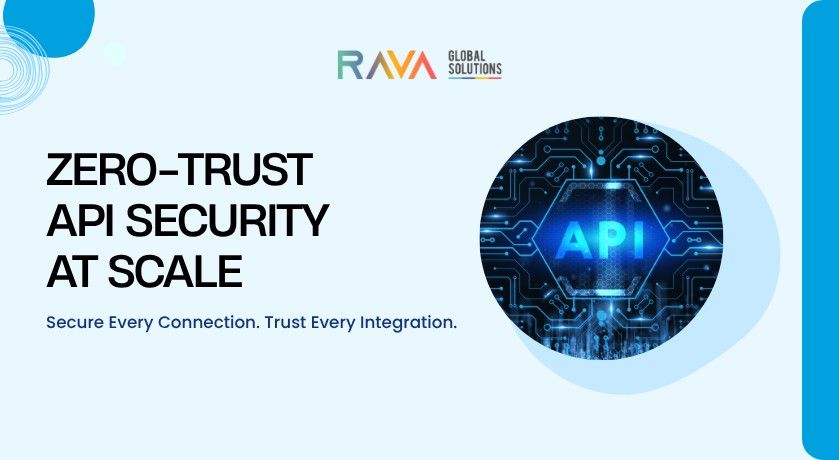
Achieving enterprise API security at scale requires moving away from perimeter defenses toward an identity-centric, Zero-Trust architecture. By combining continuous authentication, rigorous compliance controls, and unified governance, organizations can eliminate blind spots. Partnering with the Best MuleSoft Partner USA ensures your high-volume integrations remain secure, resilient, and fully visible across complex multi-cloud environments.
Achieving enterprise API security at scale requires moving away from perimeter defenses toward an identity-centric, Zero-Trust architecture. By combining continuous authentication, rigorous compliance controls, and unified governance, organizations can eliminate blind spots. Partnering with the Best MuleSoft Partner USA ensures your high-volume integrations remain secure, resilient, and fully visible across complex multi-cloud environments.
The Escalating Threat to Modern Enterprise Integrations
Cybersecurity changed forever when the traditional corporate perimeter dissolved completely. Today, enterprises handle billions of data requests through interconnected ecosystems, making endpoints the primary target for sophisticated exploits. Recent industry reports indicate that API vulnerabilities now account for over 60% of enterprise data breaches. Organizations frequently struggle with shadow endpoints, broken object-level authorization, and fragmented visibility across legacy infrastructure.
Securing these connection points requires an aggressive shift toward proactive, identity-centric architecture. Waiting for a breach to occur before auditing your endpoints will lead to operational disruption and severe financial penalties. The modern enterprise must embed protective layers directly into the integration fabric. Working alongside a premier integration specialist helps companies build resilient systems that stop threats before they touch the core infrastructure.
Core Security Frameworks: Legacy Perimeter vs. Zero-Trust Architecture
Standard gateway policies no longer suffice for distributed corporate networks. A comprehensive comparison highlights why modern engineering teams reject outdated perimeter tactics in favor of granular, continuous verification strategies.
| Security Attribute | Legacy Perimeter Approach | Modern Zero-Trust Strategy | Enterprise Impact |
|---|---|---|---|
| Trust Model | Implicit trust inside the network | Never trust, always verify continuously | Eliminates lateral threat movement |
| Access Control | Static API keys and simple tokens | Dynamic OAuth2 and mTLS validation | Reduces credential theft risks |
| Threat Visibility | Perimeter log monitoring | Real-time behavioral telemetry | Accelerates incident response times |
| Governance | Manual spreadsheet tracking | Centralized, automated policy enforcement | Guarantees continuous compliance |
Three Pillars of Enterprise Integration Defense
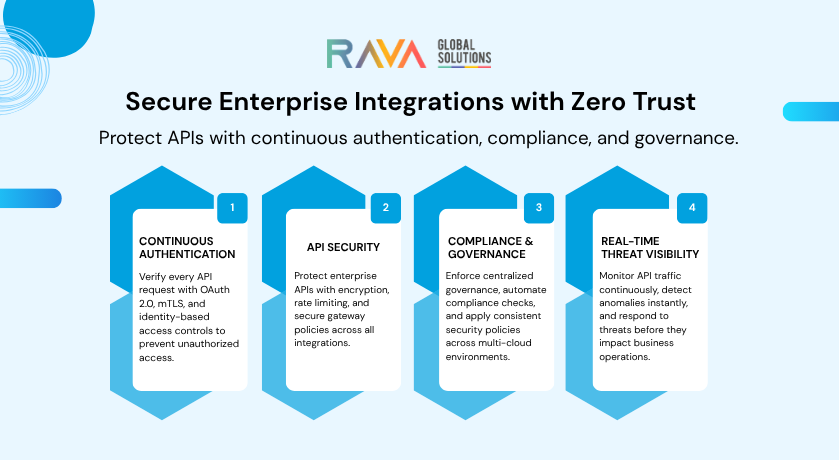
Building a secure integration ecosystem requires balancing strict protection mechanisms with developer agility. Enterprises achieve this balance by focusing on three core areas: continuous authentication, absolute compliance, and centralized governance.
- Identity-Centric Authentication: Move beyond simple passwords by implementing mutual TLS (mTLS) and short-lived tokens for every transaction.
- Automated Compliance Auditing: Embed automated validation checks into your continuous deployment pipelines to catch misconfigurations early.
- Centralized Integration Governance: Establish global policies governing data flows between internal applications and external vendors.
Implementing these pillars prevents unauthorized access while ensuring that legitimate traffic moves without friction. Organizations use a robust framework to maintain operational velocity without compromising corporate data security.
Four Steps to Implement Scale-Ready API Security
- Establish Complete Integration Visibility
You cannot protect assets that your security team cannot see or track. Discover all existing, legacy, and undocumented endpoints across your entire corporate digital landscape. Utilizing advanced discovery tools uncovers hidden vulnerabilities before malicious actors exploit them. Our engineering teams recommend building a dynamic catalog using the MuleSoft Services Page to manage all connection points from a single dashboard.
- Enforce Strict Multi-Cloud Governance
Distributed infrastructure requires uniform policy enforcement across all cloud providers and on-premises data centers. Apply consistent rate-limiting, threat protection, and data masking rules globally to prevent localized exploits. In our enterprise implementations, we found that deploying unified API governance in multi-cloud environments keeps compliance standards across AWS, Azure, and private servers.
- Deploy Real-Time Telemetry and Observability
Static logs fail to capture the subtle anomalies associated with modern credential stuffing and scraping attacks. Implement behavioral analytics to monitor traffic patterns, flag unusual outbound data volume, and block suspicious IP addresses instantly. When designing high-throughput architectures, our architects rely on API observability best practices to identify active threats within milliseconds.
- Continuous Threat Modeling and Testing
Integration security requires continuous iteration rather than a simple annual inspection. Run automated penetration tests and fuzzing exercises against your endpoints during every development cycle. This proactive testing exposes structural flaws, broken authentication mechanisms, and injection risks before code reaches production environments.
Real-World Scenarios: Protecting High-Velocity Industries
Global Financial Services Provider Saves Millions
A major banking institution faced severe regulatory compliance fines due to exposed legacy endpoints that connected to external fintech applications. The internal development team struggled with fragmented access logs and lacked centralized credential management. By implementing a standardized Anypoint gateway strategy, we unified their authentication protocols across three global regions. This architectural pivot eliminated unauthorized data access attempts and reduced compliance audit preparation times by 70%.
Healthcare Network Secures Critical Patient Portals
A regional healthcare system experienced frequent service disruptions caused by automated scraping bots targeting patient record databases. The attacks bypassed traditional firewalls by mimicking legitimate browser requests to internal endpoints. We deployed advanced rate limiting alongside behavioral telemetry, which allowed the IT team to isolate malicious traffic without disrupting medical provider access. Patient data remained secure, system uptime returned to 99.99%, and administrative trust improved.
Frequently Asked Questions
What is the primary cause of enterprise API security failures?
The primary cause of security failures is a lack of centralized visibility, which leads to shadow endpoints and unmonitored data flows. Without comprehensive discovery tools, older endpoints remain active and fail to receive modern security patches. This gap allows malicious actors to bypass standard perimeter defenses and access core databases undetected.
How does Zero-Trust architecture apply to high-volume enterprise integrations?
Zero-Trust architecture works by removing implicit trust from all connections and requiring continuous authentication for every data transaction. Every request must present valid credentials, undergo authorization checks, and maintain encryption during transit regardless of origin. This methodology prevents attackers from moving laterally through an internal corporate network if a single device becomes compromised.
Why should our organization work with the Best MuleSoft Partner USA?
Working with the Best MuleSoft Partner USA ensures that your enterprise integrations are using validated, field-tested security blueprints. Elite partners bring deep technical expertise in configuring complex gateway policies, scaling token validation architectures, and aligning platforms with strict corporate compliance mandates. This expert guidance eliminates costly architectural mistakes, accelerates project delivery timelines, and builds long-term operational resilience.
Securing Your Digital Future with Confidence
Protecting your enterprise integration landscape requires deep technical expertise, constant vigilance, and the right strategic infrastructure partner. Fragmented tools and ad hoc security patches only delay the inevitable. RAVA Global Solutions helps organizations replace uncertainty with absolute architectural clarity, ensuring your data flows safely at scale.
Are you ready to eliminate shadow endpoints, automate your compliance workflows, and future-proof your integration platform? Speak with a Principal Enterprise Architect at RAVA Global Solutions today to receive a comprehensive security assessment.