Quick Summary: What Is Salesforce Technical Debt?
Salesforce technical debt is the compounding operational tax an organization pays when legacy custom code, redundant validation rules, and obsolete integrations degrade platform performance. Visiting a premier Salesforce Services Page enables businesses to systematically identify, audit, and remediate these structural inefficiencies. This process restores native platform agility, reduces maintenance costs, and guarantees data integrity.
Salesforce technical debt is the compounding operational tax an organization pays when legacy custom code, redundant validation rules, and obsolete integrations degrade platform performance. Visiting a premier Salesforce Services Page enables businesses to systematically identify, audit, and remediate these structural inefficiencies. This process restores native platform agility, reduces maintenance costs, and guarantees data integrity.
The Compounding Cost Of Architectural Friction
Many growing American enterprises face a frustrating reality where simple platform updates take weeks to deploy. When you first adopted the platform, workflows moved fast, and configurations felt clean. Over time, successive administrations layered point-in-time solutions without assessing the broader infrastructure.
This ad hoc engineering approach directly creates severe technical debt in your CRM ecosystem. Teams face broken validation paths, slow page load times, and conflicting automation rules. Consequently, your sales representatives spend more time fighting software bugs than closing active business deals.
Industry Research Quantifies The Invisible Drain
Unmanaged customization management challenges do more than irritate internal users. Recent Q1 2026 enterprise architecture analytics reveal that unmitigated code complexity consumes roughly 41% of corporate IT engineering velocity. Instead of building innovative revenue tools, developers waste precious hours hotfixing legacy apex triggers.
This architectural drag creates a highly precarious foundation for modern business scaling. A national survey of Chief Technology Officers conducted in May 2026 confirms that database sprawl delays major system migrations by an average of eight months. Working with a dedicated Salesforce Consulting Partner USA provides the specialized diagnostics required to reverse this costly operational deceleration.
Symptoms Of Critical Platform Degradation
- Apex CPU Time Limit Errors: Complex, unoptimized code can cause loops to freeze your automated background tasks.
- Data Field Duplication: Multiple departments create separate fields for identical data points, ruining analytics.
- Failed Managed Package Updates: Outdated custom overwrites block essential security patches and seasonal platform feature upgrades.
- User Adoption Drop-offs: Frustrated operational teams completely abandon the system in favor of offline spreadsheets.
Evaluating Platform Health: Legacy Chaos Versus Modern Clarity
| Architectural Metric | Fragmented Custom Architecture | Optimized Standard Environment |
|---|---|---|
| Release Management Velocity | Weeks of regression testing | Rapid, automated afternoon deployments |
| API Integration Stability | Fragile point-to-point connections | Resilient, decoupled middleware architecture |
| Data Integrity Level | High duplication across silos | Single source of verified customer truth |
| Flow Automation Design | Overlapping triggers and rules | Streamlined, consolidated process orchestration |
Structural Root Causes Of Enterprise System Stalls
Most system degradation does not happen overnight due to a single bad deployment. Rather, it accumulates slowly through years of shifting organizational priorities and missing internal governance frameworks. When business units bypass official IT channels, they build competing solutions inside the same cloud instance.
This decentralized development style quickly leads to broken object relationships and orphan metadata libraries. Without unified oversight, your core customer relationship management ecosystem transforms into an expensive, unmaintainable digital maze. Reclaiming operational control requires a deliberate shift toward modern enterprise design principles.
Why Missing Governance Destroys ROI
Without strict structural boundaries, your platform configuration inevitably drifts away from standard best practices. Every custom field added without a clear business justification introduces future maintenance risks. Eventually, the cost of maintaining old modifications eclipses the actual value they provide to your operations.
A lack of long-term planning also prevents companies from adopting modern artificial intelligence enhancements. Advanced analytical models require clean, well-mapped object relationships to deliver reliable business insights. Initiating a comprehensive CRM architecture modernization clears out structural debris so you can deploy next-generation capabilities.
Real-World Scenario: Eradicating Logistics Bottlenecks
A major Midwest supply chain enterprise found its sales pipeline completely stalled due to system latency. Their customer accounts took more than 15 seconds to load due to 300 active workflow rules. Because of this lag, field reps regularly skipped logging critical communication data.
The executive leadership team engaged a specialized team to execute a complete system rehabilitation. By consolidating conflicting automated processes into clean flows, the organization instantly restored normal operational performance. This crucial cleanup allowed them to utilize Salesforce as a real-time decision engine across all regional distribution centers.
Real-World Scenario: Financial Services Compliance Recovery
An established national mortgage lender started failing standard regulatory data audits due to conflicting account records. Years of uncoordinated system modifications created duplicate financial fields across multiple cloud instances. The internal IT department lacked the resources to untangle the complex data architecture safely.
By partnering with a strategic consultant, the firm executed a complete metadata cleanup strategy. The technical team safely removed four hundred obsolete custom fields without disrupting daily branch workflows. This remediation effort eliminated audit failures and saved the company thousands in potential regulatory fines.
Implementation Framework For System Remediation
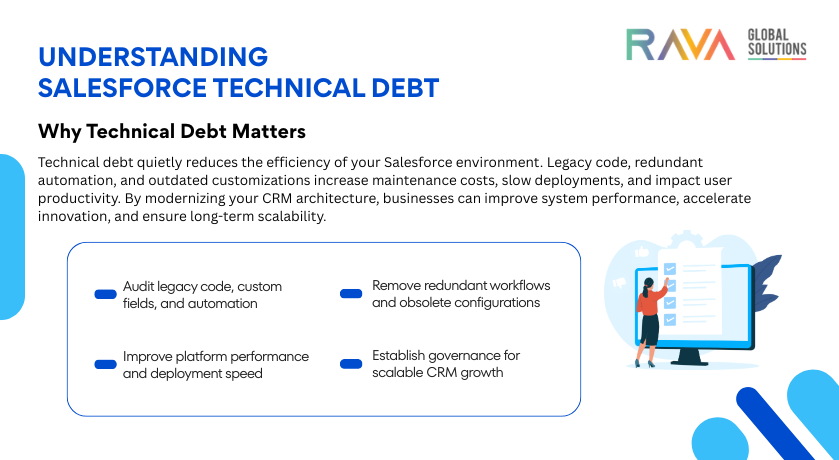
- Comprehensive Metadata Scanning: Run deep diagnostic tools to identify all unused custom fields, apex classes, and validation rules.
- Architectural Dependency Mapping: Trace exactly how your current custom components interact with vital external systems and packages.
- Consolidation and Refactoring: Convert outdated process builder configurations into single, high-performance lightning flows per object.
- Enforcing Governance Standards: Establish a strict internal review board to validate every future customization request against strict guidelines.
Practitioner Insights From The Integration Trenches
In our enterprise implementations, we found that deleting code is often more valuable than writing new scripts. Technical teams frequently fear removing legacy configurations because they do not understand the historical context. However, leaving dead metadata active within your system significantly inflates your security risk profile.
A successful remediation project requires close alignment between engineering teams and executive stakeholders. Clean architecture is not simply a technical luxury; it is a fundamental driver of business agility. Entrusting this complex process to an expert team ensures your platform retains its long-term commercial value.
The Strategic Path Beyond Technical Burden
Ignoring the warning signs of system decay only increases the ultimate cost of future digital transformation. Postponing necessary structural maintenance creates an environment where minor bug fixes require extensive software re-engineering. This operational paralysis allows more agile, cloud-native competitors to capture your market share.
Investing in a deliberate platform optimization strategy completely resets your technological foundation. Your development cycles become highly predictable, allowing you to launch new market features ahead of schedule. Embracing structured automation practices helps your entire enterprise move with absolute confidence and speed.
Selecting Your Strategic Optimization Partner
Remediating enterprise system debt requires far more than basic administrative knowledge. It demands deep architectural insight, sophisticated code analysis tools, and a proven history of successful platform turnarounds. Working with the right American technical specialist protects your core infrastructure investments from sudden operational failures.
RAVA Global Solutions delivers the precise engineering expertise required to untangle your most complex cloud configurations. We focus on systemic health, operational scalability, and measurable business performance outcomes rather than temporary quick fixes. Let our team restore clarity and velocity to your digital sales environment.
Frequently Asked Questions
How do you identify hidden technical debt in an enterprise Salesforce instance?
You can identify technical debt by tracking slow page load times, high test execution failures, and excessive custom field limits. Running standard platform health checks and metadata dependency tools also reveals abandoned automation rules and redundant apex triggers.
Why does excessive customization break standard platform updates?
Excessive customization overrides native platform logic, preventing new seasonal software releases from running properly. When custom apex code relies on deprecated hardcoded values or obsolete API versions, standard security patches can cause immediate system failures.
What is the financial risk of delaying a CRM architecture modernization?
Delaying modernization inflates your annual IT budget by forcing developers to spend time fixing old bugs rather than building revenue-generating features. It also blocks the integration of modern automated tools, lowering overall employee productivity and damaging customer retention.
How can a Salesforce Consulting Partner USA help our internal team?
A specialized US consulting partner provides objective architectural audits, proprietary code-scanning tools, and advanced refactoring strategies that internal teams rarely have time to execute. This external support allows your staff to maintain daily operations while experts safely rebuild platform foundations.
What governance steps prevent customization debt from returning?
Organizations must implement a centralized review board, enforce strict documentation standards, and prioritize native declarative features over custom code. Establishing clear ownership for every object and data stream ensures your system remains optimized for future scaling.
Secure Your Digital Foundation Today
Clinging to a bogged-down software ecosystem restricts your market growth and limits your operational vision. You can easily break free from the constraints of legacy code by optimizing your enterprise cloud architecture today. Selecting a top-tier Salesforce Consulting Partner USA ensures your business software remains a powerful driver of long-term commercial success.
Our seasoned enterprise architects are ready to evaluate your system performance and design a clear cleanup blueprint. We eliminate system layout confusion so your sales teams can focus on driving measurable bottom-line revenue. Connect with RAVA Global Solutions to unlock the true power of your enterprise technology investment.