Quick Summary: Why Does Enterprise Integration Drive Growth?
Enterprise integration unites siloed applications, data warehouses, and cloud infrastructure into a unified ecosystem. By replacing custom point-to-point connections with reusable application programming interfaces (APIs), companies automate cross-functional workflows, eliminate data latency, accelerate product launches, and reduce operational maintenance costs by up to 60%.
Enterprise integration unites siloed applications, data warehouses, and cloud infrastructure into a unified ecosystem. By replacing custom point-to-point connections with reusable application programming interfaces (APIs), companies automate cross-functional workflows, eliminate data latency, accelerate product launches, and reduce operational maintenance costs by up to 60%.
Modern enterprises often run over one thousand disparate cloud and on-premises applications. When these critical systems cannot communicate cleanly, critical customer data fragments, operational costs balloon, and critical decisions stall. True business velocity requires moving past fragile manual workarounds. A robust approach to enterprise integration turns fragmented software into an agile foundation for continuous innovation and rapid digital transformation.
The Hidden Cost Of Disconnected Digital Systems
Many organizations manage hybrid multi-cloud systems held together by fragile point-to-point custom code. Research among global IT leaders reveals that data silos consume up to 30% of engineering bandwidth for routine maintenance alone. Disconnected systems also create blind spots in inventory, supply chain tracking, and customer experience management.
Legacy architectures create significant friction for leadership teams trying to scale operations smoothly. According to enterprise connectivity benchmarks, integration challenges delay over 70% of digital transformation initiatives across global organizations. Companies without a unified integration layer spend more time patching brittle connections than shipping revenue-generating features.
This operational drag directly harms your bottom line and customer satisfaction. Sales teams lack real-time visibility into inventory, while customer support agents juggle multiple disjointed dashboards. By unifying your core assets through professional MuleSoft Consulting Services, your technical teams eliminate operational drag and unlock secure, scalable data access across every business unit.
How Connected Enterprises Outpace Competitors
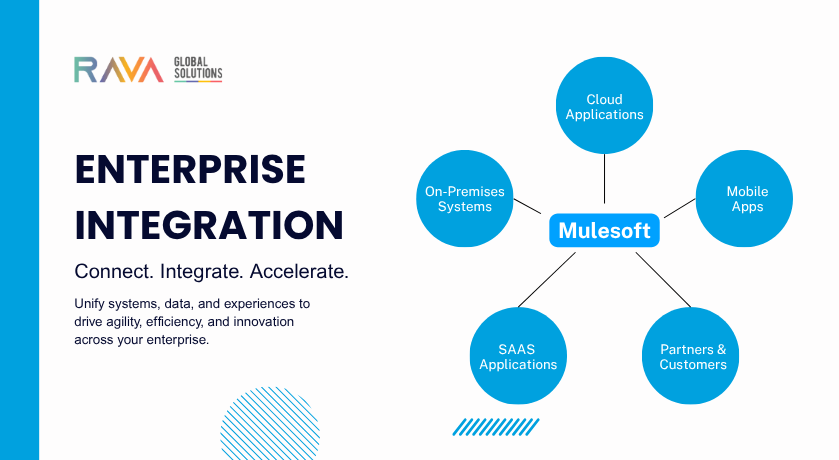
A connected enterprise treats its operational data as a shared, liquid asset rather than a departmental silo. By establishing a modern API-led connectivity layer, your organization decouples core data assets from end-user applications. This structural shift allows development teams to build, launch, and test new customer-facing tools in weeks rather than quarters.
Operating in the modern API economy enables forward-thinking enterprises to quickly compose new business capabilities. Rather than rewriting complex backend logic for each new channel, developers simply reuse standardized APIs. This composable approach reduces development cycles, protects sensitive core systems, and creates flexible foundations for generative artificial intelligence and autonomous workflows.
Standardized connectivity also ensures that business teams make decisions using accurate, real-time data feeds. When your sales, finance, and product telemetry share a single source of truth, cross-departmental friction disappears. Realizing these efficiency gains requires establishing a clear framework for measuring Integration ROI: How to Measure the Business Value of MuleSoft Investments to evaluate performance improvements continuously.
Comparing Legacy Integration With Modern API-Led Architecture
| Operational Metric | Legacy Point-to-Point Pipelines | Modern API-Led Integration Network | Business Impact |
|---|---|---|---|
| Time to Market | 6 to 9 months per application link | 2 to 4 weeks using reusable API assets | 70% faster service rollouts |
| System Maintenance | 60–80% of IT operational budget | Under 25% of ongoing IT budget | Significant operational savings |
| Data Synchronization | Batch processing with hours of latency | Event-driven, sub-second data streaming | Instant operational clarity |
| Security & Compliance | Inconsistent endpoint-level security | Centralized governance and policy control | Lowered risk of compliance failure |
| Scalability | High risk of system breakage during spikes | Elastic microservices and modular gateways | Seamless handling of traffic surges |
Five Core Strategic Pillars Of Enterprise Connectivity
Modern integration strategy requires a structured framework that bridges technical architecture with commercial business outcomes. When designed properly, this foundation supports immediate operational needs while easily scaling for future software adoptions.
- API-Led Connectivity Architecture: Systematically organize your interfaces into System, Process, and Experience layers. This structure protects mission-critical backends while empowering front-end teams to innovate freely.
- Universal Data Governance: Apply centralized access policies, automated threat detection, and standardized encryption across every connected touchpoint. This approach guarantees regulatory compliance across all operating regions.
- Event-Driven Messaging Frameworks: Adopt asynchronous event brokers to process high-volume transactions instantly. This architecture prevents system bottlenecks during high-demand business events.
- Self-Service Asset Portals: Publish well-documented, reusable APIs across internal developer portals. This practice eliminates redundant engineering work and dramatically accelerates cross-team project delivery.
- Real-Time Observability and Telemetry: Monitor transaction flows, system health, and error rates using automated dashboards. Proactive alerting allows teams to resolve data bottlenecks before end-users experience service delays.
Real-World Scenarios: Enterprise Integration In Action
Global Logistics Provider Unifies Fragmented Supply Chain
A multinational freight carrier struggled with disparate warehouse management software, port customs databases, and driver telematics. Dispatch teams faced a four-hour data delay, resulting in missed shipment connections and increased demurrage penalties.
The engineering leadership deployed a central integration platform to standardize transactional data across legacy mainframes and modern cloud endpoints. The unified event stream delivered real-time container tracking to customer web portals and driver mobile applications simultaneously. Dispatchers reduced port wait times by 42%, while adoption of customer self-service tracking reached 88%.
Regional Financial Services Firm Modernizes Customer Onboarding
A regional bank lost prospective loan applicants due to a disconnected, paper-heavy underwriting process. Verification required manual data entry across three separate legacy banking ledgers and external credit verification bureaus.
The bank introduced an API-led integration framework that safely connects front-end loan applications directly with verification databases and core account management systems. Automated data pipelines replaced manual verification steps entirely. Loan origination turnaround dropped from six days to under fifteen minutes, increasing completed applications by 65%.
Step-by-Step Roadmap For Integration Modernization
Audit Existing Endpoints and Map Data Flows
Identify every active database, SaaS tool, and legacy application across your enterprise. Catalog where manual exports, batch scripts, and custom integrations currently create operational risks. Practitioner Insight: In our enterprise architecture audits, we frequently uncover dozens of undocumented point-to-point scripts that present significant single-point-of-failure risks.
Define Layered API Architecture Standards
Organize upcoming integration requirements into discrete System, Process, and Experience APIs. This separation ensures backend stability while giving edge applications full flexibility to evolve. Practitioner Insight: Always isolate underlying databases with System APIs first; skipping this step forces expensive architectural rework when upgrading legacy core systems later.
Deploy Centralized Security Policies and Governance
Enforce consistent authentication protocols, token management, and role-based permissions across every API gateway. Ensure every connection complies with industry standards including SOC 2, HIPAA, and GDPR. Practitioner Insight: Implementing automated policy enforcement at the gateway level reduces compliance auditing cycles from months to days.
Iterate, Automate Workflows, and Track Value
Retire high-maintenance point-to-point connections systematically as new reusable APIs go live. Monitor system performance, API reuse rates, and developer onboarding times to evaluate operational gains. Practitioner Insight: For an in-depth look at building an adaptable system architecture, review our analysis on Why Every Modern Business Needs MuleSoft Integration Solutions to accelerate your modernization journey.
Five Key Pitfalls To Avoid In System Unification
Treating Integration as a Tactical IT Fix: Viewing integration as an isolated software expense rather than a core business strategy limits executive sponsorship and long-term organizational value.
Building Monolithic Point-to-Point Scripts: Continuing to write tight, custom code for new systems recreates technical debt and prevents agile software modifications down the road.
Overlooking API Discovery and Documentation: Failing to provide developer documentation across a central repository causes teams to build duplicate integrations for assets that already exist.
Ignoring Operational Error Handling: Forgetting to build automated alerting, message queues, and error-routing logic causes silent data pipeline failures and downstream reporting errors.
Neglecting Organization-Wide Change Management: Omitting operational training for cross-functional business units leaves non-technical teams reliant on outdated manual spreadsheets and workarounds.
Frequently Asked Questions
What is the primary purpose of enterprise integration?
The primary purpose of enterprise integration is connecting disparate software applications, cloud databases, and legacy systems into a unified operational environment. This connectivity enables automated data exchange, reduces manual entry errors, and provides real-time access to information across all business units.
How does an API-led integration approach differ from traditional point-to-point coding?
Traditional point-to-point coding tightly couples two specific applications using custom, brittle scripts that require manual intervention whenever either system updates. In contrast, an API-led integration framework organizes connections into modular, reusable layers, making it easy to swap, update, or add software systems without breaking the broader infrastructure.
What business metrics demonstrate integration success?
Key metrics include project delivery speed, API asset reuse percentage, infrastructure maintenance costs, and transaction error rates. Organizations also track business-level impacts, such as shorter customer onboarding times, improved order-processing efficiency, and reduced downtime during system updates.
Can legacy on-premises systems integrate seamlessly with modern cloud platforms?
Yes, modern integration platforms use hybrid runtime engines and secure API gateways to connect legacy mainframes directly with cloud environments. This configuration lets organizations extract value from existing on-premises investments while adopting modern SaaS applications at their own pace.
When should an organization transition to an enterprise integration platform?
Organizations should transition when managing multiple business applications that face data discrepancies, high maintenance costs, or slow development cycles that hinder growth. Adopting a unified platform is critical before scaling multi-cloud environments, launching mobile channels, or deploying complex data automation initiatives.
Build Your Connected Enterprise
Modern market leadership belongs to organizations that turn fragmented data into immediate operational momentum. Disconnected systems slow innovation, frustrate employees, and degrade customer experiences. Implementing a modern, scalable enterprise integration strategy unlocks the agility your teams need to outpace competitors and scale without technical debt.
At RAVA Global Solutions, we design and deliver resilient integration architectures that transform complex enterprise ecosystems into high-performing, connected digital engines. Whether you are modernizing legacy mainframes or orchestrating a secure multi-cloud strategy, our team delivers the technical clarity and operational velocity your business demands. Connect with our enterprise architects today to plan your integration roadmap.