Quick Summary: Measuring MuleSoft Value
Enterprises measure integration ROI by tracking reduced development hours, lower maintenance costs, and faster project delivery times. Maximizing these API investments requires mapping technical metrics directly to strategic business outcomes. Working with the best MuleSoft service provider USA ensures clear financial visibility and sustainable architectural growth across your entire ecosystem.
Enterprises measure integration ROI by tracking reduced development hours, lower maintenance costs, and faster project delivery times. Maximizing these API investments requires mapping technical metrics directly to strategic business outcomes. Working with the best MuleSoft service provider USA ensures clear financial visibility and sustainable architectural growth across your entire ecosystem.
The True Cost Of Integration Silence
Many enterprise executives face a silent profit killer. Legacy systems drain operational budgets through constant patches and unexpected downtime. Businesses often spend millions on software licenses without tracking the actual financial returns.
A recent 2026 global enterprise connectivity study shows that unintegrated data costs large organizations over $2.5 million annually in lost productivity. Leaders must stop viewing integration as a simple IT expense. It serves as the primary engine for modern operational speed and business agility.
To solve this visibility crisis, smart enterprise leaders change their measurement strategies. They shift their focus from basic uptime metrics to clear financial returns. Partnering with a top-tier consulting firm simplifies this complex tracking process. Discover how our specialized teams build transparent financial frameworks on our MuleSoft Services Page.
Mapping API Investments To Business Outcomes
Modern architecture requires clear metrics to justify operational technology expenses. Organizations often struggle to connect technical API performance to high-level corporate financial goals. This disconnect leaves leadership skeptical about future technology expenditures.
[System Connectivity] ➔ [Faster Data Flow] ➔ [Reduced Developer Hours] ➔ [Higher Profit Margins]
True business value appears when you link system speed to employee productivity. For example, faster data sync times reduce customer service call durations. Shorter calls immediately lower operational costs and improve customer satisfaction scores.
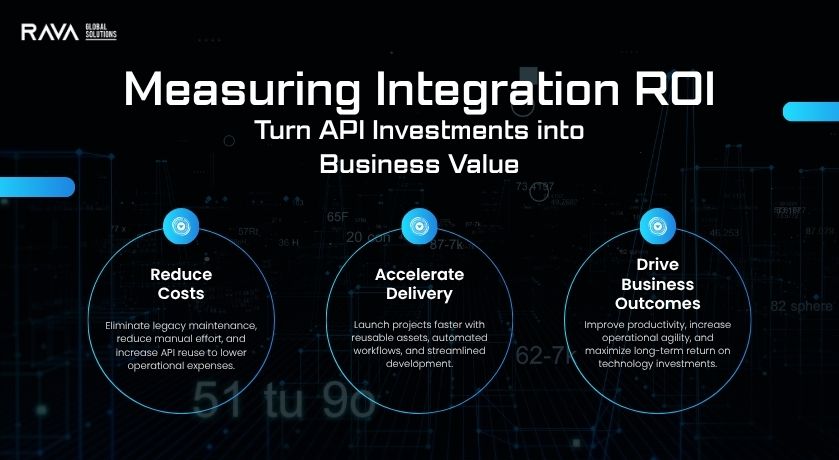
Enterprise teams must categorize their savings into direct and indirect financial buckets. Direct savings include retired legacy server licenses and reduced maintenance labor. Indirect savings include faster time-to-market for new digital customer applications.
The Strategic Value Framework
Structured metrics provide the foundation for successful long-term digital transformation projects. The following matrix contrasts traditional ad hoc tracking with modern strategic measurement.
| Measurement Metric | The Legacy IT Approach | The New Strategic Way |
|---|---|---|
| Development Speed | Tracking lines of code written | Measuring reusable API asset drops |
| System Maintenance | Fixing broken endpoints manually | Deploying automated self-healing loops |
| Operational Scaling | Adding expensive hardware manually | Utilizing automated predictive scaling |
Strategic alignment converts abstract technology into predictable profit centers. Organizations eliminate waste by standardizing their core performance indicators early. This structured approach helps teams identify precisely where value leaks occur.
Three Steps To Calculate Integration ROI
1.Catalog Current Operational Expenses
First, document every dollar spent on maintaining your existing legacy infrastructure. Include software licensing fees, server hosting costs, and internal developer hours. Most companies underestimate their current maintenance costs by forty percent.
2.Track Asset Reuse Ratios
Next, measure how often your developers reuse existing API building blocks for new internal projects. High reuse ratios directly accelerate software delivery timelines. In our enterprise implementations, we found that reuse reduces development costs by half over twelve months.
3.Quantify Accelerated Delivery Windows
Finally, measure the time difference between old deployment cycles and new API led releases. Faster launches allow your business to capture market share before competitors can react. Speed to market remains a massive competitive advantage in modern digital economies.
Real World Scenarios: Value In Action
A major North American logistics firm struggled with fragmented supply chain tracking systems. The company faced severe data delays, manual order processing errors, and rising customer complaints. These operational inefficiencies cost the business thousands of dollars in daily shipping penalties.
The logistics firm integrated its core shipping applications using an API led architecture. They implemented predictive scaling for high-load integration environments to manage peak holiday shipping volumes smoothly. This proactive technological upgrade eliminated manual data entry errors across all regional distribution hubs.
Consequently, order processing speeds increased by 65% within 6 months. The company saved over $400,000 in manual labor expenses during the first year alone. Their technology platform transformed from an expensive bottleneck into a powerful revenue driver.
Maximizing Returns With Managed Intelligence
Achieving long-term integration success requires continuous platform optimization and deep technical oversight. Many internal IT teams lack the specialized bandwidth to monitor complex ecosystem health around the clock. This talent gap often leads to missed performance targets and delayed support responses.
Enterprises protect their digital investments by utilizing advanced automated monitoring systems. RAVA Global Solutions provides continuous operational stability through proactive architectural management. We deploy AI-driven SLA intelligence for managed services to neutralize potential system anomalies before they impact your clients.
Safe operations keep your internal teams focused on creating new revenue-generating digital products. Preventative maintenance eliminates the chaotic cycle of constant emergency software patching. Strategic stability ensures your business captures the full financial value of your modern digital platform.
Frequently Asked Questions
How long does it take to see clear ROI from integration?
Most enterprises achieve measurable financial returns within 6 to 9 months after deployment. Initial savings stem from reduced developer hours and the elimination of duplicate legacy software licenses. Long-term value compounds as teams reuse existing API assets in subsequent digital projects.
What is the primary cause of integration project delays?
Project delays often result from poorly defined data standards and weak governance frameworks. Organizations waste valuable time rewriting code when initial API designs lack clear alignment with enterprise architecture. Partnering with experienced digital strategists eliminates these common developmental bottlenecks.
How does API reuse lower overall development costs?
API reuse enables developers to build new applications using pre-validated functional blocks rather than coding from scratch. This practice shortens project timelines, minimizes software bugs, and significantly reduces the time required for quality assurance testing. Over time, a robust API library lowers average project costs by thirty percent.
Securing Your Digital Future
Measuring technology value requires the right frameworks, experienced people, and reliable engineering practices. Vague estimates will not satisfy corporate boards or cautious chief financial officers during budget reviews. You need clear, provable data points to justify your infrastructure evolution.
Recent industry data confirms that businesses using structured integration frameworks experience a 235% return on investment. Our engineering teams design transparent systems that highlight every dollar saved across your enterprise ecosystem. We eliminate the guesswork from complex technical infrastructure projects.
Partner with a team that treats your operational budget with absolute precision. RAVA Global Solutions stands ready to guide your organization through the complexities of modern architecture. Contact the Best MuleSoft Service Provider USA today to unlock the true financial power of your technology investments.