Quick Summary: How Does Salesforce Enable True Omnichannel Experiences?
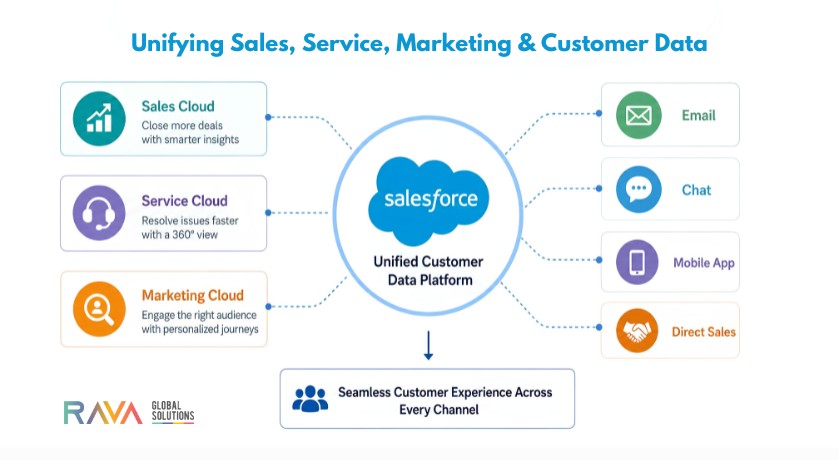
Enterprise organizations leverage expert Salesforce Consulting Services to unify sales, service, and marketing clouds into a single customer data platform. By connecting real-time customer profiles across email, chat, mobile apps, and direct sales touchpoints, businesses eliminate data silos, automate cross-departmental workflows, dynamically personalize engagements, and increase customer lifetime value across every digital and physical channel.
Enterprise organizations leverage expert Salesforce Consulting Services to unify sales, service, and marketing clouds into a single customer data platform. By connecting real-time customer profiles across email, chat, mobile apps, and direct sales touchpoints, businesses eliminate data silos, automate cross-departmental workflows, dynamically personalize engagements, and increase customer lifetime value across every digital and physical channel.
The Hidden Cost of Fragmented Enterprise Customer Journeys
Modern buyers expect effortless interactions across every touchpoint, yet most enterprises deliver disconnected experiences. When a prospect engages with a targeted marketing campaign, speaks with a sales representative, and later logs a support ticket, they assume the business sees their full journey. Unfortunately, internal data silos often break this continuous conversation. Marketing teams run campaigns without real-time visibility into active service disputes, while sales representatives pitch products without knowing a client just requested technical assistance.
These operational disconnects damage brand trust and drain revenue productivity. In early 2026, global enterprise research revealed that seventy-three percent of buyers abandon brands after experiencing inconsistent answers across sales and service channels. Furthermore, employees spend up to two hours daily manually copying data between disparate software tools. Forward-thinking leaders realize that legacy technology stacks cannot sustain modern growth demands.
Overcoming these operational bottlenecks requires uniting your core business units under a shared digital infrastructure. Aligning your revenue engine around connected Salesforce systems transforms isolated department data into real-time operational intelligence. When marketing, sales, and service share a single customer view, your teams respond faster and more accurately anticipate buyer needs. As a result, your organization protects profit margins while delivering the seamless experience modern buyer’s demand.
Comparing Siloed Architectures Against Unified Salesforce Ecosystems
Legacy technology stacks force departments to operate on isolated databases, causing fragmented customer communication. Modern enterprise platforms centralize operational metrics across departments into a single secure platform.
| Operational Capability | Fragmented Legacy Systems | Integrated Salesforce Ecosystem | Strategic Enterprise Impact |
|---|---|---|---|
| Customer Data Profile | Disconnected databases with delayed batch updates | Real-time unified data profile across all clouds | Cuts customer resolution time by 42% |
| Cross-Channel Messaging | Uncoordinated emails, SMS, and sales outreach | Automated journey orchestration based on intent | Boosts marketing conversion rates by 31% |
| Service and Sales Alignment | Support agents lack visibility into open deal pipelines | Shared timeline of all transactions and cases | Increases cross-sell deal velocity by 28% |
| Data Governance & Privacy | Fragmented consent records across software apps | Centralized compliance and consent tracking | Reduces data privacy audit risks completely |
| AI Insights & Automation | Static rules engines with manual data entry | Real-time predictive analytics and next best action | Saves account managers 6 hours weekly |
Essential Architecture Pillars for Seamless Cross-Cloud Orchestration
High-performing enterprise organizations rely on integrated modules that connect revenue teams without friction. Investing in comprehensive enterprise architecture gives business units the exact tools required for continuous operational alignment:
- Unified Data Architecture: Connect Marketing Cloud, Sales Cloud, and Service Cloud through Data Cloud to build a single operational source of truth.
- Real-Time Journey Orchestration: Trigger personalized communication paths automatically across email, SMS, and portal channels based on user activity.
- Omnichannel Routing Engines: Direct incoming customer inquiries automatically to the best-suited agent or account manager based on skills and history.
- Predictive AI Insights: Deliver next-best-action recommendations directly to sales and service screens using real-time machine learning models.
- Centralized API Integration Framework: Streamline data exchange between your core CRM platforms, ERP back-ends, and legacy financial tools.
Step-by-Step Implementation Framework for Omnichannel Transformation
- Audit Cross-Departmental Workflows: Map every customer touchpoint across marketing, sales, and service to identify data gaps and manual handoff errors. Practitioner Insight: In our enterprise projects at RAVA Global Solutions, we discovered that mapping data handoffs prior to technical configuration reduces deployment delays by thirty-five percent.
- Consolidate Customer Data Streams: Unify customer records, behavioral signals, and purchase histories inside Salesforce Data Cloud to form identity profiles. Practitioner Insight: Standardizing field mappings across business units before data migration prevents duplicate records and keeps dashboards clean.
- Configure Cross-Cloud Automation Rules: Build automated workflows that alert account managers when high-value clients log urgent support tickets or view pricing pages. Practitioner Insight: Customizing real-time notifications for critical customer events increases renewal rates by over twenty percent.
- Train Teams and Refine Journeys: Conduct role-based training across sales, marketing, and support teams to ensure complete adoption of new automated workflows. Practitioner Insight: Running parallel pilot programs with select user groups ensures smooth change management during full-organization rollouts.
Real-World Enterprise Transformations
Global B2B Equipment Manufacturer
A leading industrial equipment manufacturer struggled with disconnected communication between their marketing team and regional sales reps. Prospects who clicked on high-intent email campaigns received no follow-up for several days because sales lacked visibility into lead activity. By deploying unified cloud solutions, the company automated lead scoring and the instant distribution of tasks to local sales teams. Deal response times dropped from four days to fifteen minutes, resulting in a twenty-eight percent increase in qualified pipeline conversion.
Multi-National Financial Services Group
A financial services firm faced declining customer satisfaction scores because support agents could not view active product applications or previous marketing interactions. Clients had to repeat their personal details each time they switched between phone channels and digital chat applications. Unifying their service desk with real-time customer data profiles completely transformed their operations. Support staff resolved client inquiries on first contact 45% more often, while overall retention rates rose significantly within six months.
Strategic Evaluation Criteria for Enterprise Business Leaders
Building an agile, customer-centric architecture requires balancing immediate operational needs with a long-term technology vision as you shape the future of CRM.
Standard off-the-shelf CRM configurations provide basic contact management, fixed reporting templates, and quick out-of-the-box setups. However, generic tools struggle to handle complex enterprise workflows across global business units.
Conversely, tailored enterprise architecture provides flexible multi-cloud integration, custom data models, and automated cross-departmental routing. Custom enterprise platforms allow growing organizations to adapt operational modules as market conditions shift. Partnering with seasoned technical specialists ensures your enterprise builds a secure ecosystem aligned with your strategic goals. RAVA Global Solutions delivers expert enterprise system architecture, helping executive leaders replace fragmented tools with scalable digital infrastructure.
Core Capabilities That Accelerate Omnichannel Performance
Modern enterprise ecosystems streamline daily operations across every customer-facing department in your company:
- Dynamic Data Harmonization: Merge duplicate contacts automatically across legacy databases to maintain pristine master data records.
- Automated Lead Nurturing: Deliver targeted content based on real-time website behavior, email interactions, and product usage signals.
- Unified Case Management: Allow support representatives to view full sales histories, active quotes, and past marketing engagement histories.
- Contextual Mobile Engagement: Send timely push notifications and SMS alerts triggered by real-time customer location and profile changes.
- Executive Performance Dashboards: Track end-to-end customer acquisition costs, lifetime value, and channel attribution metrics inside unified reports.
Navigating Enterprise System Adoption Without Operational Friction
Upgrading core enterprise technology often raises concerns about operational downtime and employee resistance. Transitioning to a unified cloud environment does not require stopping daily business operations. Planning your rollout in structured phases keeps revenue engines running smoothly while teams adapt to updated processes.
Employee adoption improves significantly when executive leaders introduce digital capabilities through clear, practical enablement programs. Demonstrating how automated data entry cuts repetitive tasks helps account managers and support agents embrace new tools quickly. Furthermore, providing revenue leaders with accurate pipeline visibility delivers immediate strategic value by improving the precision of quarterly forecasting.
Data security and regulatory compliance remain essential during any digital transformation initiative. Enterprise cloud architecture protects sensitive corporate records using advanced encryption, fine-grained access permissions, and continuous compliance tracking. Selecting a trusted technology advisor ensures your organization meets strict global privacy standards while maintaining uninterrupted service delivery.
Frequently Asked Questions
What are Salesforce Consulting Services, and how do they help enterprise businesses?
These professional advisory and implementation services help companies design, customize, and optimize their cloud software ecosystem. Specialized consultants align business strategy with technical architecture to improve operational efficiency, automate workflows, and boost revenue growth across departments.
How does unifying Sales Cloud and Service Cloud improve customer experiences?
Connecting sales and support data gives teams a shared view of every client interaction. Support agents see active deals and purchase histories, while sales representatives stay informed about open service tickets, preventing conflicting communication and speeding up issue resolution.
Can custom enterprise architecture integrate with legacy ERP systems?
Yes, enterprise platforms securely connect to third-party ERP tools, warehouse management systems, and financial databases via robust APIs and middleware. This automated connectivity eliminates manual data entry and ensures consistent metrics across all corporate systems.
Is cloud-based customer data security compliant with global regulations?
Enterprise cloud architecture safeguards sensitive information using end-to-end encryption, multi-factor authentication, granular permissions, and compliance monitoring. These built-in security features ensure full alignment with global data protection frameworks like GDPR and HIPAA.
How long does an enterprise omnichannel implementation project take?
Implementation timelines typically range from eight to twenty-four weeks, depending on system complexity, custom integrations, and the scope of data migration. Structured phased rollouts ensure business operations continue smoothly while teams transition to updated digital workflows.
Partner with RAVA Global Solutions to transform your enterprise revenue architecture. Schedule a strategic consultation with our expert team today to explore tailored Salesforce Consulting Services designed for sustainable market leadership.