Deploy Event-Driven Integration Triggers
A single minute of unplanned assembly downtime costs automotive manufacturers up to $36,000, which adds up to more than $2 million every hour. In Michigan plants from Detroit to Grand Rapids, line supervisors still scramble across physical factory floors because their shop-floor tools cannot communicate with back-office databases. Fragile custom code breaks whenever suppliers update advance shipping notices, while critical inventory updates remain trapped in legacy databases. Modern production schedules stall when operational technology cannot exchange data with enterprise resource planning systems.
Quick Summary: Why MuleSoft Integration Services Matter
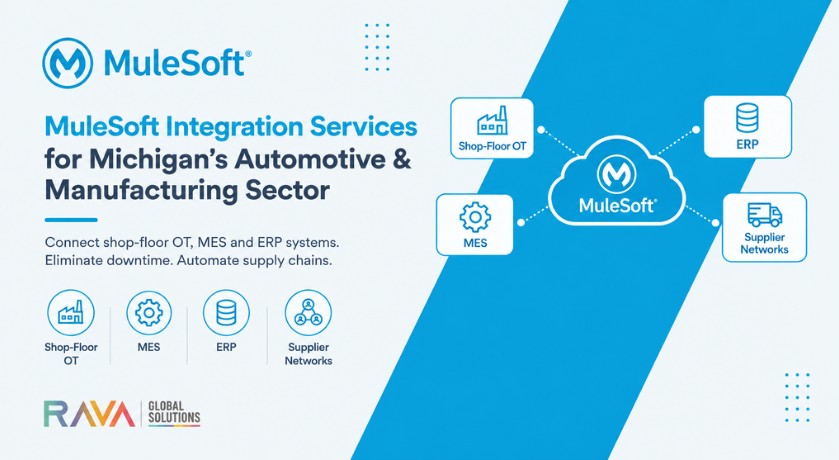
MuleSoft Integration Services link legacy industrial hardware, shop-floor production software, enterprise resource planning, and third-party supplier networks through reusable application programming interfaces. This integration framework eliminates brittle point-to-point data connections, protects automotive operations from unplanned downtime, and provides real-time supply chain transparency across modern industrial plants.
MuleSoft Integration Services link legacy industrial hardware, shop-floor production software, enterprise resource planning, and third-party supplier networks through reusable application programming interfaces. This integration framework eliminates brittle point-to-point data connections, protects automotive operations from unplanned downtime, and provides real-time supply chain transparency across modern industrial plants.
Breaking Silos Across The Industrial Assembly Line
Industrial production lines in the Great Lakes State run around the clock to meet demanding vehicle assembly targets. Yet operational teams often spend hours manually reconciling purchase orders, inventory counts, and machine maintenance records across disconnected screens. A reliable deployment of MuleSoft Integration Services replaces these slow workarounds with direct, event-driven data pipelines between legacy machines and enterprise platforms.
When plant equipment sends real-time status signals directly into your centralized ERP for manufacturing, planners can detect parts shortages before line stoppages occur. Plant managers gain direct visibility into tooling wear, line speeds, and overall equipment effectiveness without waiting for end-of-shift reports. Real-time system coordination keeps local Tier-1 and Tier-2 suppliers aligned with changing master production schedules.
The Cost Of Disconnected Factory Systems
Recent manufacturing benchmark studies show that uncoordinated plant systems cause up to 800 hours of unnecessary factory downtime every year. When custom scripts fail between legacy mainframes and modern cloud platforms, assembly lines stop without warning. Operators must guess material availability, which leads to expensive express freight charges and missed customer delivery windows.
Legacy plant tools often communicate through outdated file transfers and brittle custom point-to-point code written decades ago. Whenever an enterprise tool requires an upgrade, fragile custom connections snap and break data flows. This architectural friction prevents engineering teams from deploying modern predictive maintenance, computer vision inspection, and autonomous material handling.
Transitioning to automated API connectivity removes brittle communication paths across distributed assembly lines. Plants connect Programmable Logic Controllers, Manufacturing Execution Systems, and warehouse scanners into an open, secure communication web. As a result, engineering teams can modernize plant applications step by step without risking production line halts.
| Operational Capability | Legacy Point-to-Point Scripting | Modern MuleSoft API Architecture |
|---|---|---|
| Interface Maintenance | Fragile custom scripts break during routine system updates | Modular API building blocks isolate core systems from external changes |
| Data Synchronization | Slow batch files transfer updates with multi-hour delays | Real-time event streams synchronize shop floors and back offices instantly |
| System Visibility | Fragmented spreadsheets hide bottlenecks and machine faults | Unified dashboards track cycle times, order statuses, and machine alerts |
| Scalability | Adding a single new production tool requires weeks of custom coding | Pre-built API components cut new system onboarding down to days |
Unlocking Modern Industrial Efficiency
Michigan plants must deliver higher product quality while balancing compressed production schedules and tight labor markets. Moving toward complete digital manufacturing lets production managers link real-time machine telemetry to high-level business goals. Clear system communication ensures that every completed sub-assembly automatically decrements inventory counts and updates customer fulfillment portals.
Connecting manufacturing operations with modern cloud networks also strengthens cybersecurity posture on the plant floor. Isolated systems create shadow IT practices, unmonitored ports, and unprotected field gateways that invite security threats. Centralized API gateways let engineering teams monitor, log, and govern every piece of operational data moving across plant perimeters.
Core Advantages For Automotive Suppliers
Modernizing industrial data architecture provides tangible operational improvements for Tier-1 and Tier-2 suppliers:
- Eliminates Manual Data Re-Entry: Automated data handoffs between shop-floor sensors and core databases remove human logging errors entirely.
- Lowers Unplanned Line Stops: Real-time diagnostics alert maintenance crews to failing bearings and overheating spindles before physical breakdowns occur.
- Speeds Supplier Information Sharing: Standardized API connections allow supply chain partners to share advance shipping notifications and part inventories instantly.
- Accelerates Engineering Change Orders: Plant engineers push computer-aided design updates directly to shop-floor computer terminals without operational delays.
Step-by-Step Modernization Blueprint
Catalog Legacy Hardware and Systems
Every successful enterprise modernization begins with an exhaustive audit of active machinery, legacy databases, and proprietary networks. Plant technicians map out which serial interfaces, field controllers, and terminal databases must share telemetry with modern enterprise networks.
Practitioner Insight: In our enterprise implementations, we found that cataloging undocumented machine configurations early prevents unexpected protocol mismatches during live plant cutovers.
Establish the Three-Layered API Framework
Engineers construct System APIs to unlock data from core databases and machinery without altering underlying legacy source code. Next, Process APIs combine these clean data streams into operational business workflows, such as dynamic material replenishment or automated quality inspections. Finally, Experience APIs format this consolidated information for hand-held shop terminals, executive reporting screens, and external supplier portals.
Practitioner Insight: Restricting plant operators and external business partners to Experience APIs ensures core operational databases remain fully insulated from system overload.
Deploy Event-Driven Integration Triggers
Teams configure asynchronous publish-subscribe message queues to replace sluggish batch file transfers across factory systems. When an automated torque wrench finishes a cycle or an optical sensor flags a defect, the system broadcasts the event instantly across the plant network. Downstream systems update inventory levels, trigger rework orders, and alert supervisors within milliseconds.
Practitioner Insight: Transitioning to event-driven architectures prevents the costly network congestion commonly caused by traditional database polling routines.
Roll Out Secure Supplier Gateways
Plant engineers publish controlled, authenticated API interfaces that allow external parts suppliers to view real-time consumption rates directly. Sub-tier vendors receive real-time visibility into active consumption rates, allowing them to restock kanban bins automatically. This shared visibility eliminates bullwhip effects and reduces the need for expensive safety stock warehouses.
Practitioner Insight: Enforcing zero-trust mutual authentication on all external vendor endpoints prevents unauthorized access to internal production networks.
Validate and Measure Continuous Data Flow
Plant leaders implement unified diagnostic dashboards to monitor real-time API transactions, latency rates, and operational throughput. Engineering teams compare these metrics against production milestones to identify lingering assembly-line bottlenecks. Constant interface monitoring helps technical teams resolve minor data friction before it affects physical manufacturing output.
Practitioner Insight: Setting proactive latency alerts allows engineering teams to resolve network hiccups long before they trigger nuisance line faults.
Real-World Scenarios: From Line Halts To Fluid Operations
A heavy-duty axle manufacturing plant outside Detroit faced frequent production stoppages due to inventory mismatches. Forklift drivers picked steel components based on outdated batch printouts, which caused critical assembly cells to starve for parts midway through production shifts. The plant implemented a modern integration layer to connect its barcode scanners, shop floor controllers, and warehouse management software. Today, parts movements register in core databases instantly, eliminating line-starvation incidents and reducing buffer inventory costs by 22 percent.
Another precision stamping facility in Warren struggled with high scrap rates caused by delayed tooling notifications. Legacy stamping presses continued running bad parts for hours before quality auditors manually keyed defect counts into desktop terminals. Integrating press sensors with quality management software through API connectors automated the entire inspection workflow. The system now halts tool strokes immediately when dimensions drift out of tolerance, saving the company more than $380,000 in ruined raw materials every quarter.
Essential Integration Priorities
Industrial operations run smoothest when software architecture matches physical workflows on the plant floor:
- Prioritize High-Value Production Bottlenecks First: Modernize interfaces connecting the most downtime-sensitive manufacturing stations before tackling secondary administrative applications.
- Insulate Core Operational Databases: Use dedicated caching and queuing layers so heavy shop-floor data traffic never slows primary corporate financial applications.
- Standardize Master Data Definitions: Ensure part numbers, unit conversions, and assembly station codes mean the exact same thing across all plant software tools.
- Train Plant Technicians on Interface Monitoring: Give on-site maintenance teams simple diagnostic tools so they can quickly verify whether a stoppage stems from mechanical failure or data network issues.
Frequently Asked Questions
What Are MuleSoft Integration Services?
MuleSoft Integration Services connect separate software systems, industrial hardware, and cloud applications using structured, reusable application programming interfaces. Instead of writing custom point-to-point code between every system, companies use this platform to build a flexible integration layer that allows data to flow securely between shop floors and enterprise databases.
How Do Modern APIs Connect Legacy Plant Floor Machines?
Modern integration platforms connect to legacy machines through industrial internet-of-things gateways, programmable logic controllers, and standardized manufacturing communication protocols. The platform converts raw machine signals into standard data formats that modern cloud applications and enterprise databases understand, avoiding the need to replace functional manufacturing machinery.
Why Do Automotive Plants Choose API Integration Over Custom Scripts?
Automotive plants choose API integration because point-to-point custom code breaks easily during routine system upgrades and creates significant maintenance costs. API-led connectivity creates modular building blocks that engineers can reuse across multiple production lines, reducing software development time and insulating critical assembly operations from unpredictable software bugs.
How Does Connected Plant Data Lower Unplanned Downtime?
Connected plant data streams machine performance diagnostics into predictive maintenance platforms in real time. Maintenance crews receive automated alerts about motor temperature spikes, vibration anomalies, and component wear days before physical parts fail, allowing teams to complete repairs during scheduled changeovers rather than enduring emergency line stops.
Can API-Led Connectivity Accelerate Electric Vehicle Plant Transitions?
API-led connectivity accelerates electric vehicle manufacturing transitions by allowing engineers to add new battery assembly, robotic welding, and cell testing systems without rewriting core enterprise software. Standardized integration building blocks let manufacturers reconfigure assembly lines and update supplier logistics networks in weeks, not months.
Modernize Your Manufacturing Operations With Confidence
Assembly line delays and disconnected plant data cost industrial manufacturers millions in lost productivity each year. RAVA Global Solutions serves as a calm, trusted guide, helping industrial leaders replace brittle legacy connections with reliable, enterprise-grade integration architecture. Our team works directly alongside your engineering staff to connect legacy shop floors with modern enterprise platforms, protecting your production lines from costly downtime. Explore how our specialized MuleSoft Integration Services help manufacturers build modern, scalable, and fully connected production facilities.