Quick Summary: How Do You Identify Automation Opportunities In Salesforce?
High-impact Salesforce automation targets routine, rule-based bottlenecks like lead triage, approvals, record hygiene, and case routing. Organizations pinpoint viable candidates using an evaluation matrix that balances task volume, human effort, error frequency, business impact, and architecture complexity. Automating validated pathways protects data fidelity, elevates user adoption, and safeguards customer response velocity.
High-impact Salesforce automation targets routine, rule-based bottlenecks like lead triage, approvals, record hygiene, and case routing. Organizations pinpoint viable candidates using an evaluation matrix that balances task volume, human effort, error frequency, business impact, and architecture complexity. Automating validated pathways protects data fidelity, elevates user adoption, and safeguards customer response velocity.
Every growing enterprise eventually encounters operational drag across its daily pipeline. Marketing generates strong inbound volume, yet qualified prospects wait hours for initial outreach because manual assignments cause delays. Account executives spend valuable selling time reconciling duplicate records and manually pinging managers for discount approvals.
Securing experienced Salesforce Consulting Services gives growing organizations a clear roadmap out of administrative gridlock. Rather than building complex tools blindly, leadership teams gain clarity on where digital workflows create genuine operating leverage. Recent 2026 enterprise system performance reports show that 64% of workflow automations fail to deliver positive returns because teams digitized broken, unvetted steps. You can protect your bottom line by systematically vetting business processes before building a single trigger.
The Hidden Drain Of Administrative Inertia
Manual interventions quietly erode team productivity across every modern revenue organization. Sales reps lose over six hours each week manually keying basic customer fields and hunting down status confirmations across email chains. Incomplete data entry leads to miscalculated territories, misdirected records, and unreliable forecasting numbers. This steady administrative friction frustrates employees and actively degrades customer trust.
Recent enterprise operations benchmarks from early 2026 indicate that human data handling creates an average record error rate of 4.3%. These administrative oversights cause severe delays in response time, missed client renewals, and broken executive dashboards. When manual steps dominate daily operations, team morale drops and deal velocity stalls out. Eliminating this drag requires an objective audit of current tasks, not hasty software patches.
The Strategic Evaluation Framework: Five Pillars Of Viability
Disciplined operations leaders evaluate potential automations against five specific criteria before touching production environments. Avoid automating low-value tasks simply because the software makes it technically possible. Score each potential business process from one to five across these core operational dimensions:
- Transaction Volume: How many times does this exact task occur each business day?
- Execution Effort: How much dedicated labor time does a person spend completing it manually?
- Human Error Vulnerability: How often do typos, missing data, or missed deadlines occur?
- Downstream Business Impact: Does a mistake or delay directly harm pipeline revenue, customer satisfaction, or compliance?
- Architectural Complexity: How many integrations, custom objects, and legacy permissions does the process touch?
Opportunity Score = (Volume + Effort + Error Rate + Business Impact) – Complexity
High-volume tasks with significant human error rates produce substantial business value when automated cleanly. Conversely, an obscure edge case that requires nuanced human discretion should remain manual. Over-engineering complex exceptions creates rigid architectures, constant validation errors, and heavy maintenance costs.
| Operational Process | Daily Volume | Error Risk | Business Value | Strategic Recommendation |
|---|---|---|---|---|
| Inbound Prospect Intake | High | Severe | Critical | Prime Candidate |
| Customer Support Triage | Very High | Moderate | Substantial | Prime Candidate |
| Standard Quote Approvals | Moderate | High | Significant | High-Value Target |
| Custom Executive Contracts | Rare | Low | Highly Variable | Keep Manual |
| Ad-Hoc Territory Splits | Rare | Moderate | Limited | Keep Manual |
High-Impact Workflow Targets Across The Enterprise
Certain functional areas inside Salesforce naturally deliver rapid, measurable efficiency gains when converted to deterministic workflows. Operational leaders discover immediate leverage across several core business processes.
Automated Prospect Routing And Territory Distribution
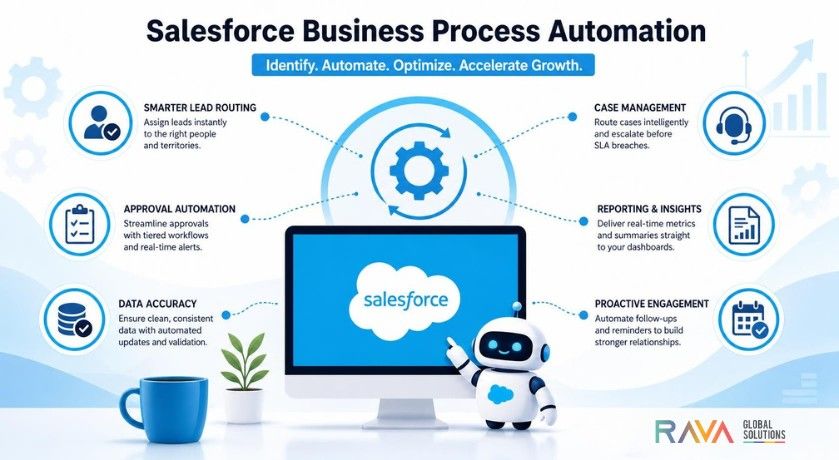
Inbound inquiries turn cold quickly when representatives leave assignments sitting in unassigned queues. Advanced rules immediately direct leads based on company size, geography, product line, and current representative capacity. Deploying reliable Salesforce lead routing removes internal bias, maintains clear ownership rules, and drives initial response times down to minutes.
Tiered Approval Pathways And Alert Triggers
Time-sensitive deals frequently stall while awaiting management sign-offs on custom pricing discounts or non-standard terms. Dynamic approval flows capture exact discount margins and automatically alert the appropriate manager through Slack or mobile push notifications. The platform automatically logs complete audit histories, keeping corporate governance intact without slowing sales cycles.
Case Management And Omnichannel Service Flow
Support agents lose focus when they manually re-tag incoming support tickets or scan emails for urgent keywords. Intelligent Flows parse ticket descriptions, classify customer issues, and route cases directly to qualified service specialists. Automated escalation rules prevent service-level agreement breaches by alerting supervisors well before deadlines elapse.
Record Normalization And Background Data Updates
Reps often forget to populate critical operational fields, like churn reasons or updated billing addresses. Automated record-triggered actions populate related fields instantly in the background without requiring user input. Standardizing address formats, parent-child account links, and currency values at the database level keeps your central pipeline clean and reliable.
Retention Check-Ins And Scheduled Leadership Summaries
Account managers easily miss client follow-ups when tracking customer renewals manually across multiple spreadsheets. Automated task triggers notify account owners ninety days before renewals expire, prompting proactive customer touchpoints. Automated reporting subscriptions also deliver weekly operational metrics straight to executive dashboards every Monday morning without manual compiling.
Four Signs A Process Should Remain Completely Manual
Not every operational routine belongs inside an automated Flow builder. Automating an unstable or ill-defined workflow merely accelerates confusion and frustrates teams. Keep an eye out for these four clear warning indicators:
- Fluid Decision Boundaries: Any procedure requiring subjective human intuition or situational context struggles under strict programmatic rules.
- Infrequent Strategic Work: Tasks that happen only a few times each quarter do not justify the development and validation costs.
- Volatile Business Requirements: If territory models, discount rules, or product packaging change every few weeks, wait until business parameters stabilize.
- High-Value White-Glove Deals: Non-standard enterprise negotiations benefit from human relationship management that software logic cannot replace.
Real-World Case Study: Transforming Clinic Intake Operations
A multi-site outpatient clinical network struggled with massive operational drag across its patient scheduling workflow. The medical organization received hundreds of specialty referrals and inquiries each week across five regional locations. Administrative coordinators used shared spreadsheets to review incoming records, verify insurance parameters, and manually book follow-up consultations.
This fragmented intake process caused serious administrative bottlenecks. Referral turnaround times averaged nearly 30 hours, leading to dropped consultations and strained relationships with referring physicians. In addition, manual transcription resulted in an 8.2% data entry error rate on critical patient charts. These entry mistakes delayed insurance pre-authorizations and forced medical staff to track down missing paperwork instead of caring for patients.
Leadership engaged RAVA Global Solutions to architect a scalable, robust intake solution. The technical team implemented tailored Salesforce automation to streamline patient onboarding from initial inquiry through appointment confirmation. Incoming referrals are now ingested via secure APIs, checked for complete insurance information, and assigned to the ideal clinic site based on specialty and schedule availability.
The operational results transformed clinical performance across all five facilities:
- Rapid Referral Outreach: Initial patient response times dropped from thirty hours down to under five minutes.
- Flawless Record Hygiene: Clerical input error rates fell from 8.2% to below 0.3%, protecting treatment timelines.
- Substantial Labor Savings: Front-desk teams saved 16 hours per clinic each week, allowing staff to focus entirely on on-site patient care.
- Seamless Scaling: The clinic group absorbed a 40% growth in referral volume over seven months without hiring extra administrative staff.
Step-By-Step Implementation Blueprint For Sustainable Automation
Deploying reliable operational workflows requires technical discipline, cross-functional collaboration, and clean system architecture. Follow this field-tested roadmap to keep deployments maintainable over the long term.
Document The Current Process Visually
Shadow front-line users to trace each handoff, manual entry, and approval hurdle on a visual workspace. In our enterprise implementations, we found that teams eliminate redundant approval loops simply by mapping the raw manual process openly.
Clean The Business Logic Before Building
Simplify your approval ladders and required inputs before writing a single rule. Never automate an unnecessary administrative step. Cutting superfluous validation loops reduces technical debt and accelerates project delivery.
Construct Maintainable, Modular Flows
Build small, reusable record-triggered sub-flows rather than one giant, monolithic process. In our enterprise implementations, we found that modular architecture isolates potential bugs, simplifies testing, and helps systems stay safely within platform governance limits.
Simulate Edge Cases In A Full Sandbox
Push incomplete data, bad lookups, and concurrent transactions through your sandbox environment to observe how the system responds. Verify that new automations do not trigger unexpected conflicts with existing Apex classes or validation rules.
Launch Incrementally With Targeted Training
Deploy the new system to a single regional pilot group first. Collect direct feedback from frontline operators, track error logs closely, and confirm system adoption before rolling the setup out across the wider organization.
Frequently Asked Questions
Which Salesforce Tasks Deliver The Fastest Return When Automated?
Lead assignment, approval escalations, case classification, and standard field updates generate immediate returns. These routine actions occur frequently and follow clear business rules, making them ideal targets for early automation. Streamlining these daily steps eliminates administrative burdens quickly without introducing high architectural risk.
How Does Automated Lead Routing Improve Revenue Outcomes?
Automated routing platforms inspect new prospects immediately against territory models, industry segments, and sales representative capacity. The software assigns the record instantly, sends notification alerts, and populates initial next steps. Eliminating hours of manual handoffs raises initial prospect contact rates and helps teams close more business.
When Should A Process Remain Completely Manual In Salesforce?
Keep tasks manual when they involve subjective discretion, occur infrequently, or depend on shifting corporate policies. Automating an unstable workflow creates constant development work and generates unnecessary edge cases. Keep unique exceptions in human hands until the underlying process stabilizes.
How Do Modern Salesforce Flows Protect Data Quality?
Automated Flows enforce strict formatting rules, validate inputs across related records, and complete required lookups automatically behind the scenes. Because the system manages standard field mapping directly, human typos and omitted data points rarely reach your production database.
Why Should Growing Companies Partner With Experienced Consultants For Automation?
Specialized consulting partners provide the technical experience to prevent platform-limit bottlenecks, sprawling technical debt, and messy architectures. Consultants help your business identify high-leverage operational opportunities, select appropriate platform tools, and build stable workflows that scale smoothly alongside enterprise growth.
Transforming Your Operating Model With Sustainable Automation
Lasting operational efficiency does not come from turning every manual task into a complex automated flow. It comes from knowing which processes generate measurable business value when digitized and which tasks belong in the capable hands of your team. By removing repetitive administrative burdens from daily routines, you give your professionals the space to build customer relationships and drive strategic growth.
Examine your existing daily operations with an objective eye this quarter. Identify the manual handoffs, data reconciliations, and slow approval chains that create friction across your pipeline. When you want to design and deploy durable, revenue-driving solutions, our team at RAVA Global Solutions is ready to support your operational journey. Discover how our seasoned Salesforce Consulting Services can elevate your enterprise operations today.