Quick Summary: Agentic AI vs Generative AI
Agentic AI systems execute complex multi-step workflows autonomously by planning, using enterprise tools, and adapting to real-time feedback without constant human prompting. While traditional generative AI focuses on synthesizing text, code, or images based on static prompts, autonomous agents actively make decisions, trigger API workflows, and pursue defined business outcomes.
Agentic AI systems execute complex multi-step workflows autonomously by planning, using enterprise tools, and adapting to real-time feedback without constant human prompting. While traditional generative AI focuses on synthesizing text, code, or images based on static prompts, autonomous agents actively make decisions, trigger API workflows, and pursue defined business outcomes.
Moving Beyond Words to Independent Action
Enterprise leaders face an unprecedented shift in workplace automation. For the past three years, corporate budgets flowed heavily into large language models designed to assist human workers. Modern teams now recognize that generating text summaries or draft emails only solves a small portion of daily operational friction.
A recent 2026 enterprise survey revealed that 74% of CIOs saw diminishing returns from simple chat interfaces. Business leaders need intelligent systems that execute end-to-end tasks rather than merely offering advice. This shift marks the rise of Agentic AI, moving organizations from passive content creation to active, event-driven task execution.
Understanding this technological evolution requires looking closely at how software architectures handle business context. Traditional generative tools sit quietly until a human user types a query into a box. Autonomous agents listen for live business events, analyze state changes, and continuously interact with software applications across your technology stack.
Comparing Enterprise Intelligence Models
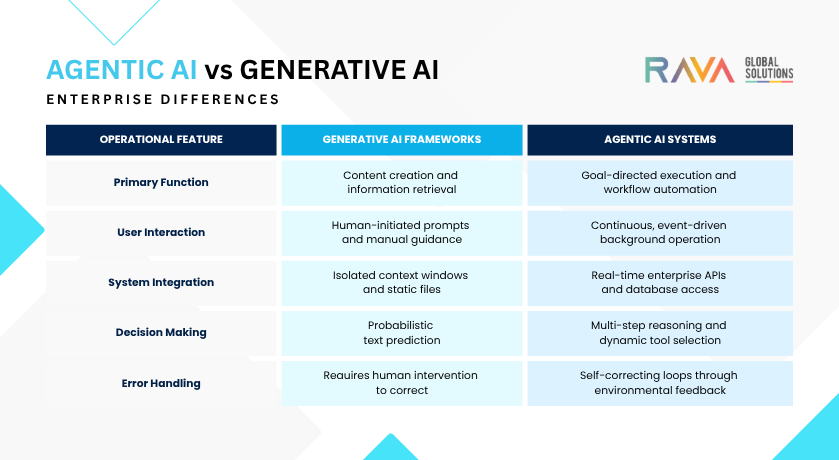
| Operational Feature | Generative AI Frameworks | Agentic AI Systems |
|---|---|---|
| Primary Function | Content creation and information retrieval | Goal-directed execution and workflow automation |
| User Interaction | Human-initiated prompts and manual guidance | Continuous, event-driven background operation |
| System Integration | Isolated context windows and static files | Real-time enterprise APIs and database access |
| Decision Making | Probabilistic text prediction | Multi-step reasoning and dynamic tool selection |
| Error Handling | Requires human intervention to correct | Self-correcting loops through environmental feedback |
Why Static Automation Fails Enterprise Scale
Standard business automation relies heavily on brittle, hardcoded rules that break when formats change slightly. Traditional generative tools attempt to fix this issue by reading unstructured documents, yet they remain stuck inside isolated application windows. When an unexpected system error occurs, a standard model reports the failure back to the user without attempting a fix.
Recent 2026 data shows that 68% of enterprise automation projects failed to scale due to rigid integration pipelines. Autonomous architectures overcome these hurdles by combining logical reasoning with direct execution capabilities. Instead of stopping at a high-level plan, an agent calls relevant system endpoints, verifies the outcome, and tries alternative paths if an initial step fails.
- Detect Event –> 2. Formulate Plan –> 3. Call API –> 4. Verify Result
Organizations building scalable digital operations rely on structured architecture to support these self-healing routines. To see how structured frameworks stabilize intelligent software, explore The Rise Of Autonomous Business Operations: Beyond Traditional Automation. Without a clear operating model, intelligent systems quickly create governance blind spots across corporate networks.
Real-World Scenarios Across the Enterprise
Financial Operations and Claims Processing
A global logistics company receives thousands of vendor invoices daily with missing purchase order numbers. Instead of flagging these invoices for manual human review, an enterprise agent opens the accounting ledger and cross-references historic shipping manifests. It then queries the vendor portal API, validates line items against receiving logs, updates the ERP system, and queues the approved payment.
Supply Chain Event Management
A regional distributor experiences a sudden port disruption that threatens key customer deliveries. The deployed agent monitors live shipping feeds, detects incoming delays, and calculates updated delivery estimates. It then queries warehouse inventory levels across neighboring distribution nodes, re-routes regional stock automatically, and notifies affected account managers with updated tracking schedules.
Port Disruption Detected
│
▼
Query Warehouse APIs
│
▼
Re-Route Regional Stock
│
▼
Notify Account Managers
Connecting these intelligent agents across legacy software requires modern integration platforms and structured data pipes. Companies looking to modernize their underlying platform architecture often leverage specialized AI Automation Services to streamline data flows between enterprise systems.
Deploying Autonomous Systems Step-by-Step
Phase 1: Domain Selection –> Phase 2: API Integration –> Phase 3: Guardrails
1.Select High-Impact Business Domains
Begin by targeting operations containing clear success metrics and structured system logs. Look for processes where staff spend hours transferring data between enterprise systems. High-volume customer support routing and vendor onboarding represent ideal starting grounds for initial deployment.
2.Prepare Integration Infrastructure
Secure API endpoints and robust identity access systems must exist before deploying intelligent agents. Agents require granular access tokens to read database records and write transactions back to core systems. Establishing strict access controls ensures software agents operate only within approved system boundaries.
3.Implement Guardrails and Human Oversight
Establish explicit authorization thresholds for transactions exceeding specific financial or operational limits. In our enterprise implementations, we found that placing human approval steps on high-stakes actions builds organizational trust while capturing valuable training data.
4.Monitor Behavior and Continuous Learning
Track execution success rates and system logs through centralized management dashboards. Monitor how well agents handle system exceptions and update procedural rules when edge cases emerge. Over time, these insights help refine operational guardrails and expand system autonomy safely.
Deploying complex technology without aligning business incentives frequently leads to budget waste and abandoned initiatives. Enterprise leaders should review Why AI Projects Fail Without a Business Operating Model to avoid common governance pitfalls. Proper structural planning ensures long-term operational success across every department.
Frequently Asked Questions
What is the main difference between Agentic AI and Generative AI?
Generative tools focus on creating content like text, code, or images based on explicit user prompts. Agentic AI systems independently plan, select tools, call APIs, and execute complex workflows to achieve specific enterprise goals without step-by-step human intervention.
How do autonomous agents interact with existing enterprise software?
Autonomous agents connect to existing software environments using standard APIs, database connectors, and enterprise messaging queues. They read system outputs, process business logic, and trigger downstream system actions just like a human operator using software interfaces.
Are autonomous software agents safe for regulated industries?
Yes, when built with strict governance guardrails, role-based access controls, and comprehensive audit logging. Organizations can enforce rule-based limits that require human authorization before an agent executes high-value financial transfers or modifies sensitive records.
Can generative systems be upgraded into agentic architectures?
Yes, generative language models often serve as the core reasoning engine within an agentic framework. By surrounding a model with memory modules, planning capabilities, and API tool integrations, developers transform a simple text generator into an active workflow agent.
How does agentic architecture handle operational errors?
Unlike static software scripts, autonomous agents use feedback loops to evaluate their own output. If an API call fails or yields unexpected data, the agent analyzes the failure message, adjusts its strategy, and attempts a secondary solution automatically.
Building a Resilient Digital Foundation
Navigating the transition from passive text generation to active enterprise orchestration requires a thoughtful approach. Technology leaders must balance the excitement of rapid automation with the discipline of robust system governance. Success relies on clear process mapping, clean API access, and continuous platform monitoring.
RAVA Global Solutions helps forward-thinking organizations architect sustainable, secure, and highly effective automation foundations. Partner with our engineering experts to turn complex operational friction into a streamlined competitive advantage for your global enterprise.