Quick Summary: Why Are Enterprises Replacing Standalone LLMs With RAG?
Standalone large language models rely entirely on static training data, leading to factual hallucinations, knowledge cutoffs, and data leaks. Retrieval-Augmented Generation connects models directly to live company databases via vector search. This architecture delivers verified, auditable answers in real time, cutting enterprise operational hallucination rates by over 80 percent.
Standalone large language models rely entirely on static training data, leading to factual hallucinations, knowledge cutoffs, and data leaks. Retrieval-Augmented Generation connects models directly to live company databases via vector search. This architecture delivers verified, auditable answers in real time, cutting enterprise operational hallucination rates by over 80 percent.
The Breaking Point Of The Standalone Model
Every chief technology officer knows the quiet sting of a live software demonstration gone wrong. A private chatbot confidently quotes an expired pricing sheet to a valued client. Then it invents a company policy that never existed. In that single moment, months of internal excitement give way to sudden executive hesitation.
These awkward errors are not simple bugs in the system. They occur because foundational language models rely on statistical guesswork rather than verified memory. They predict the next likely word instead of checking company facts. When companies demand zero tolerance for mistakes, modern AI Automation Services step in to provide verifiable corporate knowledge.
Recent industry studies from early 2026 show that 64 percent of standalone enterprise bot pilots fail to scale beyond initial deployment. Leaders often pause rollouts because of persistent hallucinations and private data risks. While company data changes daily, public foundation models quickly become outdated. Deploying them across disorganized company drives without guardrails can create serious compliance risks.
Understanding The Core Enterprise Knowledge Bottleneck
Foundational models excel at writing prose, summarizing reports, and rewriting computer code. Yet they fail completely when a user asks for yesterday’s regional sales numbers. Fine-tuning models directly seemed like a smart fix two years ago. However, retraining large models weekly demands massive budgets and creates stubborn engineering delays.
Trained weights simply cannot keep pace with fast internal knowledge cycles. When your engineering crew alters an operational manual, the core model remains blind to the change. Rerunning training loops burns cash and risks catastrophic forgetting across previously solid topics. Modern businesses need real-time answers without paying for constant foundational retraining.
Retrieval-Augmented Generation solves this gap by splitting knowledge storage from language generation. The architecture leaves your core documents inside secure company cloud repositories. It retrieves exact passages only when an authorized employee asks a direct question. This straightforward separation keeps proprietary data safe while delivering precise, contextual answers instantly.
The Strategic Shift: Standalone LLM Versus Enterprise RAG
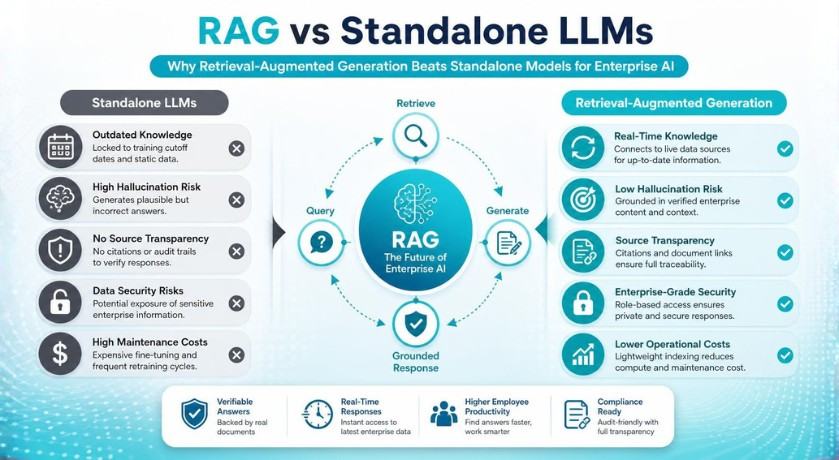
Business leaders need transparent comparisons before swapping out core enterprise infrastructure. The table below outlines how retrieval pipelines systematically fix the core weaknesses of ungrounded foundation models.
| Strategic Capability | Standalone Language Model | Retrieval-Augmented Generation | Enterprise Business Impact |
|---|---|---|---|
| Knowledge Currency | Frozen at public training cutoff date | Real-time synchronization with active drives | Eliminates outdated advice and pricing mistakes |
| Information Provenance | Zero audit trails or source citations | Direct document links and chunk citations | Enables compliance audits and fast fact-checking |
| Hallucination Risk | High frequency on niche internal data | Extremely low due to grounded context retrieval | Protects corporate reputation and operational safety |
| Data Access Security | Universal access to embedded information | Strict role-based permissions applied pre-query | Prevents internal data leakage across departments |
| Maintenance Cost | Costly periodic fine-tuning cycles | Lightweight vector indexing on existing storage | Cuts ongoing compute spend by up to 70 percent |
Core Architectural Pillars Of Grounded Intelligence
Building a dependable retrieval engine requires much more than dumping documents into an open database. Successful systems follow a clear pipeline that turns messy corporate records into searchable semantic points.
- Semantic Chunking Engines: Smart parsers break complex documents into logical text blocks rather than arbitrary paragraph splits. This process preserves tables, lists, and context so that the search engine can find meaningful facts.
- Vector Search Databases: High-performance indexers convert text into mathematical coordinates based on semantic meaning. When workers ask questions in plain language, the system matches conceptual intent rather than simple keywords.
- Role-Based Security Layers: Access filters verify worker credentials before sending context to the language model. Human resources files stay completely invisible to staff members without explicit administrative permissions.
- Source Attribution Modules: The generation engine appends exact file names, page numbers, and dates to every output. Team members can verify generated claims with a single click.
Transitioning Toward An AI-Ready Enterprise
Moving away from isolated experiments demands a clear company roadmap. Many organizations rush into generative technology without organizing their underlying files, which leads to immediate frustration.
Building an AI-ready enterprise requires clean data pipelines, well-defined user governance, and stable infrastructure. Your teams must audit internal knowledge silos before picking vector tools or search algorithms. Clear permissions ensure that confidential leadership memos never surface in general staff queries.
Once companies clean their data, team confidence grows rapidly. Knowledge workers stop wasting hours searching through broken intranet directories for basic answers. Instead, they interact with a single conversational interface that quotes approved documentation every time. True productivity gains happen when workers trust the facts appearing on their screens.
Why Modern CRM Systems Require Grounded Pipelines
Customer relationship platforms store your most valuable client conversations, deal stages, and transaction histories. Yet standard conversational add-ons often fail because they lack immediate operational context.
A modern enterprise AI architecture connects client profiles directly to billing systems, technical logs, and service contracts. When an account executive asks about renewing a contract, the system first reads every relevant ticket. The rep receives an accurate status summary along with actionable suggestions for the call.
Grounded retrieval turns static customer records into proactive business intelligence. Operations leaders spot customer churn risks weeks before accounts run dry. Frontline service agents resolve difficult technical tickets in minutes instead of days. Grounded accuracy transforms standard customer software into a responsive growth engine.
Real-World Scenarios: How Grounded Systems Transform Daily Operations
Resolving Complex Industrial Equipment Failures
A field technician stands inside a noisy production plant trying to repair a high-voltage assembly. The standard operating manual spans twelve hundred pages of technical schematics and safety warnings. Asking a basic foundation model yields generic electrical advice that ignores the plant’s specific machinery.
With an engineered retrieval system, the technician speaks the error code into a mobile tablet. The system scans verified engineering documents, finds the exact circuit diagram, and checks yesterday’s maintenance notes. It produces a clear three-step repair sequence with safety citations attached. The technician completes the repair safely in twenty minutes, saving the factory thousands in downtime.
Streamlining Commercial Insurance Underwriting
An insurance underwriter evaluates a property portfolio that involves 40 different municipal building codes. Manually checking historical flood maps, loss runs, and property appraisals takes three full business days. Using public models introduces significant regulatory compliance risks regarding private customers’ financial data.
A private retrieval framework scans the applicant’s property filings against approved regional risk guidelines. The model generates a comprehensive risk profile backed by exact page references from municipal registries. The underwriter reviews the flagged concerns, validates the citations, and issues an accurate policy decision that same morning. Operational efficiency jumps without taking on hidden regulatory risk.
Building A Resilient Retrieval Pipeline
Moving from basic prompts to dependable company systems requires steady execution. Teams achieve consistent results by following four disciplined implementation stages.
- Consolidate Knowledge Silos: Gather internal documentation from scattered cloud drives, service desks, and knowledge portals. Eliminate outdated product sheets and duplicate policy guides before running indexing pipelines.
- Configure Vector Indexes: Translate sanitized documents into semantic embeddings using high-efficiency indexing models. Test semantic retrieval recall thoroughly against messy real-world employee search queries.
- Establish Identity Guardrails: Map corporate user permissions directly to the retrieval query router. Ensure that queries filter out restricted documents before the language model reads the context.
- Implement Hallucination Checks: Route all generated outputs through automated validation checks that confirm citations. If the retrieved context lacks an explicit answer, configure the system to state that the information is missing.
Strengthening Your Strategy With Modern AI Automation Services
Adopting enterprise artificial intelligence does not mean handing over control to unpredictable models. Real operational success comes from building systems that remain dependable, auditable, and firmly rooted in your data. Forward-thinking companies are replacing ungrounded tools with structured retrieval networks that turn messy documents into competitive advantages.
Our team at RAVA Global Solutions builds enterprise architectures that solve real operational friction. We help your business move beyond trial projects into reliable production systems that respect your data governance. Explore our tailored AI Automation Services today and build a dependable knowledge foundation that drives confident decisions across your entire enterprise.
Frequently Asked Questions
What Is The Difference Between Fine-Tuning And Retrieval-Augmented Generation?
Fine-tuning updates the internal weights of a language model through additional training cycles. This process teaches the system a specific tone, dialect, or technical vocabulary. However, fine-tuning struggles with dynamic facts, requires costly computing power, and cannot easily cite its sources.
Retrieval-Augmented Generation leaves the base model intact and supplies fresh reference material during the query. The system fetches relevant passages from external drives and inserts them into the user prompt. This design provides immediate access to updated company data, prevents hallucinations, and delivers exact source citations at a fraction of the cost.
How Does A Grounded System Prevent Corporate Data Leaks?
A grounded pipeline protects sensitive information by applying access security checks before the model processes text. When a staff member asks a question, the vector database checks their user credentials against corporate permission rules.
Documents the employee cannot view are filtered out before search results generate. The language model never reads, processes, or summarizes restricted information for unauthorized users. This security design keeps confidential legal agreements and payroll records completely private across department boundaries.
Why Do Standalone Language Models Hallucinate Facts?
Standalone language models do not look up information in a verified database while writing. Instead, they rely on complex probability distributions to predict which word should follow the previous one.
When a model encounters gaps in its training data, it generates sentences that sound plausible but lack factual truth. These statistical guesses often produce incorrect dates, fake case studies, and erroneous technical steps. Grounded systems stop this behavior by forcing the model to compose answers using only verified reference text.
Can Retrieval Systems Work With Messy Enterprise Data Formats?
Yes, modern retrieval pipelines parse diverse unstructured formats including PDF reports, spreadsheets, presentations, and email threads. Specialized parsing tools extract text while preserving tables, hierarchical headers, and embedded metadata.
Once converted into clean text chunks, the information moves into vector databases for fast semantic search. Even legacy intranets and siloed customer software become instantly searchable when connected through a disciplined data preparation pipeline.
How Fast Can An Organization Deploy An Enterprise Retrieval Pipeline?
A focused enterprise retrieval pilot typically takes four to eight weeks from kickoff to production testing. Initial weeks focus on selecting knowledge domains, cleaning source documentation, and configuring secure user access levels.
The remaining time covers vector indexing, testing response accuracy, and integrating the conversational interface with daily workflows. Partnering with experienced system architects helps companies bypass common operational roadblocks and achieve steady returns on investment much faster.