Executive Summary
As businesses connect more applications, cloud services, APIs, data platforms, and AI systems, choosing the right integration approach has become a strategic technology decision.
MuleSoft and iPaaS platforms can both help organizations connect systems and automate data flows, but they are not necessarily interchangeable. The right choice depends on an organization’s integration complexity, API requirements, governance model, scalability needs, technical capabilities, and long-term architecture strategy.
For smaller or straightforward integration requirements, a conventional iPaaS platform may provide the simplicity and speed needed. For organizations managing complex ecosystems, reusable APIs, multiple integration patterns, and enterprise-wide governance, MuleSoft may provide a broader integration architecture.
The important question isn’t “Is MuleSoft better than iPaaS?”
It is:
“Which integration strategy best fits our business and technology environment?”
MuleSoft vs iPaaS: Understanding the Difference
Before comparing the two, it is important to clarify the terminology.
iPaaS, or Integration Platform as a Service, is a cloud-based approach for connecting applications, systems, data sources, and services. iPaaS platforms generally provide prebuilt connectors, visual development tools, workflow automation, monitoring, and other capabilities designed to simplify integration.
MuleSoft is an integration platform that can support application, API, and data integration across enterprise environments. Its Anypoint Platform approach extends beyond point-to-point connections by providing capabilities for API design, management, integration development, deployment, and governance.
This distinction matters because organizations should evaluate integration platforms based on the problems they need to solve, rather than simply comparing product feature lists.
Why Integration Strategy Matters in 2026
Enterprise technology environments are becoming increasingly distributed.
A typical organization may have:
- SaaS applications
- CRM platforms
- ERP systems
- Legacy applications
- Cloud infrastructure
- Data warehouses and data lakes
- Partner systems
- Mobile applications
- APIs
- AI applications and agents
Connecting these systems individually can quickly create a complicated web of dependencies.
This is where integration architecture becomes important.
A well-designed strategy can help organizations:
- Reduce data silos
- Reuse integration assets
- Improve system connectivity
- Automate business processes
- Establish API governance
- Improve visibility across integrations
- Support future applications and technologies
The goal should not simply be connecting more systems. The goal is creating an integration foundation that can evolve as the business changes.
For organizations looking at this from a broader modernization perspective, our guide to enterprise integration modernization explores how integration can fit into a larger technology transformation strategy.
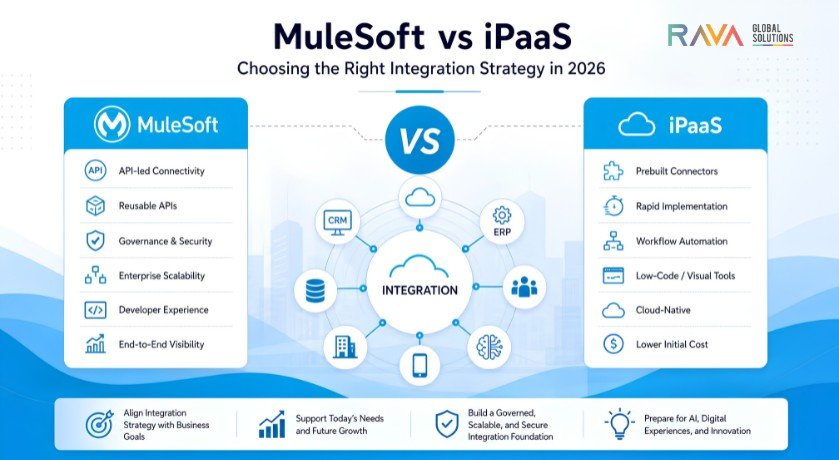
MuleSoft vs iPaaS: Key Differences
The most useful comparison is not simply based on features. Organizations should consider how each approach fits their operational and architectural requirements.
| Factor | Conventional iPaaS Approach | MuleSoft |
|---|---|---|
| Primary focus | Application and workflow integration | Enterprise integration and API-led connectivity |
| Ease of initial setup | Often designed for rapid implementation | Can require greater architectural planning |
| Prebuilt connectors | Typically a major strength | Supports connectors and integration capabilities |
| API management | Depends on platform | Strong emphasis on API lifecycle and management |
| Complex integrations | Suitable depending on platform and use case | Designed to support complex enterprise integration scenarios |
| Reusable APIs | Varies by platform | Strong architectural emphasis |
| Governance | Capabilities vary by provider | Enterprise governance capabilities |
| Scalability | Depends on platform architecture | Designed for enterprise-scale integration |
| Developer experience | Often varies from low-code to developer-oriented | Supports professional developers and broader integration development |
| Best fit | Straightforward integrations and automation | Complex, API-centric, governed enterprise ecosystems |
The important takeaway is that “iPaaS” describes a category, not one specific product.
Different iPaaS platforms offer different capabilities, architectures, levels of customization, and governance models.
Therefore, the comparison should be between MuleSoft and the specific iPaaS platform being considered, rather than treating every iPaaS solution as identical.
1. Integration Complexity
One of the first questions organizations should ask is:
How complicated are our integration requirements today—and how complicated are they likely to become?
A business connecting a few SaaS applications may not need a highly sophisticated integration architecture.
For example:
CRM → Marketing Platform → Email System
A straightforward iPaaS implementation may be sufficient.
But consider an enterprise environment involving:
CRM → ERP → Data Platform → APIs → Partner Systems → Legacy Applications → Customer Applications
The architectural requirements become significantly different.
Multiple systems, data models, APIs, security requirements, and dependencies need to be managed consistently.
This is where an enterprise integration platform such as MuleSoft may become more relevant.
2.API Management and Reusability
Integration shouldn’t always mean creating a new connection every time another application needs data.
A more scalable approach is to create reusable APIs and integration assets.
For example, instead of building separate connections between multiple applications and a customer database, an organization could expose governed customer capabilities through reusable APIs.
This can help reduce duplication and make integrations easier to manage over time.
MuleSoft’s API-led approach is particularly relevant for organizations that want APIs to become reusable building blocks across their technology ecosystem.
This becomes increasingly important as organizations build mobile applications, digital experiences, partner ecosystems, and AI-powered applications.
3.Governance and Security
Integration creates another important responsibility:
Who controls how systems communicate?
As the number of integrations grows, organizations need to consider:
- Authentication
- Authorization
- API policies
- Access control
- Data protection
- Monitoring
- Versioning
- Lifecycle management
- Compliance
- Ownership
A platform may make it easy to create an integration, but that does not automatically mean the resulting architecture will remain manageable at scale.
For organizations operating in regulated or complex environments, governance needs to be designed into the integration strategy rather than added later.
MuleSoft can be particularly relevant when organizations need a structured approach to API management, governance, and lifecycle management.
4.Scalability
An integration that works for five applications may not work the same way when an organization has hundreds.
As integration environments grow, organizations can encounter:
- More APIs
- More data flows
- More users
- More applications
- More partners
- More dependencies
- More monitoring requirements
The challenge therefore changes from:
“Can we connect these systems?”
to:
“Can we manage and scale these connections without creating integration sprawl?”
This is one of the most important distinctions to consider when evaluating MuleSoft against a simpler iPaaS approach.
5.Developer Experience
Not every organization has the same technical resources.
Some businesses prioritize visual development and low-code capabilities because they want business or integration teams to move quickly.
Others have dedicated development and architecture teams that require deeper control over integration logic, APIs, deployment, testing, and architecture.
The right platform therefore depends partly on who will build and maintain the integrations.
Before choosing a platform, organizations should ask:
- Who will develop integrations?
- Who will maintain them?
- How much customization is required?
- Do we have experienced integration developers?
- How much should be handled through visual tools?
- What level of control do our developers need?
The simplest development experience isn’t necessarily the best choice for every enterprise.
6.Total Cost of Ownership
Cost should also be evaluated beyond the initial subscription.
Organizations should consider:
- Platform licensing
- Implementation
- Development effort
- Maintenance
- Monitoring
- Training
- Governance
- Infrastructure
- Support
- Future integrations
A platform that appears less expensive initially may become more costly if integrations become difficult to maintain or need to be rebuilt as requirements grow.
Likewise, a more sophisticated platform may not make financial sense for an organization with only a handful of straightforward integrations.
The objective should be to evaluate total cost against business and architectural value.
When Should You Consider an iPaaS Approach?
A conventional iPaaS approach may be appropriate when an organization has relatively straightforward integration requirements.
It can make sense when:
- Integrations are relatively simple
- Prebuilt connectors meet most requirements
- Rapid implementation is important
- The number of systems is manageable
- Advanced API architecture is not a major requirement
- Integration governance requirements are relatively limited
- The organization wants a simpler development experience
For these situations, choosing a simpler platform can be a practical decision.
When Should You Consider MuleSoft?
MuleSoft becomes more compelling when integration is viewed as an enterprise architecture capability, rather than simply an automation tool.
Organizations may want to evaluate MuleSoft when they need:
- Complex application integrations
- API-led architecture
- Reusable integration assets
- Enterprise API management
- Strong governance
- Integration across cloud and legacy environments
- Multiple integration patterns
- Greater architectural control
- Scalable enterprise integration
- A foundation for connecting future digital and AI applications
If your organization is evaluating these requirements, you can explore our MuleSoft Integration Services to understand how an enterprise integration approach can support complex connectivity and modernization initiatives.
The decision should still be based on actual requirements rather than assuming that greater platform sophistication automatically creates greater value.
MuleSoft vs iPaaS: A Practical Decision Framework
Instead of asking which technology is “best,” organizations can score their requirements across several dimensions.
Choose a simpler iPaaS approach when:
Integration complexity: Low to moderate
Number of systems: Limited
API strategy: Basic
Governance: Moderate
Development: Rapid/low-code preferred
Customization: Limited
Architecture: Relatively straightforward
Consider MuleSoft when:
Integration complexity: Moderate to high
Number of systems: Large or growing
API strategy: Strategic
Governance: High
Development: Professional development and architecture required
Customization: Significant
Architecture: Enterprise-wide and distributed
This isn’t a rigid rule.
The best decision depends on the organization’s specific technology landscape, business objectives, team capabilities, and expected growth.
Questions to Ask Before Choosing an Integration Platform
Before making a decision, technology leaders should ask:
- How many systems do we need to connect?
Consider both current and expected future applications.
- How complex are our integrations?
Simple data transfers require a different approach from multi-system business processes.
- Do APIs play a strategic role in our architecture?
If APIs are becoming reusable business assets, API lifecycle management becomes increasingly important.
- How important is governance?
Highly regulated organizations may require stronger control over security, access, policies, and lifecycle management.
- Who will maintain the integrations?
Consider the skills and capacity of your internal teams.
- How quickly will our integration environment grow?
Today’s requirements shouldn’t be the only consideration.
- Are we preparing for AI?
AI applications and agents increasingly require access to trusted enterprise data and business systems. Your integration architecture may therefore become part of your AI strategy.
Integration Strategy Is Bigger Than the Platform
Choosing an integration platform is only one part of the equation.
Organizations also need an architecture and operating model for managing integration.
That includes:
- API governance
- Integration standards
- Security policies
- Data ownership
- Monitoring
- Documentation
- Lifecycle management
- Reusability
- Change management
Without these practices, even a powerful integration platform can become difficult to manage.
This is why modernization should be approached strategically rather than simply replacing one integration tool with another.
Our article on integration as a competitive advantage looks at the broader business value of connecting systems effectively—not just the technical side of integration.
MuleSoft, iPaaS, and the Future of Enterprise Integration
Integration requirements are also changing because of AI.
AI applications and agents increasingly need access to business systems, APIs, operational data, and real-time information.
That means integration is no longer only about moving data between applications.
It can become the layer that allows intelligent applications to interact with the systems that run the business.
This makes questions around API governance, data access, security, reusable services, and integration architecture even more important.
Organizations should therefore choose an integration strategy that supports not only today’s applications but also the architecture they expect to build next.
The Bottom Line
There is no universal winner in the MuleSoft vs iPaaS debate.
A simpler iPaaS platform may be the right choice for organizations with straightforward integration requirements, limited complexity, and a strong preference for rapid implementation.
MuleSoft may be a better fit for organizations that need a more comprehensive approach to enterprise integration, APIs, governance, scalability, and reusable connectivity.
The right question is not:
“Which platform has more features?”
It is:
“Which platform can support our integration requirements today while giving us the architecture, governance, and flexibility we need tomorrow?”
Integration should support business growth—not become another source of complexity.
At RAVA Global Solutions, we help organizations evaluate integration requirements in the context of their broader technology architecture, business processes, and modernization goals. The objective is to choose an approach that creates sustainable connectivity rather than simply adding another integration tool.
Frequently Asked Questions
Is MuleSoft an iPaaS?
MuleSoft is an integration platform with capabilities that overlap with what is commonly expected from iPaaS solutions. However, its broader capabilities around APIs, integration architecture, governance, and enterprise connectivity make it important to evaluate it based on its specific platform capabilities rather than treating it as interchangeable with every iPaaS product.
Is MuleSoft better than an iPaaS platform?
Not necessarily. The right choice depends on integration complexity, API requirements, governance, scalability, technical resources, cost, and business objectives.
When should a business choose an iPaaS?
An iPaaS can be appropriate when an organization needs to connect a manageable number of applications, wants faster implementation, and does not require extensive customization or sophisticated enterprise API architecture.
What is the main advantage of MuleSoft?
One of its key strengths is its ability to support an enterprise-wide integration and API strategy, including reusable APIs, integration development, API management, governance, and connectivity across diverse systems.
Does MuleSoft support legacy system integration?
MuleSoft can be used to connect modern cloud applications with legacy and on-premises systems. This can be particularly relevant for organizations modernizing gradually rather than replacing their entire technology environment at once.
How should companies evaluate MuleSoft vs iPaaS?
Start with business and technical requirements. Assess integration complexity, application landscape, API strategy, governance, security, scalability, development skills, implementation effort, and total cost of ownership before selecting a platform.