Quick Summary: How Does MuleSoft Manage The Complete API Lifecycle?
Direct Answer: End-to-end API lifecycle management uses MuleSoft to guide interfaces from design to retirement. It pairs the Anypoint Platform with API-led connectivity to plan, build, test, deploy, secure, and monitor integration assets. This approach guarantees standardized governance, continuous telemetry, and clean deprecation across all enterprise microservices and legacy core systems.
Direct Answer: End-to-end API lifecycle management uses MuleSoft to guide interfaces from design to retirement. It pairs the Anypoint Platform with API-led connectivity to plan, build, test, deploy, secure, and monitor integration assets. This approach guarantees standardized governance, continuous telemetry, and clean deprecation across all enterprise microservices and legacy core systems.
The Enterprise Integration Dilemma: Solving Runaway Digital Sprawl
Enterprise IT leaders face a quiet crisis across distributed architectures. Organizations add hundreds of cloud endpoints and custom connectors each year. However, unmanaged services quickly become technical debt and create serious vulnerabilities. Professional MuleSoft Integration Services help teams regain complete control of these digital assets. They replace chaotic point-to-point connections with structured, reusable services.
Industry research reveals that over 71% of enterprise data breaches now trace back to unmonitored shadow APIs and unpatched legacy endpoints. Without clear lifecycle governance, development cycles slow down, and security blind spots multiply. Modern digital businesses cannot afford undocumented endpoints running silently across production environments. A unified operational strategy solves this problem before costs spiral out of control.
Strategic lifecycle management turns software integration into an efficient, predictable assembly line. By treating APIs as digital products rather than quick coding fixes, engineering teams reduce rework. Clear visibility keeps stakeholders aligned from the initial scoping meeting through final service deprecation. Let us explore how this operational framework works across each stage.
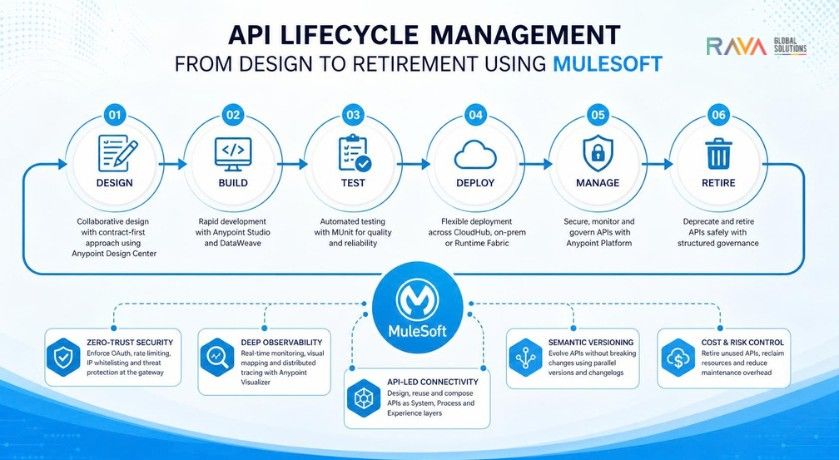
1. Collaborative Design And Contract-First Planning
Great APIs begin with intentional business planning. Architects identify key data requirements and downstream user journeys before writing any code. This contract-first discipline prevents costly mid-project revisions and keeps distributed teams focused on business outcomes.
MuleSoft supports this initial phase through the Anypoint Design Center. Architects author machine-readable specifications using standardized RAML or OAS formats. The platform enables instant mock service generation so that front-end developers can simulate data exchanges immediately. Early stakeholder feedback validates request structures, payload shapes, and authorization parameters before engineering begins.
2. Rapid Implementation And Accelerated Development
Moving from design contracts to working software requires robust connectivity tooling. Engineering teams must bridge modern SaaS applications with decades-old mainframe databases. Hand-coded connectors often become brittle maintenance burdens over time.
Anypoint Studio speeds up construction using pre-built connectors and visual mapping canvases. Developers transform intricate data schemas effortlessly using the powerful DataWeave language. The platform binds the original API specification directly to the underlying flow logic. This tight coupling ensures that developers build services that adhere strictly to published contracts without operational drift.
3. Automated Testing And Continuous Validation
Software reliability depends on comprehensive quality testing under realistic operational loads. Manual endpoint inspection misses edge-case bugs and delays releases. Modern delivery pipelines demand automated verification at every level of the stack.
Teams utilize the MUnit framework to write fully automated unit and functional test suites. These tests run directly inside automated CI/CD pipelines to catch breaking schema changes before release. Mocking processors simulate external database timeouts and third-party partner service drops. Thorough automated testing ensures that only high-quality services reach production hosting environments.
4. Agile Deployment And Hybrid Gateway Runtime
Modern enterprise workloads live across multi-cloud environments, private data centers, and managed platforms. Infrastructure teams require flexible hosting models that adapt to changing data residency regulations. Rigid deployment frameworks restrict operational agility and inflate hosting bills.
MuleSoft provides versatile runtime flexibility through CloudHub, on-premises customer runtimes, and Anypoint Runtime Fabric. Platform operators deploy microservices into containerized Kubernetes clusters with automated elasticity. Zero-downtime updates allow teams to push performance patches during business hours without interrupting client transactions. This flexibility guarantees high availability across geographically dispersed enterprise footprints.
Traditional Endpoints Versus Governed API Lifecycle Systems
Adopting a structured lifecycle strategy transforms organizational development performance:
| Operational Metric | Legacy Point-to-Point Interfaces | Governed MuleSoft Lifecycle Strategy |
|---|---|---|
| Development Velocity | Redundant coding across siloed development teams | Reusable assets discoverable via Anypoint Exchange |
| Security Posture | Fragmented access controls and unmonitored gateways | Centralized zero-trust policies and automated token checks |
| Runtime Observability | Disconnected, manual server logging workflows | Real-time telemetry, trace analysis, and visual mapping |
| Change Management | High risk of unintended downstream system outages | Semantic versioning with automated client transition paths |
| Asset Retirement | Abandoned zombie endpoints exposing sensitive core data | Structured deprecation schedules and automated decommissioning |
5. Zero-Trust Security And Edge Governance
Unsecured interfaces represent the most accessible doorway for corporate cyber threats. Leaving authorization logic up to individual software developers invites dangerous configuration gaps. Security policies must apply consistently across every public and internal endpoint.
Anypoint API Manager enforces perimeter security through pre-built policies applied in real time. Administrators apply OAuth 2.0 verification, IP whitelisting, and dynamic rate limiting without editing underlying application code. These capabilities protect core databases from traffic spikes and denial-of-service attempts. Addressing runaway API sprawl and security protects critical corporate resources from malicious external breaches.
6. Deep Operational Monitoring And Proactive Analytics
Operating mission-critical systems requires constant visibility into data throughput and transaction health. Silent service bottlenecks hurt end-user satisfaction and damage customer trust. IT operations specialists need proactive alerts before minor hiccups become major outages.
Anypoint Visualizer and Anypoint Monitoring automatically map live application dependencies. Telemetry dashboards track request response times, error distributions, and JVM thread utilization. Distributed network tracing pinpoints failing backend database connections in seconds. Operational teams resolve emerging performance issues long before business operations feel any disruption.
7. Semantic Versioning And Non-Breaking Evolution
Business models evolve quickly, requiring software interfaces to accommodate new data structures. However, altering production message payloads can break connected client mobile apps and partner portals. Enterprises must upgrade service capabilities without leaving active business consumers stranded.
Engineers implement strict semantic versioning rules to distinguish minor improvements from major breaking revisions. MuleSoft API Community Manager and Exchange distribute interactive changelogs and updated sandbox endpoints directly to consumer networks. By publishing parallel versions concurrently, companies give client developers ample runway to migrate to updated interfaces. This transparency keeps enterprise partnerships smooth and friction-free.
8. Strategic Retirement And Safe Endpoint Sunset
Retiring an outdated interface requires equal planning as launching a new product. Zombie endpoints that run forgotten in staging or legacy clouds remain frequent vectors for system intrusion. Failing to shut down obsolete endpoints drains budget through unnecessary compute consumption.
Platform teams mark endpoints as deprecated in Anypoint Exchange and notify consuming developers directly. Usage metrics track remaining client applications to guarantee all production systems transition safely. Once client traffic drops to zero, administrators revoke access certificates and safely turn off underlying runtime resources. Clean retirement keeps your overall integration modernization strategy lean, safe, and cost-effective.
Implementation Sequence: Five Steps To Master Lifecycle Execution
Rolling out an enterprise-wide integration initiative demands structured governance. Follow this practical deployment roadmap to ensure sustainable operational success:
Establish A Center For Enablement (C4E):
Practitioner Insight: Shift your IT focus from delivering projects to building reusable integration assets. Form a dedicated cross-functional team that curates design templates, sets security standards, and assists internal teams with adoption.
Standardize Core Data Taxonomies:
Practitioner Insight: Define shared data types and corporate taxonomy schemas in RAML before starting development. Consistent customer, invoice, and product objects prevent redundant translation work across downstream departmental applications.
Enforce Policy Templates Automatically:
Practitioner Insight: Mandate automated security policies across all internal development environments. Require mutual TLS, JSON threat protection, and automated client validation before promoting code through continuous delivery pipelines.
Automate Continuous Health Checks:
Practitioner Insight: Create dedicated synthetic probes within Anypoint Monitoring to validate endpoint health around the clock. Synthetic requests verify end-to-end database connectivity and continuously simulate user transactions.
Formalize Decommissioning Runbooks:
Practitioner Insight: Define clear deprecation timelines in partner SLAs. We advise setting a mandatory ninety-day sunset period that alerts connected teams before unbinding gateways and reclaiming host infrastructure.
Real-World Case Study: Transforming Healthcare Data Interoperability
A regional healthcare provider struggled with severe operational delays across its patient records network. Their clinical databases, appointment schedulers, and medical billing portals relied on legacy custom scripts. Whenever insurance clearinghouses changed their data formats, administrative staff faced days of system downtime.
The provider partnered with RAVA Global Solutions to build a governed API-led integration network. Our specialists mapped clinical workflows into reusable System, Process, and Experience APIs inside Anypoint Platform. By publishing FHIR-compliant design contracts early, the internal development teams completed the data migration months ahead of schedule.
The results changed their day-to-day operations. Patient data lookup speeds improved by 65%, and integration maintenance costs dropped by 42%. Automated gateway policies secured patient health records under strict HIPAA standards. The organization replaced brittle point-to-point connections with an agile, future-ready integration platform.
Frequently Asked Questions
What is the primary difference between API management and full lifecycle management?
API management typically focuses on runtime controls like security policies, rate limiting, and consumer analytics. In contrast, full API lifecycle management oversees an interface across its complete operational existence. This process begins with business scoping and interface design, moves through automated testing, and concludes with planned retirement.
How does MuleSoft handle API versioning without breaking existing consumer workflows?
MuleSoft uses semantic versioning, along with URL and header routing, to keep client connections stable. Organizations can run multiple API versions concurrently on the same runtime engine. This parallel hosting capability lets older client applications run smoothly while newer consumers upgrade to updated message formats.
Why is API retirement considered a critical operational and security stage?
Obsolete, forgotten endpoints running without oversight create significant enterprise vulnerabilities. Hackers exploit these unmonitored shadow APIs to bypass modern perimeter controls and extract internal database records. Structured retirement revokes operational privileges, cleans up access certificates, and reclaims runtime computing resources.
What role does the Center for Enablement play in MuleSoft projects?
The Center for Enablement changes IT from a traditional delivery model to an architectural guidance engine. Instead of hand-coding every integration request, this team publishes standardized reusable templates, components, and best practices. Distributed project teams then discover and reuse these assets to build integrations quickly.
How does contract-first design prevent project delivery delays?
Contract-first design establishes a clear, machine-readable agreement between data providers and application consumers before coding begins. By creating mock services in Anypoint Design Center, front-end and back-end teams build in parallel against stable endpoints. This early validation avoids expensive architectural revisions late in the delivery schedule.
Building A Sustainable Enterprise Integration Backbone
Mastering the complete API lifecycle protects your digital architecture from unexpected disruptions and costly security oversights. Treating APIs as governed assets ensures steady operational agility, lowers infrastructure costs, and accelerates time to market. At RAVA Global Solutions, our certified consultants deliver end-to-end MuleSoft Integration Services that align modern software systems with strategic enterprise goals. Connect with our engineering specialists today to modernize your legacy integration architecture with confidence.