Executive Summary: Autonomous Maintenance With Human Verification
Modern software release cycles outpace manual writing, creating documentation drift and costly engineering bottlenecks. By integrating agentic diff parsing, vector knowledge retrieval, and automated pull requests into a human-in-the-loop pipeline, enterprise teams reduce authoring overhead by 60%. Leveraging specialized AI Automation Services USA ensures enterprise runbooks, APIs, and system guides stay permanently synchronized with production codebases.
Modern software release cycles outpace manual writing, creating documentation drift and costly engineering bottlenecks. By integrating agentic diff parsing, vector knowledge retrieval, and automated pull requests into a human-in-the-loop pipeline, enterprise teams reduce authoring overhead by 60%. Leveraging specialized AI Automation Services USA ensures enterprise runbooks, APIs, and system guides stay permanently synchronized with production codebases.
Strategic Framework & Underlying Business Architecture
Technical debt is widely tracked in modern software development, but documentation debt remains an unquantified operational drain. When engineering teams deploy code daily through automated CI/CD pipelines while documentation updates rely on manual quarterly sprints, the delta between real-world system behavior and reference manuals widens.
This operational divergence—known as system-documentation drift—introduces systemic enterprise vulnerabilities:
- Inflated Developer Onboarding Cycles: New hires spend weeks parsing stale wiki pages or cross-examining senior engineers rather than shipping code, raising Mean Time to Onboard (MTTO).
- Elevated Support Escalations: External API consumers and internal system operators submit high-priority tickets caused by deprecated endpoints, inaccurate parameter definitions, or altered data schemas.
- Compliance and Audit Failures: Regulated industries governed by SOC 2 Type II, ISO 27001, or HIPAA face non-compliance penalties when production configurations deviate from documented standard operating procedures (SOPs).
Traditional manual updates fail because writing sits outside the developer’s active feedback loop. Merely adding generic large language models (LLMs) to the workspace introduces hallucinated parameters, inaccurate code snippets, and unsanctioned data leakage.
Solving this requires architecting an autonomous, event-driven documentation engine. By connecting codebase webhooks to contextual generative agents, enterprises translate structural code changes into accurate documentation drafts. This shift transforms documentation from a lagging manual chore into a continuous telemetry stream, reflecting broader efficiencies unlocked by Generative AI for business operations.
Comparative Analysis: Documentation Lifecycle Paradigms
Maintaining technical collateral across large-scale software footprints requires choosing the right operational model:
| Operating Dimension | Manual Docs-as-Code | Ungoverned Generative AI | Agentic AI + Human-in-the-Loop |
|---|---|---|---|
| Trigger Mechanism | Manual authoring during or after engineering sprints | Ad-hoc engineer prompts inside isolated web interfaces | Event-driven Git webhooks, AST analysis, and schema changes |
| Verification Gate | Peer review via Markdown Pull Requests | None; direct copy-paste into corporate repositories | Automated semantic validation followed by mandatory SME sign-off |
| API & Schema Drift | High; documentation updates lag deployments by weeks | Extreme; LLMs hallucinate non-existent API parameters | Zero; changes flag automated draft PRs on branch merge |
| Engineering Friction | High; developers spend 15–20% of sprints writing prose | Low initial friction, high technical rework later | Low; engineers review AI-generated diffs instead of drafting from scratch |
| Corporate IP Governance | Native to internal repositories | High risk of data ingestion by public model providers | Isolated tenant infrastructure with zero-retention API boundaries |
Implementation Roadmap: Engineering an AI-Assisted Documentation Engine
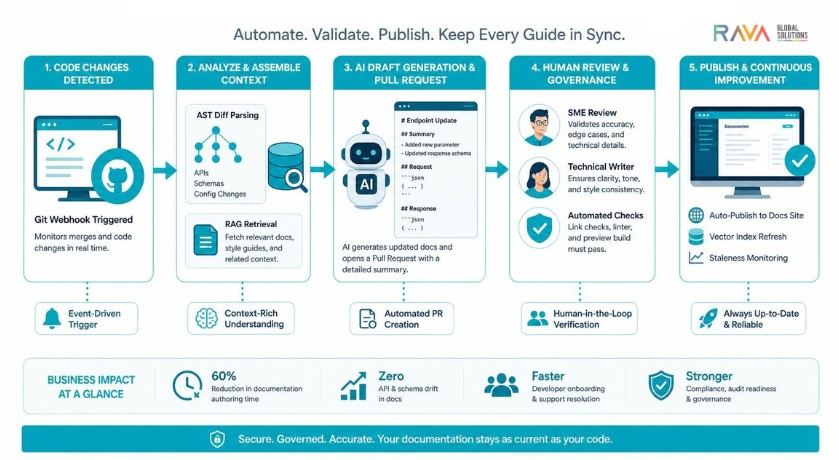
- Codebase Introspection & Trigger Configuration
Modern technical documentation must integrate directly into the developer workflow. Instead of relying on manual alerts, configure GitHub Actions or GitLab CI runners to monitor merges to default branches:
- Abstract Syntax Tree (AST) Parsing: Implement lightweight parsers to analyze code changes. Rather than evaluating raw text diffs, extract structured changes in classes, methods, endpoints, request bodies, and database schemas.
- OpenAPI / Swagger Generation: Ensure backend APIs dynamically generate updated JSON/YAML specifications upon build. These structural files serve as the ground-truth input for the AI drafting agent.
- Trigger Filtering: Filter out minor refactors, styling updates, and internal utility adjustments that do not impact public interfaces, configuration files, or operational guides.
- Context Assembly & Retrieval-Augmented Synthesis
Passing raw code to an LLM without surrounding context produces shallow, inaccurate documentation. Build an agentic pipeline that enriches incoming changes with organizational context:
- Target Documentation Retrieval: Vectorize the existing documentation repository (Markdown/MDX files). Query the vector index to identify the specific sections, conceptual pages, and tutorials impacted by the modified code.
- Deterministic Style-Guide Enforcement: Inject corporate style guidelines (such as Microsoft Writing Style Guide or Google Developer Documentation Style) as system constraints. Specify heading hierarchies, voice attributes, and banned phrases.
- Contextual Prompt Orchestration: Construct an input payload combining:
- The AST code diff.
- The extracted schema modifications.
- The current documentation markdown.
Related commit messages and pull request descriptions written by the implementing engineer.
- Automated Branching & Pull Request Generation
The generative agent must never publish directly to production documentation branches. It must behave like an automated technical writing peer:
- The AI engine checks out a new branch (docs/update-endpoints-v2.4).
- It updates the Markdown/MDX files, modifying code snippets, updating endpoint schemas, and flagging deprecated arguments.
- The system opens a Pull Request against the documentation repository, complete with a structured summary explaining the rationale behind each text modification.
- Human-in-the-Loop (HITL) Review & Governance Gates
The human-in-the-loop stage provides critical quality and security verification:
- Subject Matter Expert (SME) Review: The engineer who authored the code change verifies that the generated prose correctly captures edge cases, rate limits, and security constraints.
- Technical Writer Oversight: Editorial teams ensure clarity, tone consistency, and adherence to information architecture principles.
- Automated CI Validation: The documentation PR must pass standard link-checking, linter (e.g., Vale), and preview build tests before human approval.
- Continuous Publishing & Semantic Health Auditing
Once merged, documentation publishes automatically via static site generators (Docusaurus, Nextra, Mintlify):
- Vector Index Refresh: The published updates are immediately re-indexed into the enterprise internal search and customer-facing support bots.
- Staleness Telemetry: Run automated monthly scans comparing production service telemetry against documentation view counts and freshness dates to identify unmaintained orphan guides.
Strategic Field Insight: The most frequent production mistake in AI-assisted documentation is allowing models to generate conceptual explanations from isolated code diffs. A code diff explains what changed, but rarely why. If an engineer alters an authentication flow to resolve a concurrency deadlock, the diff only shows modified mutex locks. Instruct the generative agent to flag conceptual updates for human technical writers while strictly limiting autonomous text generation to structural descriptions, parameters, and syntax examples.
Operationalizing at Scale: The Enterprise Service Solution
Building an automated documentation pipeline across diverse technology stacks requires specialized expertise in data engineering, model governance, and integration architecture. Many IT organizations attempt to build these systems internally, only to see their pipelines degrade due to schema drift, high token expenses, and unreliable model outputs.
RAVA Global Solutions designs and deploys hardened, enterprise-grade generative workflows that align with complex regulatory and architectural standards. Through dedicated AI Automation Services USA, RAVA assists enterprise clients in:
- Designing secure, private RAG pipelines that safely ingest proprietary codebases without public data exposure.
- Integrating custom AST diff processors and automated PR engines into existing GitHub, GitLab, and Azure DevOps environments.
- Establishing human-in-the-loop review frameworks that eliminate documentation debt while reducing engineering authoring time by over half.
- Aligning technical publishing architectures with SOC 2, HIPAA, and ISO regulatory requirements.
FAQs
How do you prevent generative AI from hallucinating code parameters in technical documentation?
Ground the AI model strictly in structured schema files and enforce deterministic extraction over open-ended text completion.
Rather than allowing an LLM to infer parameters from freeform code, the pipeline must first run a deterministic compiler or AST parser to generate a formal OpenAPI/JSON schema. The model is then restricted via prompt architecture to reference only the explicitly defined keys and data types present in that schema. Any parameter introduced by the model that does not match an extracted AST token fails an automated linting step, preventing the draft from reaching human review.
How does AI-assisted documentation support cross-silo knowledge management across an enterprise?
It establishes a unified, automatically refreshed knowledge graph that bridges engineering repositories, operational runbooks, and customer support databases.
When product and system documentation updates automatically alongside code, downstream enterprise teams—such as technical support, product management, and compliance—gain access to verified reference material without inter-departmental delays. Integrating these fresh documentation repositories into a broader framework for AI for knowledge management eliminates the data silos that typically cause outdated answers in employee search portals and customer support systems.
Can this pipeline handle legacy systems that lack OpenAPI specs or structured schemas?
Yes; the workflow uses specialized reverse-engineering agents to generate baseline specifications directly from legacy codebases and network traces.
For monolithic applications or legacy microservices built without modern documentation standards, the pipeline inspects controller files, routing configurations, and captured staging environment payloads. The AI engine synthesizes these inputs into an initial draft OpenAPI specification. Once an engineering lead validates that baseline draft, the system locks in the specification and transitions to standard automated diff-tracking for all subsequent updates.
Eliminate Documentation Debt and Accelerate Engineering Velocity
Outdated technical documentation is a structural liability that slows feature releases, burdens senior engineers with repetitive queries, and frustrates customers. By combining the speed of modern generative pipelines with the governance of structured human review, enterprise leaders can keep system guides and developer portals accurate, authoritative, and synchronized with every build.
Is documentation drift compromising your operational efficiency? Contact RAVA Global Solutions today to schedule a technical architecture assessment and deploy resilient, automated documentation workflows across your enterprise applications.