If you’ve started looking for a Databricks consulting partner, you’ve probably noticed that every firm says the same things. They’re certified, experienced and trusted by well-known names. That makes the first call feel a lot like guesswork.
The short answer: choose the team that has done work like yours, will tell you exactly who will do it, and is straightforward about price and about what happens after launch. A partner badge is a fair starting point, but it doesn’t tell you any of that.
Below are 12 questions worth asking in your first or second meeting, grouped into four areas: experience, the team, cost and contracts, and life after launch. Further down there is a one-page checklist you can print and use to score each firm side by side.
Before you start: know what you want Databricks to do
Write down, in a few lines, what you need. Are you moving off an old system? Building new data pipelines? Pulling in data from Salesforce or your ERP? Getting a machine learning model into daily use? Firms have different strengths, and a clear brief makes their answers much easier to compare.
A Databricks consulting partner (you’ll also see the terms implementation partner and integration partner) can help with any of these, but few firms are equally good at all of them. Consulting is mostly advice and planning, implementation is the hands-on build, and integration is connecting Databricks to your other systems. Ask which of the three a firm is strongest at.
Experience: has this firm done it before?
1. Have you done a project like ours?
Ask for the type of company, the amount of data and where they started from. “We work with banks and retailers” tells you nothing. A useful answer has real detail: the kind of business, the system they moved from, how long it took, and what they would do differently next time.
Be careful with answers that are all logos and no detail. If they can’t describe how a past project went, including what went wrong, they may not have been close enough to it.
2. Can we speak to a past client?
Written testimonials are easy to produce and hard to judge. A 15-minute call with a real client is far more useful. Some work is covered by NDAs, so not every client will agree, but a firm that has done good work can usually find one or two who will. Ask that client what surprised them and whether they would hire the firm again.
3. What does your Databricks partner status mean in practice?
Check that the firm appears in Databricks’ own partner directory and ask which level they hold. Partner levels and requirements can change over time, so a firm’s own website, or a “top partners” article, may be out of date.
Then look past the badge. How many of the people who will work on your project hold Databricks certifications, and which ones? A badge shows that the company met certain requirements. It doesn’t show who will be doing your work.
The team: who is actually doing the work?
4. Who will work on our project?
It’s common to meet senior people during the sales process and then get a different team once the contract is signed. Ask for names, roles and years of experience for the people assigned to you, and ask to meet the lead engineer before you sign. Using offshore or subcontracted staff isn’t a problem in itself, but you should know about it up front, and you should know who is accountable for the result.
5. How would you handle our migration?
If you’re moving from another system, whether that’s Hadoop, an older data warehouse or Snowflake, the migration plan matters more than almost anything else in the proposal. A good partner will want to look at what you have before proposing anything: how many data sources there are, which reports people rely on, what can be retired. They will talk about testing, and about running the old and new systems side by side for a while. Be wary of “lift and shift in a few weeks” promises made before anyone has seen your data.
It’s also fair to ask whether Databricks is the right destination at all. We work with both Databricks and Snowflake (see our Snowflake services), and a firm that sells only one platform will naturally lean toward it.
6. Where do security and data access fit in?
Who can see which data is easy to ignore early on and painful to fix later. Databricks has a built-in tool for this called Unity Catalog. You don’t need to understand how it works, but you do want a partner who raises access rules and audit trails before you do, and who sets them up from the start rather than at the end.
Cost and contracts: what will it really cost?
7. How will you price this?
Fixed fee, hourly rate or monthly retainer? None is automatically better. A fixed fee suits work that is clearly defined. Hourly or monthly pricing fits better when the scope is still being worked out. What matters is that you know which one you’re getting and what it covers. A single total with no breakdown makes firms very hard to compare.
8. What isn’t included in your quote?
Most quotes cover the consulting work only. Databricks charges for the computing power you use, and your cloud provider (AWS, Azure or Google Cloud) bills you separately for storage and servers. Ask the partner to estimate what the platform itself will cost each month once it’s running, and what assumptions sit behind that figure. A range with reasons is a good sign. A confident number with no reasons is not.
9. What happens if the scope changes or the project runs late?
Projects change. Ask how changes are handled, who approves extra cost, and whether the work is split into milestones that you sign off one at a time. Milestones also give you a natural point to stop if things aren’t going well, so check that the contract allows for that.
After launch: what happens when the project ends?
10. What will we own at the end?
The code, pipelines and documentation should belong to you and be stored somewhere you control. Ask this directly. Some firms keep the work in their own accounts, or build things only they can maintain, which leaves you tied to them whether you want to be or not. Ask what documentation you’ll receive and whether someone outside the firm could pick it up.
11. Will you train our team, and what support is there after go-live?
Launch day isn’t the end. Ask what support is included, for how long, and what it costs after that. Ask how quickly they respond when something breaks. Good partners build training into the project so your own people can handle everyday changes. If every small report change means a call to the consultant, the project hasn’t really been handed over.
12. What would make you advise us not to do this, or to do it differently?
This question tells you the most. A partner who agrees with everything in the first meeting is selling. Listen for pushback on scope, timing or data quality. It matters most if AI is on your wish list: models built on messy or poorly governed data give poor results, and a good firm will say so. If you’re planning AI work, ask how they would check that your data is ready first. Our Data and AI services page explains how we approach that.
How to compare firms once you have the answers
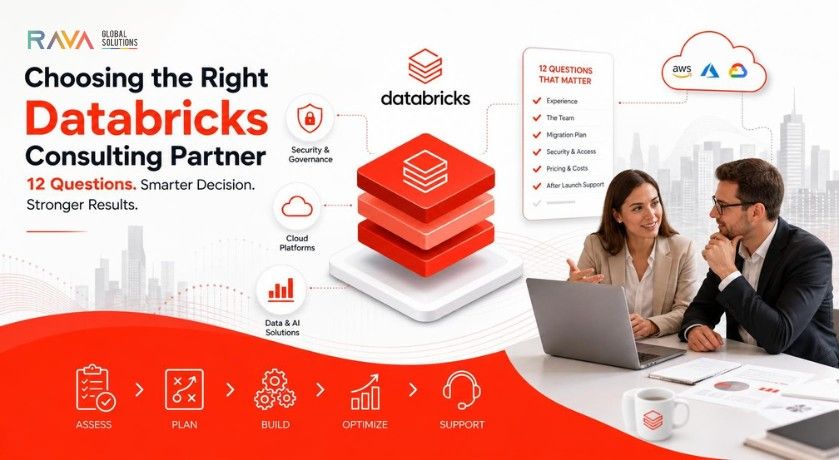
Score each firm from 1 to 5 on every question using the checklist below. Questions 4, 5 and 10 (the team, the migration plan and ownership) usually deserve extra weight.
If two firms score close, ask each for a short paid discovery phase of a couple of weeks. You’ll learn more about how a firm works in those two weeks than in any number of slide decks.
Checklist: 12 questions to ask your Databricks partner
| # | Question | A strong answer sounds like | Firm A | Firm B | Firm C |
|---|---|---|---|---|---|
| 1 | Have you done a project like ours? | Gives specific details: company type, data size, timeline, what went wrong | |||
| 2 | Can we speak to a past client? | Offers one or two references without fuss | |||
| 3 | What does your partner status mean? | Is in Databricks’ directory; names certified staff on your project | |||
| 4 | Who will work on our project? | Names the team and lets you meet the lead engineer | |||
| 5 | How would you handle our migration? | Inspects your systems first; plans testing and a side-by-side run | |||
| 6 | Where do security and access fit in? | Raises access rules early and sets them up from the start | |||
| 7 | How will you price this? | Explains the pricing model and gives a breakdown | |||
| 8 | What isn’t included in your quote? | Estimates platform and cloud costs, with reasons | |||
| 9 | What if scope changes or we run late? | Uses milestones and a clear change process | |||
| 10 | What will we own at the end? | You own the code and documentation, stored where you control it | |||
| 11 | Will you train us and support us after go-live? | States training, support hours and cost after launch | |||
| 12 | What would make you advise against this? | Is willing to push back on scope, timing or data quality |
Talk to RAVA
RAVA Global Solutions provides Databricks consulting, implementation, integration, customization, support and machine learning solutions from our base in Rochester Hills, Michigan. If you’re comparing a Databricks implementation agency in the USA, we’re happy to be one of the firms you put these questions to. Talk to our Databricks team and we’ll start with a conversation about what you’re trying to do.
Frequently asked questions
What does a Databricks consulting partner do?
They help you plan, set up and run Databricks. That includes designing how your data is organized, building the pipelines that feed it, moving data from older systems, connecting it to your other software and training your team. Some also build machine learning solutions on top of the platform.
How do I know a Databricks partner is legitimate?
Look the firm up in Databricks’ partner directory, ask for the names of certified engineers who will be on your project, and speak to at least one past client. A firm that is easy to verify on all three is usually the safer choice.
Is a bigger firm always better?
No. Large firms bring scale and global teams, but mid-sized projects can end up with junior staff. Smaller specialists often give you more senior attention but have fewer people to call on. Match the firm to the size and risk of your project.
How much does Databricks consulting cost?
It depends on the number of data sources, whether you’re migrating or building from scratch, and how much support you need after launch. Ask each firm for a breakdown rather than a single total.