
Snowflake charges for what you use. That is its big selling point, and it is also why the firm you hire matters for much longer than the project itself. A partner who sets things up carefully can keep your monthly bill predictable. One who doesn’t can leave you with a platform that quietly spends more every quarter.
The short answer: choose a Snowflake consulting partner that has done work like yours, can explain in plain words how it will control your usage costs, and will tell you who is doing the work and who you can call after launch. A partner badge is a useful signal, but these three things matter more.
The 10 questions below are worth asking in your first or second meeting. A one-page scoring checklist follows them, so you can compare firms side by side.
Before you start: gather three things
You’ll get better answers if you walk in with a short brief. Write down where your data lives today and roughly how much there is, who will use it (a finance team, a sales team, outside customers), and what you currently spend on the system you’re replacing or supplementing. Without these, every proposal will be a guess.
A Snowflake consulting partner may also be described as an implementation, integration or development partner. In practice, the labels overlap: consulting is advice and planning, implementation is the hands-on setup, integration connects Snowflake to your other systems, and development builds custom pipelines and data solutions on top. Ask each firm which of these it is strongest at.
Proof and fit
1. Have you done this for companies like ours, and can we talk to one of them?
Ask about the size of the company, the amount of data, the cloud they use (AWS, Azure or Google Cloud) and what they were moving from. A useful answer has real detail. A vague one lists industries.
Then ask to speak with a client who has been live for a year or more. Anyone can look good in the first month. A year in, the client can tell you whether costs stayed in line and whether their own team could manage the platform.
2. What does your Snowflake partner level mean, and who on our project is certified?
Look the firm up in Snowflake’s own partner directory and ask which level it holds. Levels and programme details change from time to time, so a firm’s website or a “top partners” list may be behind. Snowflake also offers individual certifications. Ask which of the people assigned to your project hold them, and ask for names.
Cost control: where Snowflake projects go wrong
3. How will you keep our usage costs under control?
This is the question that separates careful partners from careless ones. Snowflake bills for the computing power you use, so a good partner will talk about switching unused computing off automatically, choosing sensible sizes, setting spending limits and alerts, and looking at which queries are expensive. If the answer is “Snowflake scales automatically, so you don’t need to worry,” keep looking.
4. Can you estimate our monthly Snowflake bill before we start?
Your partner’s fee and Snowflake’s own charges are two separate things, and quotes often cover only the first. Ask for a range for the platform cost once the system is running, and ask what assumptions sit behind it, such as the number of users, how often reports refresh and how much data you load each day. A range with reasons is a good sign. A single confident figure with nothing behind it isn’t.
5. How will you set up access and security?
Snowflake lets you decide exactly who can see and change which data, using roles. Done well, roles follow job functions, so when someone changes teams you change one setting instead of fifty. Done badly, they turn into a tangle nobody dares touch. Ask how the firm designs roles, and ask for an example of one they set up for a past client, with details removed.
Building it: migration and connections
6. How will you move our data and reports across?
If you’re leaving another system, such as Teradata, Oracle, SQL Server or Amazon Redshift, the plan for moving it matters more than almost anything else in the proposal. A good partner will want to see what you have before proposing anything. They’ll ask which reports people rely on, what can be retired, and how you’ll check that the numbers match after the move. They will also plan to run the old and new systems side by side for a while. Be wary of anyone promising a full move in a few weeks before seeing your data.
7. How will Snowflake connect to the tools we already use?
A warehouse is only useful if data flows in and reports flow out. Ask how the firm will connect Snowflake to your reporting tools, such as Power BI or Tableau, and to the business systems that produce your data. If your customer data sits in Salesforce or your systems talk to each other through MuleSoft, make sure the partner has handled those before and can explain how they would load that data.
The team and after launch
8. Who will do the work?
It’s common to meet senior people during the sales process and a different group once the contract is signed. Ask for the names and roles of the people assigned to you, and ask to meet the lead engineer before signing. Subcontracted or offshore staff are not a problem in themselves, but you should hear about them up front.
9. What happens after go-live, and what will we own?
Ask what support is included, for how long, and what it costs after that. Ask how fast they respond when something breaks. Ask whether they’ll train your team, and make sure the code, documentation and settings are stored somewhere you control. If only the consultant can change a report, the project hasn’t really been handed over.
10. What would make you advise us not to use Snowflake, or to do this differently?
A partner who agrees with everything in the first meeting is selling. Listen for honest pushback on scope, timing or whether Snowflake is the right fit at all. We work with both Snowflake and Databricks (see our Databricks services), and a firm that sells only one platform will naturally lean toward it. The best answer to this question often includes a case where the partner would send you somewhere else.
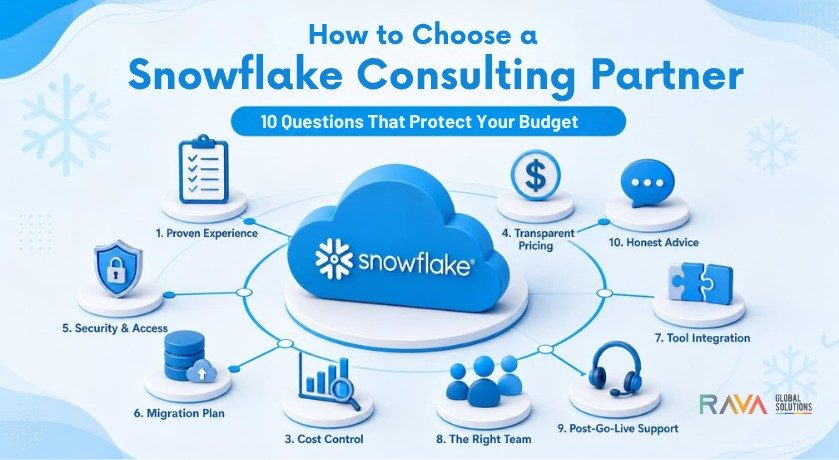
Putting the answers together
Score each firm from 1 to 5 using the checklist below. Questions 3, 6 and 8 (cost control, migration and the team) deserve the most weight, because they are the hardest to fix after you’ve signed.
If two firms score close, ask each to do a small paid pilot: one data source, one report, a few weeks. You’ll see how they plan, communicate and handle surprises before committing to the full project.
Checklist: 10 questions to ask your Snowflake partner
| # | Question | A strong answer sounds like | Firm A | Firm B | Firm C |
|---|---|---|---|---|---|
| 1 | Have you done this for companies like ours? | Gives real detail on size, cloud and starting point; offers a client who has been live a year or more | |||
| 2 | What does your partner level mean? | Is in Snowflake’s directory; names certified people on your project | |||
| 3 | How will you control our usage costs? | Talks about automatic suspension, sizing, limits, alerts and query review | |||
| 4 | Can you estimate our monthly bill? | Gives a range with reasons, separate from their own fee | |||
| 5 | How will you set up access? | Designs roles around job functions and can show an example | |||
| 6 | How will you move our data and reports? | Inspects your systems first; checks numbers match; runs both side by side | |||
| 7 | How will it connect to our other tools? | Has handled your reporting tools and source systems before | |||
| 8 | Who will do the work? | Names the team and lets you meet the lead engineer | |||
| 9 | What happens after go-live? | States support, training and cost; you own the code and documents | |||
| 10 | When would you advise against this? | Is willing to push back on scope, timing or platform choice |
Talk to RAVA
RAVA Global Solutions provides Snowflake consulting, implementation, integration, data migration, support and custom data solution development from our base in Rochester Hills, Michigan. Whether you need a consulting partner, an integration partner or a development partner, we’re happy to be one of the firms you put these questions to. If you’re comparing a Snowflake implementation agency in the USA, talk to our Snowflake team and we’ll start with a conversation about what you’re trying to do.
Frequently asked questions
What does a Snowflake consulting partner do?
They help you plan, set up and run Snowflake. That includes deciding how your data should be organized, moving data over from older systems, connecting Snowflake to your reporting and business tools, setting up who can see what, and training your team. Some also build custom data solutions on top of the platform.
How does Snowflake pricing work?
In short, you pay for the storage you use and the computing power you use. That makes the bill flexible, but it also means it can grow without anyone noticing. Check Snowflake’s current pricing page for details, and ask any partner how they will keep usage in check.
Can my own team set up Snowflake without a partner?
Often yes, for a small, simple setup. A partner earns its fee when you’re migrating from another system, connecting many sources, handling sensitive data, or need results faster than hiring would allow. A middle route is to have a partner build the foundations and train your team to run them.
What is the difference between a consulting, implementation and development partner?
A consulting partner advises and plans. An implementation partner does the hands-on setup. A development partner builds custom pipelines, reports or data applications on top of Snowflake. Many firms do all three, so ask which one they are strongest at.