Executive Summary: Controlling MuleSoft Run-Rate Operational Expenses
Enterprises lower MuleSoft maintenance costs by standardizing API contracts, implementing reusable Anypoint Exchange assets, automating regression testing with MUnit, and eliminating integration debt. For organizations orchestrating high-compliance endpoints—such as ERPs—these architectural guardrails reduce support tickets, stabilize vCore overhead, and compress operational run-rates by up to 30%.
Enterprises lower MuleSoft maintenance costs by standardizing API contracts, implementing reusable Anypoint Exchange assets, automating regression testing with MUnit, and eliminating integration debt. For organizations orchestrating high-compliance endpoints—such as ERPs—these architectural guardrails reduce support tickets, stabilize vCore overhead, and compress operational run-rates by up to 30%.
Framework & Underlying Business Architecture
Enterprise integration platforms rarely fail because of core runtime limitations; they become cost centers due to architectural drift. In a greenfield deployment, MuleSoft’s API-led connectivity model delivers rapid time-to-market. Over multi-year lifecycles, however, integration suites frequently deteriorate into an undocumented web of bespoke connections.
When an underlying enterprise system changes its data model—such as updating an enterprise billing platform or an ERP schema —teams that deploy tightly coupled integrations must manually trace, refactor, and regression-test every downstream consumer. A single contract adjustment cascades into dozens of engineering hours spent debugging DataWeave transformations and re-verifying endpoint authentications.
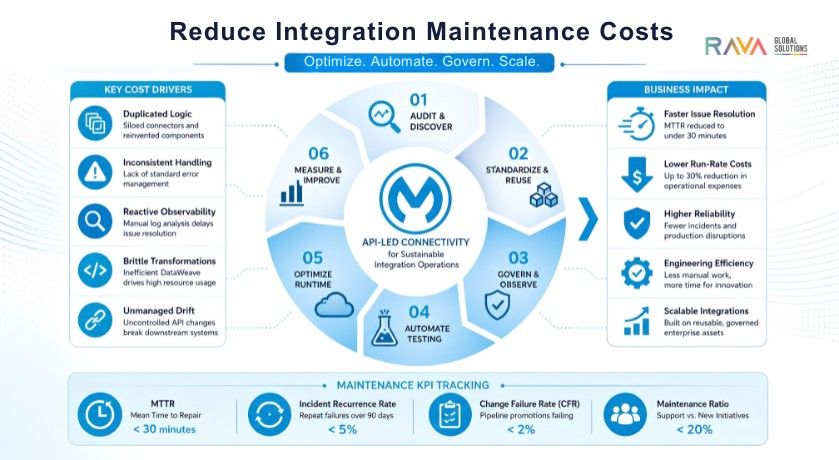
Five architectural failure modes drive 80% of unnecessary MuleSoft operational expenditure:
- Duplicated Integration Logic: Independent development pods build isolated connectors and custom authentication handshakes rather than consuming unified assets from Anypoint Exchange.
- Inconsistent Exception Handling: Absence of enterprise-wide error-handling frameworks leads to silent message drops, improper HTTP status code propagation, and unmonitored failure cascades.
- Reactive Runtime Observability: Relying on default logging without distributed tracing or automated alerting forces support engineers to parse gigabytes of raw worker logs to isolate transaction timeouts.
- Brittle DataWeave Scripts: Unoptimized transformations run in-memory streaming over massive payloads, consuming unnecessary vCore memory and driving unpredictable heap spikes. For granular execution strategies on resource efficiency and compute tuning, consult our guide to MuleSoft optimization.
- Unmanaged Interface Drift: APIs deployed without strict OAS or RAML validation rules bypass governance, allowing unvetted schema modifications to break downstream dependencies in production.
Legacy Support vs. Optimized Maintenance Models
The financial difference between reactive support and modernized integration lifecycle management is visible across development, deployment, and remediation metrics:
| Operational Dimension | Legacy / Reactive Support Model | Optimized Lifecycle Model | Measurable Business Impact |
|---|---|---|---|
| API Architecture | Point-to-point flows and uncataloged Mule apps built in silos | 3-tier API-led topology governed through Anypoint Exchange | 35–50% reduction in new connector development cycles |
| Contract Governance | Loose validation; breaking schema changes slip into production | Automated Anypoint API Governance checks within CI/CD pipelines | 60% drop in change-related interface outages |
| Testing Regimen | Manual post-deployment validation and ad-hoc Postman runs | Automated MUnit suites integrated into branch validation gates | 75% reduction in manual regression QA hours per release |
| Incident Triaging | Manual log scouring in CloudHub Runtime Manager across workers | Distributed tracing with correlated transaction IDs and OpenTelemetry | MTTR drops from hours to sub-15-minute root-cause isolation |
| Technical Debt Management | Emergency patches applied directly to runtime artifacts | Systematic technical-debt registers with planned LTS runtime upgrades | Lower emergency patch costs; zero unplanned end-of-life scrambles |
Implementation Strategy: 6 Engineering Phases to Reduce Run-Rates
- Portfolio Audit and Cost-Driver Attribution
Before modifying existing codebases, run a structured audit across your entire runtime catalog using Anypoint Runtime Manager, CloudHub Insight, and external logging aggregators:
- Extract error frequency distributions, memory utilization profiles, and worker restart counters across all deployed applications.
- Map application dependencies to classify integrations by tier: Tier 1 (Mission-Critical Real-Time), Tier 2 (Batch/Operational), and Tier 3 (Ad-Hoc/Reporting).
- Identify “hotspot applications”—the 10–15% of APIs that consume more than 60% of tier-2 support bandwidth—and prioritize them for architectural refactoring.
- Canonical Data Modeling and Anypoint Exchange Assetization
Tightly coupled integrations duplicate transformation logic across endpoints. Decouple these flows using standardized Canonical Data Models (CDMs):
- Publish vetted System APIs for core backends (such as CRM, ERP) to Anypoint Exchange.
- Enforce semantic versioning (Major.Minor.Patch) on all shared schemas and fragments. Consuming applications must lock to specific minor versions, insulating them from non-breaking enhancements.
- Mandate that enterprise modules (OAuth validation, audit logging, masking policies) are distributed as version-controlled Maven dependencies via Exchange rather than copy-pasted across flow XMLs.
- Universal Exception Handling and Distributed Tracing
Ad-hoc error handling drastically inflates Mean Time to Repair (MTTR). Establish a centralized Global Exception Strategy deployed as an imported configuration artifact:
- Differentiate systematically between fatal errors (e.g., payload validation mismatches) and transient errors (e.g., downstream network drops).
- Implement exponential backoff and circuit-breaker patterns on external calls to prevent cascading thread pool exhaustion.
- Standardize logging formats across all apps to output structured JSON containing an invariant correlationId, applicationName, targetEndpoint, and latencyMs.
- Automated Testing Gates via MUnit and CI/CD Pipelines
Manual regression verification is the single largest consumer of engineering hours during scheduled maintenance windows:
- Mandate an 80% automated line-and-branch coverage threshold using MUnit for all System and Process APIs before pull requests can merge.
- Mock external boundary calls to isolate testing exclusively to DataWeave transformation accuracy, routing decisions, and exception triggers.
- Embed contract-testing validations in CI/CD pipelines (via GitHub Actions, Azure DevOps, or Jenkins) to halt deployments if an API specification deviates from the approved governance ruleset.
- CloudHub 2.0 and Runtime Lifecycle Rationalization
Running legacy runtimes past their premier support windows exposes organizations to platform instability and emergency patch overhead:
- Standardize on MuleSoft Long-Term Support (LTS) release channels rather than tracking edge releases across enterprise production clusters.
- Containerize integration runtimes using CloudHub 2.0 shared or private spaces to benefit from automated base-image patching and infrastructure self-healing.
- Eliminate idle vCore overhead by sizing replicas according to real memory profiles rather than theoretical peak demands.
- Maintenance KPI Tracking and Capacity Reclamation
Track concrete maintenance metrics over consecutive quarters to validate return on investment:
| Maintenance KPI | Diagnostic Focus | Operational Benchmark |
|---|---|---|
| Mean Time to Repair (MTTR) | Efficacy of distributed tracing and structured logging | Under 30 minutes for P1/P2 incidents |
| Incident Recurrence Rate | Quality of root-cause fixes vs. temporary patches | Under 5% repeat failures over 90 days |
| Change Failure Rate (CFR) | Rigor of automated MUnit test suites | Under 2% of pipeline promotions |
| Maintenance Ratio | Engineering hours allocated to support vs. new initiatives | Below 20% of total integration resource capacity |
Strategic Field Insight: Shared assets can quickly become single points of organizational failure if versioning governance is neglected. A common operational error is publishing breaking updates directly to a shared System API under a floating v1 endpoint. If 20 consuming processes ingest that payload, a subtle schema modification forces an emergency, multi-team war room. Always version contracts strictly: introduce breaking modifications under /v2/ endpoints while preserving backward compatibility on /v1/until deprecation timelines elapse.
Scaling The Enterprise Operating Model
Scaling an integration environment without inflating maintenance expenses requires more than platform tooling—it demands an operating model that prevents technical sprawl:
When internal engineering teams are consumed by recurring support backlogs and complex architectural remediations, partnering with certified integration specialists accelerates recovery. Engaging dedicated MuleSoft Integration Services provides the expertise required to audit complex integration estates, execute technical debt remediation, and implement scalable Center for Enablement (C4E) frameworks that permanently curb ongoing operational costs.
FAQs
Can MuleSoft maintenance costs be lowered without rebuilding legacy integration flows?
Yes; targeted refactoring of high-impact flows reduces operational costs far more effectively than full-scale architectural rewrites.
By implementing centralized logging interceptors, tuning DataWeave memory buffers, and wrapping brittle downstream systems in standardized circuit-breaker patterns, enterprises stabilize problem integrations without altering the underlying core business logic. When evaluating which flows justify targeted refactoring versus complete decommissioning, review our strategic analysis of MuleSoft integration technical debt.
Does migrating workloads to CloudHub 2.0 eliminate integration maintenance overhead?
No; CloudHub 2.0 abstracts underlying container management and operating system patching, but it does not resolve application-layer maintenance challenges.
While managed Kubernetes runtimes eliminate manual OS-level maintenance, development teams remain fully responsible for managing API contract versions, tuning DataWeave processing efficiency, updating outdated connectors, and triaging functional application faults. Cloud infrastructure stabilizes platform availability, but disciplined API design is what controls overall support costs.
What is the most effective operational pattern for replaying failed transactions?
Deploying dead-letter queues (DLQ) with automated, idempotency-checked replay queues is the most reliable way to prevent manual database repairs.
When transactions fail due to downstream platform timeouts, capturing the raw message along with processing metadata in an Anypoint MQ or external queue prevents silent data loss. Integrating an idempotency validator within the consuming Mule flow allows these messages to be safely reprocessed automatically once the target service recovers, eliminating the need for engineers to manually construct and inject missing data payloads.
Lower Support Overhead and Modernize Your MuleSoft Architecture
Excessive MuleSoft maintenance costs stem from architectural debt, fragmented coding patterns, and reactive operational models. By moving from point-to-point connections to an asset-driven, API-led framework backed by automated testing, structured logging, and proactive governance, enterprise IT leaders transform integration estates from unpredictable operational expense drivers into reliable, high-velocity digital assets.
Is your integration ecosystem consuming more engineering capacity in maintenance than it delivers in new capabilities? Contact RAVA Global Solutions today to schedule a MuleSoft Architecture & Maintenance Assessment, identify cost-reduction opportunities across your integration portfolio, and establish a reliable, high-performance integration roadmap.