Executive Summary: Make Customer Preferences Actionable
Salesforce Marketing Cloud consent management requires clear preference capture, traceable permission records, synchronized subscriptions, and tested sending controls. Working with a Salesforce consulting partner in the USA helps translate these requirements into reliable operations, reducing reconciliation effort and unwanted outreach. The strategic outcome is communication that consistently respects customer choices across connected systems.
Salesforce Marketing Cloud consent management requires clear preference capture, traceable permission records, synchronized subscriptions, and tested sending controls. Working with a Salesforce consulting partner in the USA helps translate these requirements into reliable operations, reducing reconciliation effort and unwanted outreach. The strategic outcome is communication that consistently respects customer choices across connected systems.
Connect Customer Choices to Communication Rules
A customer unsubscribes from promotional emails. The preference center confirms the change, but a scheduled CRM import restores an older subscription value. Another campaign then reaches the same customer.
The unsubscribe experience appeared successful. The systems behind it failed to preserve the decision.
Consent management must connect customer requests with what marketing systems actually do. That requires an architecture spanning identity, permission records, subscriptions, integration, and send eligibility.
This guide focuses on Salesforce Marketing Cloud Engagement, including Email Studio, Journey Builder, and connected CRM systems. Confirm the in-scope product before implementation: Salesforce documents different consent handling for Marketing Cloud Next, Engagement, and Account Engagement.
Separate Permission, Preferences, and Subscription Status
These concepts serve different functions.
| Concept | Question answered | Example |
|---|---|---|
| Permission | May the organization communicate for this purpose under its approved policy? | Promotional email permitted |
| Channel preference | Which communication channel does the customer select or allow? | Email preferred; SMS declined |
| Topic subscription | Which communication category does the customer want? | Product newsletter selected |
| Frequency preference | How often should eligible communications arrive? | Monthly digest |
| Delivery restriction | Should this message be blocked for another reason? | Invalid address or complaint restriction |
A frequency preference cannot override a marketing withdrawal. A newsletter subscription does not grant permission for unrelated promotions or other channels.
Salesforce’s consent model supports granular records involving individuals, contact points, channel types, and data-use purposes. Brand distinctions can also help represent different preferences within the same organization. These records still require configured connections to marketing execution.
Assign Ownership to Every Preference Decision
Define which system owns consent evidence, which owns customer identity, and which applies native sending restrictions.
Also assign operational responsibility. Marketing may own subscription categories, while privacy teams approve communication policies and integration teams manage propagation.
Without this division of responsibility, a discrepancy can move between departments while outreach continues.
Consent architecture belongs within broader Salesforce data privacy planning. Teams should collect the information needed to establish and honor choices, restrict access appropriately, and define proportionate retention.
Measure the Business Impact
Reliable preferences can reduce complaint investigations, manual audience corrections, and subscription reconciliation. Measure their value against an operational baseline.
Useful indicators include:
- Time between withdrawal capture and downstream enforcement.
- Percentage of permission records with complete evidence.
- Conflicts between CRM preferences and sending-platform status.
- Confirmed messages sent contrary to an effective restriction.
- Staff hours spent investigating preference discrepancies.
Campaign engagement is useful context, but it doesn’t show whether consent controls work.
Comparative Analysis: Choose Controls That Match Enterprise Complexity
The right architecture depends on the number of brands, channels, purposes, and systems involved.
| Architecture | Suitable use case | Main advantage | Main limitation | Required safeguard |
|---|---|---|---|---|
| Single CRM opt-out field | Simple, bounded email program | Easy administration | Limited granularity and evidence | Verify enforcement across every send path |
| Publication lists and preference center | Multiple email categories | Topic-level subscription management | Incomplete representation of broader permission requirements | Associate sends with the correct publication |
| Salesforce Consent Data Model integrated with Engagement | Granular permissions across contact points and purposes | Structured consent representation | Requires synchronization and eligibility logic | Identity mapping, conflict rules, and reconciliation |
| External consent platform connected to Salesforce | Multiple collection points and marketing applications | Shared evidence and preference capture | Downstream status can become inconsistent | Reliable propagation and destination verification |
Publication lists let customers withdraw from one communication category while keeping other subscriptions. Salesforce recommends separate publication lists for different communication types and associating them with relevant sends.
For complex enterprises, publication lists usually form one part of a wider preference architecture.
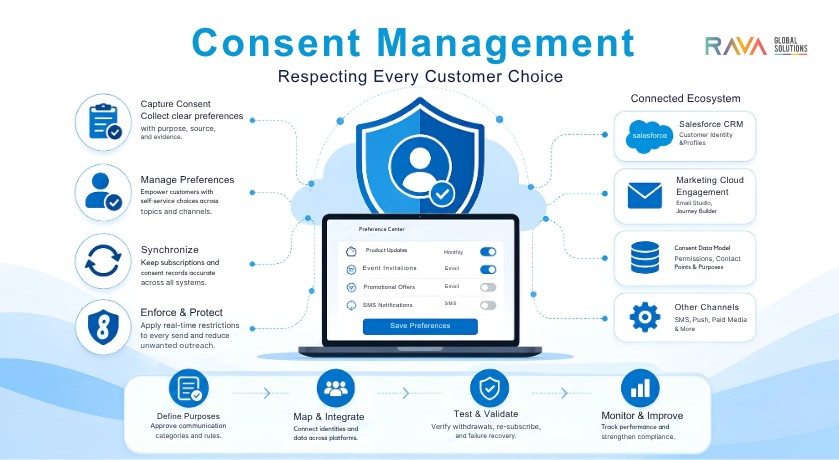
Steps To Engineer Reliable Subscription Management
- Inventory Communications and Approve Their Purpose
List every outbound communication category before configuring fields or preference pages.
Include newsletters, offers, event invitations, service updates, account notifications, and automated lifecycle messages.
For each category, document:
- Sender and brand.
- Channel and business purpose.
- Audience and relevant jurisdictions.
- Applicable permission requirements.
- Available preference and withdrawal options.
- Sending application and accountable owner.
Have the privacy or legal owner approve the resulting policy matrix. Requirements vary by jurisdiction, channel, recipient type, and message purpose.
For US commercial email, CAN-SPAM applies to B2B and consumer messages. The FTC requires an option to stop all marketing email from the sender and requires opt-outs to be honored within ten business days. Enforce design prompts rather than treating the statutory deadline as a processing target.
Release requirement: Every communication category has an approved purpose and an explicit eligibility rule.
- Establish Identity and Consent Evidence
Map CRM identifiers to Subscriber Key and Contact Key according to the organization’s integration design.
Document how preferences survive lead conversion, contact merges, duplicate records, and changed email addresses. An email address alone may not uniquely identify a person.
Where affirmative consent is collected, preserve evidence appropriate to its scope.
| Record element | Operational purpose |
|---|---|
| Customer identifier | Connects the decision to the relevant customer |
| Contact point | Identifies the email address or phone number involved |
| Brand, channel, and purpose | Defines what the decision covers |
| Status and effective timestamp | Establishes the current state and its timing |
| Capture source | Identifies the form, preference center, or assisted interaction |
| Notice version | References what the customer was told |
| Event identifier | Supports repeat-safe processing and investigation |
Distinguish unknown or pending status from affirmative permission where required. A migrated record without evidence should not silently become opted in.
Release requirement: The team can reconstruct the source, scope, and effective time of sampled preference changes.
- Design a Preference Center Customers Can Understand
Use recognizable descriptions such as “Monthly product updates” or “Event invitations.”
Explain frequency and content clearly. Keep topic subscriptions separate from channel permission so customers understand what each choice changes.
Provide an accessible way to stop all applicable marketing communications. Offer reduced frequency alongside withdrawal, but don’t make it harder to withdraw.
The technical design should address:
- Validated access links and protection against tampering.
- Minimal exposure of customer information.
- Durable recording of submitted changes.
- Clear confirmation messages.
- Assisted updates through customer support.
- Recovery when a downstream system is unavailable.
Do not display success merely because a button was clicked. Record the request durably, preserve its restriction, and track any pending propagation.
Release requirement: Each customer action produces a traceable backend event with the intended scope.
- Map Preferences to Native Marketing Cloud Controls
Connect the preference model to the controls that affect sending.
For email, distinguish broader subscriber status from category-level publication-list status. Review account and business-unit unsubscribe settings rather than assuming their scope.
Custom data-extension fields are useful only when the relevant send logic evaluates them.
Salesforce’s documented consent integration synchronizes related objects through Marketing Cloud Connect and uses queries to connect consent records with subscribers. This shows why synchronization must include configured marketing eligibility logic.
For custom unsubscribe pages, validate the context supplied to LogUnsubEvent—Salesforce documents subscriber and job-context parameters, including JobID, ListID, and BatchID. If sufficient job context is missing, the operation can master-unsubscribe the subscriber instead of performing the intended list-specific action.
Release requirement: Topic withdrawals and broader withdrawals update the correct controls without unintended scope changes.
- Synchronize Changes Without Reintroducing Old Permission
Preference updates can arrive late, repeat, or conflict.
An older 10:00 import must not overwrite a withdrawal captured at 10:05. Compare effective timestamps or event versions within the same identity and preference scope.
Implement:
- Unique event identifiers.
- Repeat-safe updates.
- Bounded retries for temporary API failures.
- Failed-update queues and alerts.
- Protection against synchronization loops.
- Monitoring of API limits and processing backlogs.
- Scheduled reconciliation between systems.
Keep demographic updates separate from permission changes. Updating a job title or company name should not reset subscription status.
Strategic Field Insight: A successful unsubscribe can be reversed by a routine import if that import writes an old “subscribed“ value. Protect withdrawals with explicit event-ordering rules and prevent ordinary profile updates from changing communication permission.
Release requirement: Delayed, duplicated, and out-of-order updates cannot unintentionally reactivate a restricted subscription.
- Enforce Preferences Throughout the Sending Lifecycle
Audience selection is only one control point.
A customer may withdraw after entering a journey or after a campaign audience is prepared. Entry-time eligibility can therefore become stale.
Inventory Journey Builder messages, scheduled campaigns, manual sends, API-triggered messages, and connected applications. For each path, document:
- Native unsubscribe controls that apply.
- Additional purpose and frequency rules.
- When eligibility is evaluated.
- How changes affect queued activity.
- How stale or unavailable preference data is handled.
Use controls supported by the specific send configuration. Do not assume that a custom consent field automatically governs every channel or send method.
Frequency preferences also require shared operational rules. Separate business units can each honor their local schedule while collectively exceeding the customer’s requested contact frequency.
Release requirement: Every production send path has documented, tested preference enforcement.
- Test Withdrawals, Re-Subscription, and Recovery
Test complete customer outcomes, not isolated API responses.
Include these scenarios:
- Offers declined while newsletter subscription remains active.
- All applicable marketing email withdrawn.
- Withdrawal during an active journey.
- Stale import received after withdrawal.
- Duplicate customer records sharing an address.
- Partial integration failure.
- Explicit customer re-subscription.
- Verify authoritative records, destination status, and actual message behavior.
Salesforce notes that re-subscription in Engagement is a separate action from updating the Salesforce Consent Data Model. Coordinate those updates and verify the outcome before restoring sending eligibility.
Release requirement: Customer choices remain effective through normal processing, failures, and recovery.
Turning Consent Architecture into Production Reality
Consent management requires business policy, customer experience, and technical execution to work together. A preference center can be easy to use, but downstream integrations can remain unreliable.
A Salesforce consulting partner in the USA can translate approved communication policies into an operating architecture by defining preference categories, mapping customer identities, configuring subscription controls, coordinating integrations, and establishing testing and monitoring.
RAVA Global Solutions offers Salesforce consultation, implementation, integration, customization, and support among its services, and includes Marketing Cloud in its stated expertise. These capabilities provide a starting point for assessing an existing preference architecture or planning a new implementation.
When evaluating a top Salesforce partner in the USA, assess the proposed deliverables and relevant experience. Ask for evidence of how the provider handles withdrawals, duplicate identities, business-unit scope, and recovery.
A Salesforce integration partner in the USA should explain how updates reach every destination and how it detects conflicts.
If procurement requires a certified Salesforce service provider in the USA, verify current partner status and the assigned team’s relevant credentials rather than relying on marketing descriptions.
A practical engagement should produce a communication-policy matrix, data model, integration specification, test results, and support procedures. These deliverables make the implementation reviewable and maintainable.
FAQs
Is All Subscribers status sufficient for enterprise consent management?
No; All Subscribers status does not independently represent every topic, purpose, brand, channel, or evidence requirement.
It remains an important email control. More complex programs may also need publication subscriptions, structured consent records, and additional eligibility logic.
A customer’s newsletter subscription must not override a broader applicable restriction. Test these relationships against the actual account and business-unit configuration.
Can transactional messages continue after a marketing unsubscribe?
Some genuinely transactional messages may continue, but you must assess their purpose and applicable rules separately from marketing eligibility.
An order confirmation and a promotional newsletter serve different purposes. The FTC evaluates a message’s primary purpose and interprets transactional categories narrowly; an existing commercial relationship does not make every message transactional.
Do not use transactional send classification to bypass a marketing withdrawal?
Broader Salesforce compliance planning should distinguish communication rules, privacy obligations, and security assurance. A platform feature or certification does not independently establish permission for a particular outreach activity.
Should unsubscribed customers be deleted from Marketing Cloud?
Do not use deletion as the default unsubscribe mechanism because deletion and communication restriction serve different purposes.
Salesforce warns that deleting a subscriber removes tracking information and can allow a new subscriber instance to be added to previously unsubscribed lists.
Maintain the records needed to honor restrictions under an approved retention policy. Handle erasure requests through a separate process that evaluates applicable deletion duties and justified retention.
Removing an audience row does not necessarily update consent records or other sending systems.
Build Customer Outreach That Honors Every Choice
A customer’s preference is a small interaction with a lasting expectation: the organization will remember it and act accordingly.
Reliable Salesforce Marketing Cloud consent management turns that expectation into consistent operations. Clear choices become traceable records, synchronized subscriptions, and tested sending decisions.
Book a consent and communication-preference consultation with RAVA Global Solutions to review your current architecture, identify enforcement gaps, and build an outreach program customers can trust.