Executive Summary: Build Around Business Outcomes
A reliable Workato implementation starts with measurable business requirements, establishes data ownership and integration controls, then advances through recipe development, testing, controlled deployment, and ongoing monitoring. When choosing a Workato implementation agency in the USA, focus on this delivery discipline: reduce manual processing and exception costs while making automated workflows accountable, recoverable, and scalable.
A reliable Workato implementation starts with measurable business requirements, establishes data ownership and integration controls, then advances through recipe development, testing, controlled deployment, and ongoing monitoring. When choosing a Workato implementation agency in the USA, focus on this delivery discipline: reduce manual processing and exception costs while making automated workflows accountable, recoverable, and scalable.
Define the Business Architecture First
Automation projects often begin with a request to connect two applications. The underlying requirement is usually more consequential: shorten customer onboarding, reduce order-entry errors, accelerate invoicing, or remove delays between departments.
Connecting systems addresses only part of that requirement. A workflow also needs rules governing when work starts, which records it can change, who approves exceptions, and how completion is verified.
Consider a sales-to-onboarding process involving Salesforce, NetSuite, and a service-management application. A closed-won opportunity might initiate customer creation, billing preparation, and onboarding tasks. However, opportunity status alone may not confirm the contract is signed, billing details are complete, or people can reuse an existing customer account.
Automating an incomplete handoff moves ambiguity downstream faster.
Establish Ownership Before Mapping Fields
Define three types of ownership before building recipes:
- Process ownership: Who is accountable for the complete business outcome?
- Data ownership: Which application controls each field or business object?
- Operational ownership: Who investigates failures and authorizes recovery?
Ownership should be specific. Salesforce might control opportunity status, while the ERP controls invoice numbers and payment terms. A customer-service platform may own completion of onboarding tasks.
Bidirectional synchronization requires additional rules. If two applications can update the same field, decide which change takes precedence and how to prevent synchronization loops.
This work is central to aligning operational workflows across systems. Integration becomes useful when departments share consistent handoff rules and record ownership.
Translate Objectives Into Acceptance Criteria
“Improve efficiency” is too broad to guide implementation. Replace it with testable requirements.
For example:
When a contract is approved and mandatory billing fields are present, create or update the ERP customer, initiate onboarding tasks, and return the onboarding reference to the CRM.
Then specify the operating conditions:
- Eligible records must reach the agreed destination within a defined time window.
- Duplicate delivery must not create duplicate customer accounts.
- Invalid records must enter a visible exception process.
- Every completed transaction must carry a cross-system reference.
- An assigned owner must receive actionable failure notifications.
These conditions shape recipe design, testing, and support.
Build a Financial Baseline
Measure current transaction volume, handling time, rework, and waiting time before estimating benefits.
A practical calculation is:
Monthly capacity released = eligible monthly transactions × minutes removed per transaction ÷ 60
For illustration, removing six minutes of manual handling from 2,000 monthly transactions releases 200 hours of capacity. It is an estimate, not a guaranteed saving or an automatic reduction in payroll.
Evaluate that capacity alongside platform costs, implementation expenditure, maintenance, and remaining exception handling. The financial value depends on how the business uses the released time.
Choose the Right Implementation Model
The delivery model should reflect workflow complexity, internal capability, and operational risk.
| Implementation model | Suitable circumstances | Strength | Main risk | Required control |
|---|---|---|---|---|
| Department-led recipe development | Bounded workflows with limited business impact | Close understanding of local requirements | Inconsistent standards and unclear support ownership | Approved connections, peer review, named owner |
| Central IT-led implementation | Shared integrations and sensitive enterprise processes | Consistent architecture and security oversight | Delivery bottlenecks when all requests depend on one team | Prioritized backlog and reusable integration components |
| Specialist-led implementation | Complex dependencies or limited internal Workato expertise | Additional architecture and delivery capacity | Dependence on the provider after launch | Documentation, knowledge transfer, clear acceptance criteria |
| Federated delivery with central governance | Multiple departments expanding automation | Local delivery supported by common controls | Governance gaps as the portfolio grows | Shared standards, release reviews, portfolio monitoring |
Many organizations benefit from a hybrid approach: central teams define connection, security, and release standards while business teams help prioritize and validate workflows.
The deciding question is whether the model can maintain control as automation expands.
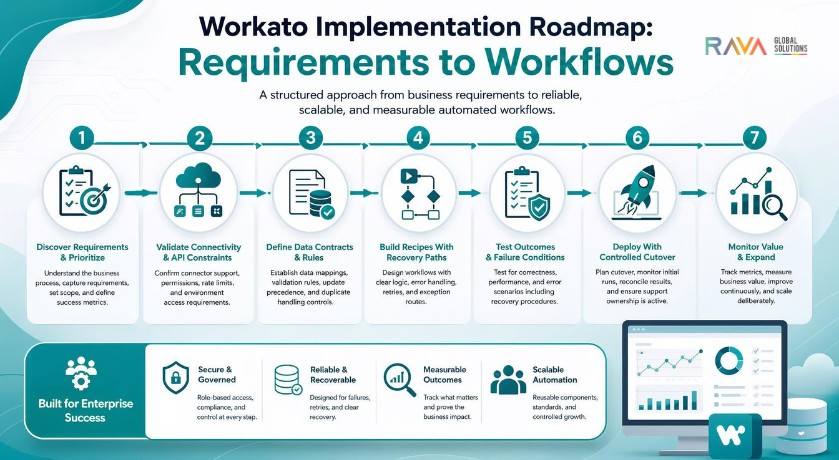
Implementation Roadmap: Engineer the Solution in Seven Steps
- Discover Requirements and Prioritize the First Workflow
Start with a workflow that has meaningful business value and manageable dependencies.
Interview the people who perform the work, including those who resolve exceptions. Document the actual process rather than relying only on a policy diagram.
Capture:
- Triggering event and eligibility rules.
- Applications, objects, and fields involved.
- Transaction volumes and peak periods.
- Manual decisions and approvals.
- Known exceptions and recovery procedures.
- Expected business outcome and accountable owner.
Separate the initial scope from future enhancements. Customer-account creation may belong in the first release; credit assessment, provisioning, and renewal processing may require separate delivery stages.
Exit criterion: Business and technical owners approve the workflow scope, baseline metrics, and acceptance criteria.
- Validate Application Connectivity and API Constraints
Confirm that the integration can perform the required operations before estimating the build.
Workato uses recipes to define workflows between applications, supported by connectors and configurable actions. RAVA’s service page lists implementation, integration, custom workflow development, and support as Workato offerings.
For each application, verify:
- Whether the connector supports the required trigger and actions.
- Whether custom objects and fields are accessible.
- Required authentication scopes and account permissions.
- Pagination, batch operations, and API version dependencies.
- Application rate limits and shared API consumption.
- Network access requirements for private systems.
Connector availability does not establish full use-case coverage. Validate the specific object, action, and permission combination.
Also distinguish Workato platform quotas from destination-application limits. Workato documents quotas for webhook traffic and recipe concurrency; connected applications impose their own constraints. Design against the tightest relevant restriction.
Exit criterion: Required operations work with approved credentials, and the integration design accounts for expected load.
- Define Data Contracts and Processing Rules
A data contract specifies what each workflow receives, validates, transforms, and sends.
Include required fields, accepted formats, identifier mappings, timestamp conventions, and rules for missing values. For monetary values, explicitly define how you handle currency and rounding.
Use stable identifiers to connect records across applications. Email addresses and display names can change; don’t default to them as customer identifiers without careful justification.
Define duplicate-handling rules before release. An idempotent operation produces the intended effect without repeating that effect when the same request is processed again.
Possible controls include destination-supported idempotency keys, unique external IDs, or durable processing records. A pre-creation lookup may help, but concurrent jobs can both find no existing record. Where possible, enforce uniqueness in the destination.
Exit criterion: Data owners approve mappings, validation rules, update precedence, and duplicate controls.
- Build Recipes With Explicit Recovery Paths
Translate the approved process into recipes with clear triggers, conditions, actions, and exception routes.
Choose the trigger according to business need:
- Event-triggered processing for timely handoffs.
- Scheduled polling when reliable events are unavailable.
- Batch processing for suitable high-volume transfers or reconciliation.
Avoid combining every department’s logic into one large recipe—separate reusable operations where that improves ownership, testing, and maintenance.
Design failure handling by category:
- Temporary service failures may justify bounded retries.
- Invalid business data requires correction or review.
- Expired credentials require connection recovery.
- Ambiguous timeouts require verification before repeating a write.
A retry policy should account for whether repeating the operation is safe. General architecture guidance recommends retrying transient faults with appropriate delays rather than treating all errors the same.
Strategic Field Insight: A successful job does not always mean the business process finished. A recipe can submit an onboarding request successfully while downstream provisioning remains incomplete. Define completion using the final business state, and reconcile that state against the initiating record.
Exit criterion: Each failure category has an owner, a notification route, and a documented recovery action.
- Test Business Outcomes and Failure Conditions
Testing should establish both correctness and recoverability.
Use representative records to verify valid transactions, missing fields, duplicate events, concurrent updates, out-of-order changes, and partial downstream failures.
For a CRM-to-ERP handoff, test what happens when customer creation succeeds but the response times out. The workflow must determine whether the customer already exists before attempting another creation.
Test throughput using realistic peak conditions. Include competing API usage from other integrations; a workflow that performs well in isolation may behave differently during month-end processing.
Business users should validate the destination records and resulting tasks. Technical job status alone is insufficient evidence.
Exit criterion: Acceptance criteria pass, including resolution of material defects and execution of all recovery procedures.
- Deploy With a Controlled Cutover
Keep development and testing separate from production, with appropriate credentials and configuration. Confirm which deployment capabilities are available in the organization’s Workato setup; Workato’s project-deployment documentation identifies environment provisioning as a prerequisite for relevant environment operations.
Before cutover, agree on:
- Release approval and production connection ownership.
- Initial processing window and backlog treatment.
- Legacy workflow shutdown or coexistence rules.
- Post-release verification.
- Pause, rollback, and data-correction procedures.
Avoid letting a legacy integration and its replacement unintentionally perform the same writes.
Where practical, begin with a limited cohort or transaction scope. Confirm results before increasing volume.
Exit criterion: Production results reconcile with expected outcomes, and support ownership is active.
- Monitor Value and Expand Deliberately
Monitor technical health and business performance together.
| Metric | What it reveals | Useful management response |
|---|---|---|
| End-to-end cycle time | Whether the complete process is faster | Investigate downstream waiting and approvals |
| Exception rate | How often manual intervention remains necessary | Correct validation gaps or unclear business rules |
| Reconciliation gaps | Whether source events produced expected outcomes | Identify missing, incomplete, or duplicated work |
| Mean time to recovery | How quickly interrupted work resumes | Improve alerts, ownership, and runbooks |
| Cost per completed transaction | Whether automation remains economically useful | Review usage, maintenance, and exception effort |
Define each metric’s denominator. “Success rate” can mean successful jobs, completed records, or completed business processes; these are different measures.
Expand only after the first workflow demonstrates stable operation and measurable value.
Operationalizing at Scale: The Service Solution
Enterprise automation requires continuity between requirements, architecture, implementation, and support. When these responsibilities are disconnected, teams can inherit recipes that run but lack clear ownership or safe recovery procedures.
A Workato implementation agency in the USA should establish that continuity by assessing dependencies, validating connector coverage, defining processing rules, building workflows, testing exceptions, and preparing the operating team for release.
RAVA Global Solutions offers Workato consulting, implementation, integration, custom workflow development, and support. Buyers can use those service areas to structure a discussion around their specific application landscape and delivery requirements.
When evaluating the best Workato consulting partner in the USA for your organization, ask how the provider converts business objectives into acceptance criteria and resolves conflicting process requirements.
Similarly, when assessing the best Workato integration partner in the USA, examine evidence of technical delivery:
- Experience with comparable application dependencies.
- Approach to preventing duplicates and handling partial failures.
- Testing and release documentation.
- Support responsibilities and escalation paths.
- Knowledge transfer and ownership of deliverables.
The right provider should make the implementation easier to operate and launch.
FAQs
How long does a Workato implementation take?
The timeline depends on dependency readiness, workflow complexity, and release requirements.
A bounded integration with accessible APIs and approved mappings requires less work than a multi-system rollout involving custom objects, historical migration, security reviews, and several business units.
Request an estimate after discovery. It should separate delivery effort from waiting periods for credentials, application changes, stakeholder approvals, and access to testing.
A credible plan includes release gates and business-owner availability alongside development tasks.
When should customer onboarding use event-driven automation?
Use event-driven automation when a reliable business event should initiate a timely, clearly defined onboarding action.
A verified contract approval may be a suitable trigger. An opportunity update may be insufficient if it occurs before required documents or billing details are complete.
Design event-driven workflow automation around explicit eligibility rules, stable identifiers, and observable outcomes.
Account for duplicate and out-of-order events. Retain a reconciliation process to detect missed or incomplete handoffs.
Where AI assists with document extraction or task preparation, validate its output before consequential system writes and route uncertain cases for review.
Can Workato guarantee that a transaction happens exactly once across systems?
Exactly-once business effects require explicit controls across participating systems; a recipe alone isn’t a universal guarantee.
A destination may commit a write even if the caller times out. Repeating the request without verification can create a duplicate.
Use destination idempotency support, unique business identifiers, durable processing state, and reconciliation where appropriate. Define compensating actions for partial completion—for example, placing an account on hold when a later provisioning step fails.
Stopping a workflow prevents further processing; it does not automatically reverse records already created.
Turn Business Requirements Into Workflows You Can Trust
Automation delivers value in the handoffs: an approved contract reaches billing, a customer gets the right onboarding tasks, and an exception reaches someone who can resolve it.
A disciplined Workato roadmap makes those outcomes repeatable. It gives each workflow clear requirements, controlled access, reliable processing rules, and evidence of business completion.
Start with the process whose delays or errors matter most. Bring its application list, transaction volumes, recurring exceptions, and desired outcome to a focused implementation discussion.
Book a Workato consultation with RAVA Global Solutions to define the first release, evaluate its dependencies, and build a practical path from business requirements to dependable automated workflows.