
Executive Summary: Evaluate Evidence Before Credentials
Choose a Databricks implementation agency in the USA by examining comparable delivery evidence, governance design, workload costs, migration controls, and support ownership. Michigan businesses should require a measured pilot and explicit acceptance criteria. This approach exposes avoidable spending, protects critical reporting, and turns partner selection into a defensible business decision. Evaluated against the demanding operational benchmarks of Michigan’s industrial corridors, this framework also gives US enterprises nationwide a standard for selecting a top-tier Databricks implementation agency.
Choose a Databricks implementation agency in the USA by examining comparable delivery evidence, governance design, workload costs, migration controls, and support ownership. Michigan businesses should require a measured pilot and explicit acceptance criteria. This approach exposes avoidable spending, protects critical reporting, and turns partner selection into a defensible business decision. Evaluated against the demanding operational benchmarks of Michigan’s industrial corridors, this framework also gives US enterprises nationwide a standard for selecting a top-tier Databricks implementation agency.
The Business Architecture Behind Partner Selection
A Databricks project can move data successfully and still disappoint the business. Reports may arrive late, cloud bills may become difficult to explain, or internal teams may struggle to maintain what the consultant delivered.
These problems often begin before implementation. The proposal describes platform features, but leaves data ownership, workload boundaries, and production responsibilities unresolved.
For Michigan manufacturers, distributors, logistics companies, and healthcare organizations, the evaluation should start with the decisions the platform must support. An assembly operation may need timely defect analysis. A supplier may need consistent purchase-order and shipment records. A healthcare analytics team may need controlled access to sensitive research data.
Each use case requires a different balance of freshness, quality, security, and cost.
Define Outcomes and Their Operating Costs
Ask potential partners to translate business requirements into measurable service targets:
- Data freshness: How long can the business wait between a source event and an available result?
- Data quality: Which missing, duplicated, or inconsistent records make the result unusable?
- Reliability: What recovery time and acceptable data loss apply to each workload?
- Cost: What does it cost to process a defined volume or serve a defined reporting workload?
- Ownership: Who resolves source-data problems, pipeline failures, and access requests?
A monthly cloud total provides limited insight on its own. Cost per million events, cost per completed batch, or cost per reporting workload gives leaders a more useful basis for comparison.
Savings claims should identify the original workload, measurement period, service level, and included costs. A cheaper deployment that misses reporting deadlines is not necessarily a better investment.
Establish Data Consistency Before Scaling Analytics
Delta Lake can support reliable processing, but it cannot determine whether two supplier records represent the same organization or whether different plants use compatible product identifiers.
Answering those questions requires business rules and accountable data owners. A clean data strategy and master data management approach help establish consistent customer, product, supplier, and location records across source systems.
A medallion design can then make that work operational:
- Bronze: Preserve source data and ingestion metadata for traceability and replay.
- Silver: Validate, standardize, deduplicate, and reconcile records.
- Gold: Publish business-ready datasets with agreed definitions and service targets.
Bronze data should follow an explicit retention and correction policy. Treating every raw record as permanently immutable can conflict with deletion requirements or source corrections.
A Practical Databricks Partner Evaluation Matrix
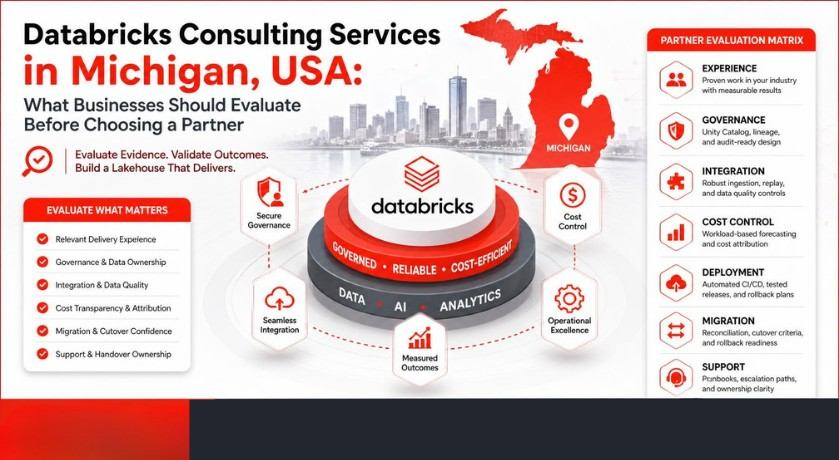
Delivery evidence should identify the best Databricks consulting partner in the USA for a particular business. Company size, location, and individual certifications provide context, but they don’t show whether a team can run your workloads reliably.
Use the following matrix to compare proposals.
| Evaluation area | Evidence to request | Strong delivery approach | Warning sign |
|---|---|---|---|
| Relevant experience | Comparable references, architecture examples, and named delivery roles | Explains constraints, decisions, and measured outcomes | Lists industries without describing actual work |
| Governance | Access model, lineage demonstration, and audit approach | Connects permissions to ownership and sensitive-data handling | Treats Unity Catalog activation as complete governance |
| Integration | Source inventory, connector design, and replay demonstration | Addresses rate limits, late data, duplicates, and failed ingestion | Assumes every source behaves like a storage-file feed |
| Cost control | Baseline, workload forecast, and attribution example | Measures costs alongside throughput and reliability | Promises a fixed savings percentage without a baseline |
| Deployment | Repository example, test evidence, and release process | Promotes reviewed configurations through separate environments | Depends on manual notebook changes in production |
| Migration | Reconciliation plan, cutover criteria, and rollback procedure | Validates business results before retiring legacy workloads | Checks schema compatibility alone |
| Support | Runbooks, escalation paths, and handover deliverables | Names owners for incidents and ongoing maintenance | Leaves post-launch responsibilities undefined |
Ask shortlisted teams to walk through one relevant failure scenario. For example: a source schema changes overnight, yesterday’s shipment records arrive again, and an executive dashboard refresh is due in an hour.
Their explanation should cover detection, containment, recovery, communication, and prevention.
Michigan Industry Requirements to Test in a Pilot
Regional knowledge becomes useful when it changes implementation decisions. A partner should understand the operational consequences of manufacturing schedules, supplier relationships, and sensitive clinical data.
Automotive and Industrial Telemetry
Plant and connected-equipment data may arrive through message brokers, edge gateways, or files written to cloud storage.
The ingestion design must reflect that path. Auto Loader processes files arriving in cloud object storage; it does not directly connect to a PLC or vehicle CAN bus. Message-bus sources require an appropriate streaming connector and source-specific configuration.
A representative pilot should test event timestamps, duplicate messages, interrupted connectivity, and late-arriving records. Watermark settings should follow the business tolerance for late data and the requirements of stateful operations.
Ask whether delayed sensor readings can change a quality result after it gets published.
Supplier and ERP Integration
Purchase orders, shipment notices, inventory movements, and production schedules often use different identifiers and update cycles.
A useful pilot should demonstrate how an EDI transaction connects to its supplier, part, shipment, and receiving location. It should also show what happens when a document is corrected or resent.
Evaluate the parsing and mapping logic, source-system API limits, and reconciliation rules. Converting an EDI payload into a Delta table is only one part of making it useful.
Healthcare Analytics
Healthcare evaluation should include identity management, sensitive-data classification, access restrictions, retention, and audit evidence.
Request a demonstration showing what an analyst can see, what remains masked or restricted, and how you can record access changes. Separately verify contractual and security requirements, including any applicable business associate agreement and the scope of claimed certifications.
Platform access controls contribute to a compliance program. They do not replace that program or independently establish certification.
Implementation Roadmap: From Assessment to Production
1.Inventory Sources, Consumers, and Dependencies
Document source systems, data volumes, update frequency, access methods, and downstream consumers.
Include less visible dependencies: manually maintained mappings, spreadsheet exports, scheduled extracts, and reports that rely on undocumented transformations.
Required deliverable: A dependency map and prioritized workload list with agreed business owners.
2.Define Identity and Governance Boundaries
Design Unity Catalog permissions around data ownership, environment separation, and access to sensitive data.
Clarify regional metastore arrangements rather than assuming one metastore spans every cloud and region. Document where data and metadata reside and how sharing will work across boundaries.
Use service principals for automated workloads, and distinguish identity provisioning from authentication and authorization.
Required deliverable: An access matrix, governance architecture, and audit-validation plan.
3.Select Ingestion and Data-Quality Controls
Choose ingestion methods according to the source: storage files, message buses, database changes, or APIs.
For files, Auto Loader can support incremental ingestion. Lakeflow Spark Declarative Pipelines (formerly Delta Live Tables) provide a declarative approach to pipeline processing. Define how each quality rule handles violations: retain and report, drop, or fail processing. WARN retains invalid records; quarantine requires an explicit design.
Required deliverable: Tested ingestion, replay procedures, quality rules, and exception ownership.
4.Establish Compute Controls and Cost Attribution
Separate workloads by execution needs. Evaluate job compute, SQL warehouses, and serverless options using representative workloads.
Apply supported policies and attribution mechanisms, including appropriate tags and billing records. Do not assume classical compute controls apply to serverless resources in the same way.
Track cost alongside processing time, concurrency, and data freshness.
Required deliverable: A workload cost model, budget alerts, and a capacity recommendation.
5.Automate Deployment and Production Recovery
Keep notebooks, pipeline code, and configurations in version control. Use Databricks bundle tooling and CI/CD to deploy reviewed resources across environments.
Tests should address transformations, permissions, reconciliation, and representative failure conditions. A deployment rollback does not automatically reverse data changes, so recovery procedures must cover both code and data.
Required deliverable: A repeatable release process, operational alerts, and recovery runbooks.
6.Validate Migration and Complete Handover
Run selected workloads alongside the legacy platform where practical. Compare record counts, financial or operational totals, freshness, and downstream behavior.
Define the point at which duplicate operation ends. Extended parallel running creates additional spending and support work.
Required deliverable: Signed acceptance results, a cutover decision, and documented ownership.
Strategic Field Insight: Successful execution does not prove correct results. A replayed source extract can produce duplicate business events while every pipeline reports success. Explicitly test retries and replay, and verify business-key behavior before approving migration.
Operationalizing at Scale: The Service Solution
A useful consulting engagement connects architecture, integration, and support to one accountable delivery plan.
RAVA Global Solutions offers Databricks consulting, implementation, integration, customization, support, and machine-learning solution development. Businesses evaluating a Databricks implementation agency in the USA can use that scope as a starting point for an implementation discussion.
The next step should be a scoped assessment that produces concrete decisions:
- Which workloads should move first?
- Which source-data problems need resolution?
- What governance and integration changes are necessary?
- How will costs and acceptance results be measured?
- Who will operate the platform after launch?
The best Databricks integration partner in the USA for your requirements should explain these trade-offs and support its recommendations with representative testing.
Agree on milestones, deliverables, exclusions, and support responsibilities before implementation begins. It makes the proposal easier to compare and the eventual outcome easier to assess.
Delivery Verification: Proven Competency & Engineering Benchmarks
Before signing an implementation statement of work, validate the consulting team’s hands-on credentials and verified delivery outcomes against production benchmarks.
At RAVA Global Solutions, our delivery model stands on top of verified Databricks ecosystem standards and accountable engineering metrics:
-
- Certified Engineering Bench: Delivery leads and pipeline engineers hold active Databricks Certified Solutions Architect Champion and Databricks Certified Professional Data Engineer credentials, ensuring architecture adheres to the Databricks Well-Architected Framework.
- Demonstrated Regional & Enterprise Impact:
-
- Manufacturing & Automotive: Engineered Auto Loader and streaming pipelines handling over 50M daily sensor events with strict watermarking, cutting compute costs by 32% while eliminating out-of-order data anomalies.
- Supply Chain & Distribution: Modernized legacy EDI/ERP transactions into an ACID-compliant Medallion lakehouse, achieving zero-data-loss cutovers and automated reconciliation across 200+ vendor catalogs.
- Healthcare Analytics: Designed HIPAA-compliant Unity Catalog governance models featuring attribute-based access control (ABAC), automated PII masking, and full data lineage verification under active BAAs.
- Accountable Governance Runbooks: Every deployment concludes with audited CI/CD release controls (Databricks Asset Bundles), custom cost-attribution dashboards, and post-cutover operational runbooks handed over to internal teams.
FAQs
Can Unity Catalog provide governance across multiple regions?
Unity Catalog supports governance, but multi-region deployments require explicit regional architecture and sharing decisions.
Document metastore boundaries, storage locations, access policies, and audit collection. Cross-region access also requires attention to residency requirements, network arrangements, and transfer costs.
Ask the partner to demonstrate both permitted access and denied access. A diagram alone doesn’t show that policies behave as intended.
Can real-time inference and business analytics run without resource contention?
They can coexist reliably when workloads have appropriate isolation, capacity, and latency targets.
Separate reporting workloads from model training and serving where their execution requirements differ. Evaluate serving endpoints for online inference rather than assuming an interactive training cluster should handle production requests.
Test concurrency, feature retrieval, request latency, and recovery behavior. Dedicated compute reduces some contention, but source delays, network limits, and poorly designed queries can still create bottlenecks.
The broader operating model matters too. Scalable enterprise AI operating models connect technical deployment to model ownership, monitoring, human escalation, and measurable business outcomes.
Should a Hadoop or Spark migration use a phased approach?
A phased migration is usually appropriate when you can separate workloads and reconcile results before cutover.
Start with a bounded workload with clear inputs, outputs, and acceptance criteria. Evaluate transformation compatibility, access controls, performance, and downstream reporting.
Reconciliation should include business totals and, where necessary, record-level checks. Schema matching alone cannot detect changed calculation logic or duplicated events.
Define rollback conditions and a retirement schedule so parallel operation does not become permanent.
Choose a Partner Who Makes the Outcome Measurable
A dependable lakehouse starts with clear decisions: what the business needs, what data you can trust, what performance costs, and who takes responsibility when something fails.
The right partner makes those decisions visible before they become expensive production problems. Look for evidence of relevant delivery, a representative pilot, and acceptance criteria your business and engineering teams can both understand.
Book a consultation with RAVA Global Solutions to discuss your source systems, priority workloads, governance requirements, and migration goals. Start with a defined scope and a measurable path toward a platform your teams can operate with confidence.