
Quick Summary: How Does AI Turn Meeting Notes Into Trackable Actions?
AI meeting follow-up software extracts verbal commitments, agreed deadlines, and project milestones directly from raw audio transcripts. The system synthesizes open discussions into structured work items, assigns individual owners, and syncs updates across business boards automatically. This workflow eliminates manual administrative work, resolves ambiguity, and ensures team accountability.
AI meeting follow-up software extracts verbal commitments, agreed deadlines, and project milestones directly from raw audio transcripts. The system synthesizes open discussions into structured work items, assigns individual owners, and syncs updates across business boards automatically. This workflow eliminates manual administrative work, resolves ambiguity, and ensures team accountability.
Every corporate leader knows the hollow feeling of an unproductive conference call. Bright minds gather, debate strategy for an hour, and leave with high enthusiasm. Yet within two days, unrecorded commitments fade into the background. Partnering with enterprise AI Automation Services solves this breakdown by transforming spoken discussions into automated task records.
Conversations often move quickly, leaving key details buried inside unstructured voice recordings. Important decisions slip through the cracks when teams depend on hurried manual note-taking. Fresh 2026 enterprise workplace studies show that knowledge workers lose up to 5.2 hours every week simply clarifying meeting action items. Without clear tracking, simple deliverables stall across disparate departments.
Manual administration also drains high-value creative energy and creates costly friction. Smart teams no longer treat meeting notes as static archive documents. Modern companies leverage AI in project management to convert verbal agreements into live project records instantly. This seamless connection bridges the gap between high-level executive alignment and actual technical delivery.
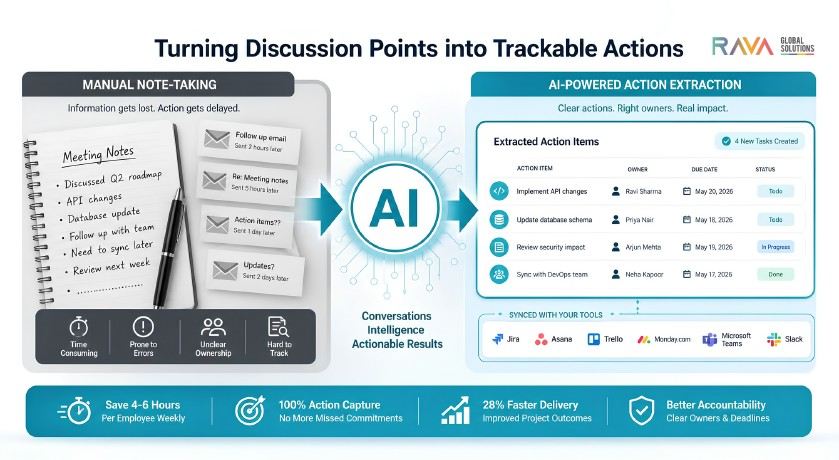
Manual Meeting Recaps Versus Intelligent Automated Action Extraction
Many enterprises still rely on junior coordinators or volunteers to take manual minutes. They circulate lengthy email threads that teammates rarely read or reference. Progressive organizations adopt modern conversational intelligence to accelerate their project delivery cycles. The comparison below illustrates why algorithmic extraction outperforms traditional meeting administration.
| Operational Dimension | Manual Note-Taking Practices | Modern Intelligent Workflows | Enterprise Business Impact |
|---|---|---|---|
| Commitment Capture | Fragmented, subjective bullet points | Exact entity and intent extraction | Prevents dropped project deliverables |
| Task Allocation | Manual emails sent hours later | Real-time direct task synchronization | Accelerates sprint velocity across teams |
| Follow-Up Cadence | Irregular reminders during check-ins | Automated nudges and status alerts | Eliminates passive project slippage |
| Context Retrieval | Searching through messy inbox chains | Instant semantic search across calls | Unlocks deep historical decision records |
Why Conventional Meeting Notes Fail To Drive Accountability
Basic transcription utilities only capture literal words without understanding enterprise context. They generate dense walls of raw text that busy professionals ignore. True workflow execution requires separating casual brainstorms from firm operational commitments.
Watch for these recurring administrative hurdles across your daily team calls:
- Diffused Ownership Syndrome: Team members often agree that a problem needs fixing without naming a single project owner. Intelligent algorithms detect unassigned commitments and immediately prompt meeting leaders for an explicit owner.
- Vague Delivery Timelines: Phrases like “soon” or “next quarter” invite chronic operational procrastination. Modern extraction models parse conversational dates and convert casual estimates into hard calendar deadlines.
- Context Loss During Hand-Offs: Summaries often omit the crucial technical background behind strategic decisions. Automated pipelines preserve key rationale snippets so absent team members understand why priorities shifted.
Forward-looking companies deploy Generative AI for business operations to orchestrate complex administrative tasks effortlessly. Automating these hand-offs keeps cross-functional teams focused on execution rather than chasing updates.
Step-by-Step System: Deploying AI-Powered Action Item Pipelines
Building a dependable follow-up pipeline requires intentional planning and proven governance models. A structured rollout guarantees that your team adopts the tools smoothly without feeling overwhelmed. Follow this practical four-step implementation blueprint to ensure lasting operational success.
- Ingest And Clean Multi-Speaker Audio: Route virtual meeting feeds through speaker-diarization engines to isolate distinct team voices cleanly. Tag individual participants by their enterprise roles to ensure precise contextual recognition. Practitioner Insight: In our enterprise implementations, we calibrate audio noise thresholds in advance to prevent background room chatter from generating ghost tasks.
- Extract Decisions Through Semantic Parsing: Deploy custom natural language models trained to distinguish between casual ideas and formal project commitments. Surface decisions, dependencies, and risk factors as discrete operational data objects. Practitioner Insight: We routinely apply confidence score filters so ambiguous remarks prompt quick human reviews rather than rogue task creation.
- Sync Directly To Enterprise Work Boards: Map approved tasks straight into team management platforms with complete contextual notes and attachments. Assign primary owners, add review dates, and populate project tags automatically. Practitioner Insight: Linking direct audio timestamps to generated tickets cuts ticket verification time by more than half.
- Automate Asynchronous Status Inquiries: Program intelligent agents to ping assignees ahead of milestone deadlines inside team chat channels. Consolidate blockers into an automated daily digest for division directors and engineering leads. Practitioner Insight: Conversational reminder bots that request simple progress updates achieve 38% higher response rates than generic email reminders.
Real-World Scenarios: Transforming Corporate Meeting Governance
The Global Fintech Architecture Alignment
A distributed financial technology firm conducted weekly design reviews across three continental time zones. Senior engineers debated critical API changes, but sprint backlogs repeatedly missed dependent database updates. Critical launch milestones slipped by three weeks due to unrecorded backend hand-offs.
RAVA Global Solutions integrated custom action-extraction models into their primary conference platforms. The pipeline parsed architecture discussions, populated engineering boards automatically, and linked code requirements to relevant owners. The firm eliminated missed dependencies entirely, accelerating their product release cycle by 28%.
The Healthcare Operations Bottleneck
A regional hospital network conducted daily operational syncs with doctors, facility managers, and logistics staff. Shift coordinators spent ninety minutes every morning manually compiling equipment maintenance requests and staffing adjustments. Busy department leads frequently overlooked urgent facility tasks amid their hectic patient rounds.
Our team deployed an intelligent conversational processor to transcribe morning briefs and extract urgent requests instantly. The system generated prioritized maintenance tickets within two minutes of call completion. This simple transition saved coordinators over seven hours each week while resolving facility issues twice as fast.
Strategic Checklist: Elevating Your Internal Collaboration Hygiene
Technology works best when paired with disciplined human communication habits. Clear meeting structures help automated models parse intent and track deliverables accurately. Use this concise checklist to optimize your daily meeting efficiency:
- Establish Verbal Confirmations: State action owners, primary tasks, and expected due dates aloud before ending any project call.
- Audit Automated Task Queues: Spend two minutes at the end of each work session reviewing generated task drafts for accuracy.
- Consolidate Meeting Channels: Route all call transcripts and summaries into a single secure repository to build a transparent decision archive.
Transforming talk into decisive action protects organizational momentum and builds long-term commercial trust. You can reclaim lost productivity and keep every project on schedule with ease. Modernize your corporate workflows with enterprise AI Automation Services from RAVA Global Solutions to build an agile, accountable organization.
Frequently Asked Questions
How Do AI Automation Services Distinguish Between Brainstorming And Real Decisions?
Natural language processing models examine linguistic cues, vocal confirmations, and semantic syntax to differentiate between ideas and commitments. When a speaker uses affirmative phrases like “I will deliver” or “let us assign,” the system recognizes an actionable agreement. Exploratory remarks lack these decisive patterns and remain categorized as conversational context.
Can Action Item Automation Integrate With Existing Project Management Tools?
Yes, automated meeting tools connect directly with major enterprise platforms through secure application programming interfaces. The system converts extracted discussion points into formatted tickets, populates custom metadata fields, and assigns tickets to specific team boards. This synchronization occurs immediately after call completion without requiring manual user intervention.
How Do Intelligent Follow-Up Systems Protect Confidential Corporate Conversations?
Enterprise solutions apply zero-data-retention agreements, localized encryption keys, and role-based access permissions to secure meeting data. Sensitive financial, legal, or personal information undergoes automated redaction before processing. Your organization retains full ownership of all call transcripts and downstream project records.
What Happens When The Meeting Audio Contains Heavy Accents Or Cross-Talk?
Modern speech-recognition models use advanced acoustic filtering and speaker-diarization algorithms to separate overlapping voices cleanly. The software isolates distinct audio tracks, cross-references vocabulary with enterprise glossaries, and corrects phonetic irregularities. Ambiguous snippets receive lower confidence scores, flagging them for brief user review before task generation.
How Much Time Does Automated Meeting Extraction Save Each Week?
Organizations typically save between four to six administrative hours per employee every single week. Automating summary writing, task distribution, and calendar coordination frees workers to focus entirely on core project execution. The streamlined workflow also shortens overall meeting lengths by keeping participants focused on definitive deliverables.