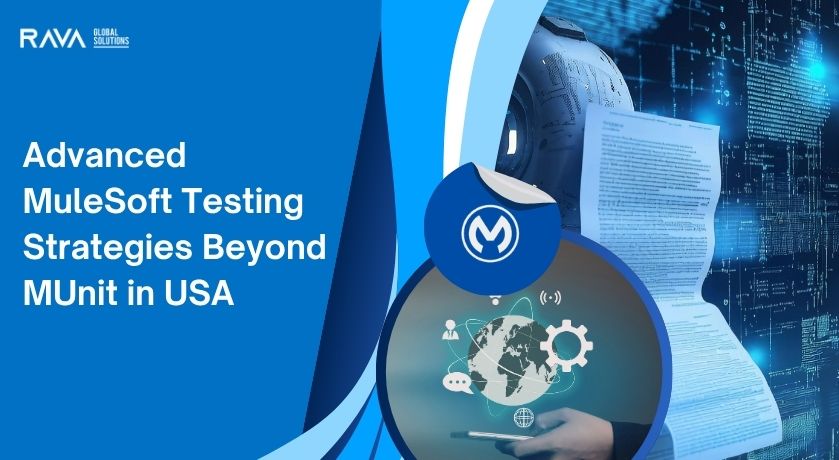
Imagine deploying a critical update that passes every single local unit test with flying colors. Hours later, your customer support desk floods with frantic notifications about dropped orders and stalled supply chains. This nightmare happens because traditional validation methods stop at the boundaries of individual code blocks. Modern enterprises require comprehensive validation strategies that look at the entire ecosystem rather than isolated components.
How to Validate Complex MuleSoft Architectures Beyond MUnit
Comprehensive enterprise testing requires shifting from isolated MUnit flows to End-to-End integration patterns, Consumer-Driven Contract Testing (CDCT), and automated performance validation. By decoupling dependencies via Service Virtualization and enforcing strict schema compliance across all API layers, organizations eliminate deployment downtime, protect data integrity, and guarantee runtime resiliency.
Comprehensive enterprise testing requires shifting from isolated MUnit flows to End-to-End integration patterns, Consumer-Driven Contract Testing (CDCT), and automated performance validation. By decoupling dependencies via Service Virtualization and enforcing strict schema compliance across all API layers, organizations eliminate deployment downtime, protect data integrity, and guarantee runtime resiliency.
Why Unit Testing Alone Is No Longer Enough
Many teams still rely heavily on MUnit. While it is useful, it mainly validates isolated Mule components. It does not fully test how systems behave under real pressure, failed APIs, broken payloads, or high transaction volumes.
Recent reports show that integration failures remain one of the biggest causes of enterprise downtime, especially in cloud-based ecosystems. Businesses using multi-system environments often face hidden risks in API orchestration, data transformation, and runtime performance.
It matters more now because modern MuleSoft ecosystems involve:
- Multiple API layers, such as Experience API, Process API, and System API
- CloudHub 2.0 deployments and hybrid environments
- Distributed message brokers like Apache Kafka and RabbitMQ
- Salesforce, ERP, and legacy system orchestration
- Real-time customer experiences with strict SLA expectations
A skilled Mulesoft partner in Michigan or across the USA understands one truth. Integration success depends on how systems behave together, not in isolation.
Moving Beyond MUnit Frameworks For True Enterprise Assurance
Recent global IT research indicates that over 75% of production integration failures stem from unexpected downstream schema changes and network latency rather than internal logic flaws. Organizations must establish strict governance and quality assurance protocols for the Mule runtime to catch these systemic vulnerabilities early.
True operational resilience requires a deep understanding of how data flows across your three-layer architecture. Experience APIs, Process APIs, and System APIs must maintain perfect synchronization even when the underlying backend software undergoes rapid modifications. Entrusting your environment to a top MuleSoft service provider in the USA ensures that your systems undergo rigorous, multi-tiered validation. Navigating these hidden architectural dependencies requires structured strategies that isolate systems, validate contracts, and simulate real-world stress.
Architectural Comparison: Component Testing Versus Ecosystem Validation
To build a truly reliable integration ecosystem, teams must understand where traditional testing falls short. Structured validation matrices allow engineering leaders to identify gaps in their current quality assurance pipelines.
| Testing Dimension | Traditional MUnit Testing | Advanced Architecture Validation | Enterprise Business Impact |
|---|---|---|---|
| Scope of Execution | Single flow isolation | End-to-end integration patterns | Eliminates hidden multi-tier bugs |
| Dependency Management | Basic payload mocking | Advanced Service Virtualization | Reduces testing environment downtime |
| Schema Enforcement | Static mock matching | Consumer-Driven Contract Testing | Prevents breaking downstream changes |
| Load Handling | No concurrency checking | Automated performance profiling | Guarantees system stability under stress |
Advanced Methodologies For Complex API-Led Connectivity Architectures
Implementing Consumer-Driven Contract Testing (CDCT) using the Pact framework allows teams to deploy changes confidently without breaking upstream dependencies. This methodology establishes explicit agreements between API layers, ensuring that any modification to a System API payload triggers an immediate alert in your Continuous Integration and Continuous Deployment (CI/CD) for Mule applications. Additionally, performing strict schema validation and payload compliance against RAML or OpenAPI Specification (OAS) blueprints prevents malformed data from corrupting downstream databases.
To test high-volume environments effectively, engineers must prioritize performance, resiliency, and message handling under extreme conditions.
- Service Virtualization and API Mocking: Use tools such as WireMock and Postman to simulate external vendor endpoints, enabling continuous testing even during third-party system outages.
- Backpressure and Thread Pool Exhaustion Handling: Use Apache JMeter or Gatling to simulate massive concurrent traffic spikes and verify that the runtime handles memory allocation gracefully.
- Dead Letter Queue (DLQ) Routing: Intentionally inject invalid payloads into your event-driven architecture to confirm that the system safely quarantines broken messages without stopping execution.
- Circuit Breaker Pattern Trip-Mechanisms: Simulate sudden network drops to verify that your HTTP policies stop traffic immediately, allowing failing backend platforms time to recover.
Partnering with an elite MuleSoft partner in the USA provides the deep technical foundation needed to embed these advanced automated testing strategies into your active GitHub Actions or Jenkins pipelines.

Real-World Scenarios: Solving Modern Integration Challenges
A prominent manufacturing company is experiencing erratic delays in order processing during peak seasonal shopping events. While their internal code passed all basic checks, their distributed message brokers suffered from severe thread starvation under heavy concurrent load. By implementing automated End-to-End integration patterns, engineers discovered that a custom DataWeave transformation validation routine was blocking execution threads during large array mappings. Introducing asynchronous processing strategies allowed the platform to handle volatile traffic surges without dropping critical client records.
Another common corporate challenge involves coordinating updates across global cross-functional platforms. A logistics firm faced frequent system disruptions because independent teams continuously modified internal ERP system schemas without notifying upstream developers. By embedding the Pact framework for contract testing directly into their CI/CD pipelines, they immediately flagged breaking modifications before they reached production. Securing the support of an experienced MuleSoft partner in Michigan allows your team to deploy similar automated guardrails, ensuring long-term operational peace of mind.
Elevating Enterprise Resiliency Beyond Standard APIs
Modern digital transformation extends far beyond traditional REST endpoints. True operational efficiency requires connecting your integration infrastructure with advanced cognitive automation systems. Utilizing MuleSoft intelligent document processing enables organizations to automatically extract, validate, and route unstructured data from complex legal and financial records. Validating these cognitive workflows requires specialized non-functional requirement (NFR) verification to ensure high extraction accuracy under heavy processing volumes.
Furthermore, true enterprise harmony requires seamless data synchronization between core operational platforms. Implementing expert MuleSoft Salesforce Integration Services allows businesses to connect customer relationship metrics with legacy backend systems of record. Safeguarding these vital pipelines requires continuous regression testing for Mule patches/upgrades, shielding your live data from unexpected platform updates. Collaborating with a specialized partner ensures your enterprise maintains loose coupling and high cohesion across all custom cloud connections.
Are you ready to transform your integration quality assurance from a manual bottleneck into an automated competitive advantage? RAVA Global Solutions provides the deep technical architecture, governance models, and automated testing frameworks required to secure your digital ecosystem. Connect with our senior engineering team today to review your current infrastructure and build a resilient, future-proof integration strategy.
Frequently Asked Questions
Why is MUnit insufficient for validating a complex three-layer architecture?
MUnit focuses primarily on isolating individual flows and mocking external dependencies within a single application boundary. It cannot detect runtime configuration issues, network latency anomalies, or contract mismatches between your Experience, Process, and System API layers. Comprehensive end-to-end integration patterns are necessary to guarantee data integrity across your entire distributed topology.
How does Consumer-Driven Contract Testing prevent production outages?
Consumer-Driven Contract Testing (CDCT) uses frameworks like Pact to define explicit data agreements between separate development teams. When a downstream System API alters its payload structure, the contract validation automatically fails inside the build pipeline. This early warning prevents breaking API changes from reaching CloudHub 2.0 deployments or Anypoint Runtime Fabric (RTF) environments.
What tools are recommended for high-concurrency and soak testing in MuleSoft?
Apache JMeter and Gatling are excellent open-source tools for executing sophisticated load, stress, and soak profiles against enterprise integrations. These tools help engineers identify thread pool exhaustion, DataWeave streaming inefficiencies, and object store memory leaks. Monitoring these test runs via Splunk or Anypoint Monitoring provides deep visibility into real-world resource consumption.
How do you validate event-driven architectures using Anypoint MQ or Apache Kafka?
Validating asynchronous, event-driven integration patterns requires simulating message bursts to evaluate backpressure controls and queue configurations. Engineers should intentionally introduce malformed messages to verify that Dead Letter Queue (DLQ) routing functions correctly without stopping active message listeners. This process guarantees transactional atomicity and graceful degradation during unexpected system spikes.
What is the role of Chaos Engineering in modern integration validation?
Chaos Engineering involves intentionally introducing network latency, dropping packets, or terminating active server replicas using tools like Chaos Mesh. This practice tests the automated fault-tolerance mechanisms of your architecture, such as Circuit Breaker policies and retry schedules. Conducting these controlled failures ensures your ecosystem remains resilient against unpredictable real-world infrastructure outages.
Strong Integrations Begin With Strong Testing
Complex MuleSoft architectures cannot rely on hope. They need testing strategies built for real-world pressure, changing payloads, runtime failures, and enterprise growth.
The companies that succeed are often the ones that test smarter before deployment becomes expensive. If your organization is expanding integrations, modernizing APIs, or strengthening MuleSoft Salesforce Integration Services, working with an experienced team can make the path far smoother.
RAVA Global Solutions helps businesses approach integration with clarity, confidence, and long-term stability. Because in enterprise systems, reliability is never accidental.