Quick Summary
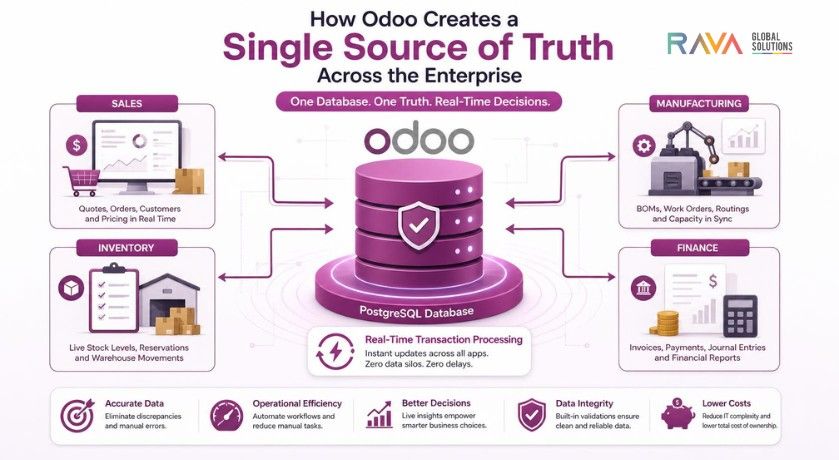
An Odoo single source of truth unites sales, inventory, manufacturing, and finance into one shared PostgreSQL database. Real-time transaction processing updates operational records instantly across all business apps. This unified model removes data silos, eliminates manual reconciliations, and ensures every department works with accurate, verified information.
An Odoo single source of truth unites sales, inventory, manufacturing, and finance into one shared PostgreSQL database. Real-time transaction processing updates operational records instantly across all business apps. This unified model removes data silos, eliminates manual reconciliations, and ensures every department works with accurate, verified information.
Every morning, leadership teams face a painful reality. Sales reports record numbers that disagree with warehouse totals. Finance closes books using figures that do not match production logs. These discrepancies force teams to spend critical hours reconciling spreadsheets rather than growing the enterprise.
When departments work in isolation, decisions stall. Teams lose trust in their internal numbers, and customer orders slip through the cracks. In 2026, enterprise market research showed that 47% of mid-market firms lost qualified sales due to cross-departmental record mismatches. Implementing an enterprise Odoo single source of truth provides the operational foundation that growing companies need to scale with confidence.
The Hidden Cost Of Disconnected Enterprise Systems
Operating on disconnected software drains capital and labor. When data sits scattered across third-party tools, employees waste up to eight hours each week copying data between screens. This manual entry leads to input errors, delayed fulfillment, and skewed cash flow forecasts.
Modern businesses cannot afford to fly blind. In 2026, global supply chain benchmarks revealed that companies using fragmented software faced a 22% higher rate of stockouts than peers using integrated platforms. Disjointed tools make leadership meetings unproductive because executives spend time arguing over which report is accurate.
A truly reliable operation requires absolute consistency from lead capture to bank reconciliation. Modernizing your tech stack with tailored Odoo ERP Solutions eliminates error-prone sync scripts. Unifying your workflows ensures that every leader sees identical numbers in real time.
How An Odoo Single Source Of Truth Works
The platform operates on a single relational database rather than a collection of synchronized applications. When a field rep books an order, that single transaction updates stock allocation, manufacturing demand, and draft journal entries simultaneously.
This instant synchronization eliminates batch updates and nightly data transfers. Clean Odoo data consistency ensures that team members never see contradictory inventory counts or invoice amounts. Every department acts as a live node within a single operational network.
Data integrity is protected at the database schema level. Validation rules prevent conflicting records, orphaned entries, and unposted transactions. Because all applications run on shared data structures, enterprise reporting remains transparent, clean, and audit-ready every single day.
Legacy Architecture Versus Modern Unified Data Platforms
Legacy systems rely on brittle connectors and scheduled integrations. Modern platforms store every business document within one cohesive structure. The table below illustrates the structural shift.
| Operational Dimension | Legacy Multi-App Stack | Traditional Tier-1 ERP | Unified Odoo Platform |
|---|---|---|---|
| Data Sync Method | Batch API calls and manual CSV imports | Custom middleware and scheduled tasks | Native direct database transactions |
| Cross-App Latency | Minutes to overnight updates | Near real-time with high server overhead | Zero latency across native apps |
| Data Reconciliation | Manual end-of-month cleanups | Costly automated reconciliation jobs | Continuous real-time reconciliation |
| Custom Field Sync | Requires manual mapping on all tools | High development cost per integration | Inherited automatically across apps |
| Maintenance Burden | High breakage risk with API changes | Requires dedicated maintenance team | Single code base with clean upgrades |
Centralizing information on an Odoo unified data platform shields your business from sync failures. A single data model lets leadership make fast, informed decisions based on confirmed operational facts.
Enterprise Benefits Of A Single Data Engine
- Accelerated Financial Closes: Native integration between sales, purchases, and payments cuts month-end closing cycles from weeks to just two days.
- Flawless Order Fulfillment: Warehouses view real-time customer promises, eliminating backorders, surprise stock shortages, and expedited freight fees.
- Trustworthy Executive Dashboards: KPI widgets draw live numbers directly from underlying tables, giving directors clear visibility into margins and cash flow.
- Lower IT Infrastructure Costs: Replacing fragmented software tools with one modular platform lowers maintenance budgets and reduces vendor contract complexity.
Real-World Implementation Scenarios
High-Velocity Industrial Equipment Distributor
The Challenge: A national pump distributor managed customer orders in a modern cloud CRM while their operations team ran inventory inside legacy accounting software. Custom webhook integrations failed several times a month, producing phantom inventory errors and causing embarrassing delivery delays for major enterprise accounts.
The Transformation: The distributor migrated their entire sales pipeline, multi-warehouse inventory, and procurement network into a unified deployment.
The Outcome: The single database environment eliminated 100% of order-entry discrepancies, cut order-to-dispatch time from 36 hours down to 4 hours, and recovered $180,000 in annual labor previously spent reconciling mismatched inventories.
Contract Electronics Manufacturer
The Challenge: An electronics firm with three production facilities struggled with purchasing inaccuracies. Engineering altered Bills of Materials (BOMs) in their design tools, but procurement worked off outdated spreadsheets, resulting in costly component shortages and idle assembly lines.
The Transformation: RAVA Global Solutions implemented native engineering change orders (ECO) tied directly to live MRP and vendor purchase agreements.
The Outcome: Real-time updates ensured that any engineering revision updated production routes and purchase orders across all plants within seconds. The firm cut manufacturing delays by 73% and improved inventory turnover by 31% during the first six months.
The Four-Step Migration Strategy
- Audit Existing Silos: Map every independent data store, custom integration, and spreadsheet across the company. Document where duplicate customer records and manual interventions slow down daily business.
Practitioner Insight: Start with finance and shipping; mapping these two endpoints early reveals the exact path of your organization’s actual transaction flow.
- Standardize Master Data: Clean customer profiles, vendor directories, and product catalogs before moving any information. Consolidate duplicate records and establish strict naming conventions across all departments.
Practitioner Insight: Never migrate historical bad data into a clean environment; archive older transactions and import only verified opening balances.
- Configure Transaction Workflows: Build end-to-end paths connecting initial quotes to stock picking, billing, and general ledger postings. Test each handoff using complex, real-world customer orders.
Practitioner Insight: Validate operational routes alongside front-line staff; warehouse pickers and sales reps spot practical workflow bottlenecks faster than executive committees.
- Deploy and Validate in Waves: Launch operations through structured rollouts, verifying data balance sheets at every step. Keep technical support teams available to guide users through their new shared workspaces.
Practitioner Insight: Schedule cutover during a planned inventory count so opening balances match physical assets down to the exact unit.
Core Enterprise Principles For Long-Term Data Health
- Enforce Strict User Permissions: Assign role-based access rules so employees modify only records directly connected to their daily responsibilities.
- Automate Source Document Tracking: Rely on native smart buttons to trace every financial entry back to its original purchase order or shipping slip.
- Conduct Scheduled Data Health Checks: Run automated diagnostic audits monthly to identify unlinked records, draft entries, or abandoned customer carts.
- Train Teams Continuously: Provide clear documentation and hands-on guidance so every employee understands how their actions support company-wide data integrity.
Frequently Asked Questions
What makes an Odoo single source of truth different from connected apps?
An interconnected software stack uses external APIs or sync scripts to copy data between separate databases, which introduces data latency and syncing errors. The integrated platform stores all CRM, sales, manufacturing, and accounting data in a single PostgreSQL database. Transactions update across all modules instantly without middleware.
Can custom modules break cross-departmental data consistency?
Custom modules can harm integrity only if developers write bad code that bypasses native ORM methods and validation triggers. When developers follow standard framework practices, custom fields integrate directly into the core database tables. Working with certified development teams protects your business from data fragmentation and upgrade issues.
How does unified data improve supply chain planning?
Purchasing algorithms calculate replenishment orders using live sales orders, real-time inventory counts, and current manufacturing lead times. Planners avoid over-ordering because the system accounts for incoming shipments and reserved components at the same time. This coordination reduces holding expenses while protecting order fulfillment schedules.
How does a unified system simplify financial compliance and tax audits?
Auditors can trace every journal entry back to its source document, such as an approved purchase order, bill of lading, or vendor invoice, with one click. Complete audit trails record the user, timestamp, and modification history for every business transaction. This transparency reduces audit prep times from weeks to hours and lowers compliance review expenses.
Will migrating to a unified database disrupt daily business operations?
A phased migration strategy prevents operational downtime. Legacy platforms remain active while technical teams scrub master files, run sandbox tests, and confirm opening balance reconciliations. Cutover happens during off-peak hours, so employees can step into an updated environment with accurate opening records.
Modernize Your Operations With RAVA Global Solutions
Running a competitive enterprise on fragmented software creates unnecessary risk. Disconnected systems slow down staff, confuse managers, and eat into profitability.
Establishing an Odoo single source of truth provides your business with clear visibility across all operational touchpoints. RAVA Global Solutions partners with growing enterprises to replace fragile workflows with clean, scalable, and fully integrated ERP systems. Contact our architecture team today to schedule an operational assessment and bring clarity to your business data.