Quick Summary: How Do You Eliminate Revenue Leakage Across the Customer Lifecycle?
Revenue leakage occurs when disconnected systems, poor data visibility, and manual handoffs create invisible process gaps across sales, service, and marketing operations. Organizations prevent this loss by implementing unified RevOps frameworks inside Salesforce, aligning data models from initial lead capture through long-term customer retention, and automating cross-departmental workflows.
Unmanaged operational gaps silently undermine predictable growth across every stage of your buyer journey. When handoffs fail between marketing, sales, and customer success, valuable deals quietly slip through the cracks. B2B enterprises lose up to four percent of their total enterprise value annually to preventable process breakdowns. Fixing these gaps requires a connected single source of truth across your entire ecosystem.
Revenue leakage occurs when disconnected systems, poor data visibility, and manual handoffs create invisible process gaps across sales, service, and marketing operations. Organizations prevent this loss by implementing unified RevOps frameworks inside Salesforce, aligning data models from initial lead capture through long-term customer retention, and automating cross-departmental workflows.
Unmanaged operational gaps silently undermine predictable growth across every stage of your buyer journey. When handoffs fail between marketing, sales, and customer success, valuable deals quietly slip through the cracks. B2B enterprises lose up to four percent of their total enterprise value annually to preventable process breakdowns. Fixing these gaps requires a connected single source of truth across your entire ecosystem.
The Hidden Mechanics of Enterprise Revenue Leakage
Modern revenue operations break down when teams rely on fragmented point solutions to manage customer relationships. Disconnected technology platforms isolate critical operational data into functional silos across departments. Marketing generates prospects without visibility into sales activity, while sales reps close contracts without context regarding customer success operations. These structural disconnects create friction, delay contract execution, and compromise pipeline visibility.
Recent enterprise studies indicate that sixty-eight percent of executive teams experience severe pipeline blind spots during cross-departmental handoffs. When customer information fails to transition smoothly, deal velocity slows down and conversion metrics suffer. Implementing tailored Salesforce Consulting Services helps organizations unify these distinct touchpoints into a single, cohesive lifecycle model.
Unifying these siloed systems protects existing contract value while building operational scale. Clean data foundations allow automation engines to route leads, trigger task assignments, and alert managers to stalling deals. Eliminating manual data entry gives account executives more time to engage directly with qualified decision-makers. Strategic alignment ensures that every customer touchpoint builds trust and protects profit margins.
Legacy Operations vs. Unified Revenue Architecture
| Operational Capability | Traditional Legacy Approach | Unified Salesforce Framework |
|---|---|---|
| Data Synchronization | Batch updates cause 24-48 hour delays | Real-time event streaming via Data Cloud |
| Pipeline Visibility | Manual spreadsheet reporting | Automated pipeline intelligence dashboards |
| Lead Handoffs | Static email notifications | Dynamic routing based on rep capacity and fit |
| Customer Retention | Reactive renewal outreach | Predictive churn scoring and automated alerts |
Architectural Stages of the Customer Lifecycle
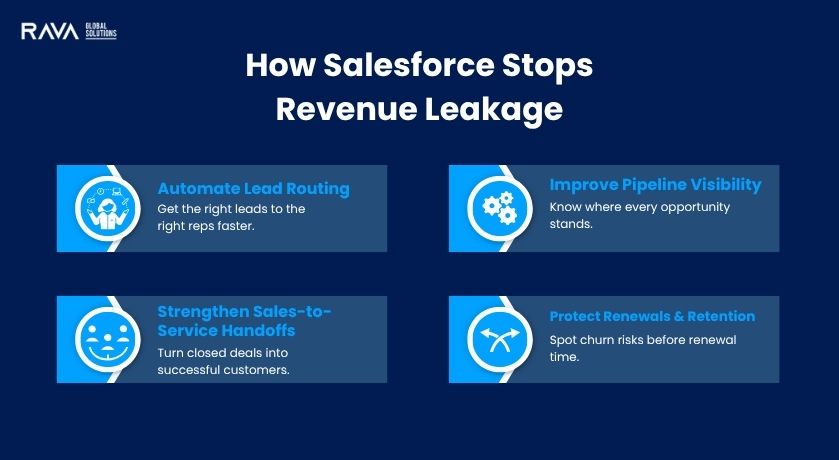
Strategic Lead Routing Automation
Prospect velocity drops when inbound inquiries sit unassigned in sales queues for extended periods. Establishing optimized rules ensures high-value prospects reach the right account representative instantly. Incorporating Advanced Lead Routing Strategies In Salesforce For Faster Conversions removes manual intervention and improves initial response speed. Automated queue management balances workloads while enforcing strict service-level agreements across regions.
- Dynamic territory assignments route accounts instantly based on industry size, revenue parameters, and geographic location.
- Real-time lead scoring suppresses low-quality submissions while escalating high-intent inquiries directly to account executives.
- Automated escalation workflows notify management when high-value leads remain unassigned past established response thresholds.
- Cross-channel engagement tracking updates sales records as prospects interact with marketing collateral and webinars.
Advanced Pipeline Execution and Intelligence
Inaccurate sales forecasts obscure true market demand and disrupt strategic business planning. Implementing automated sales pipeline tracking allows commercial leadership to monitor deal progression with confidence. Establishing clear validation rules prevents representatives from advancing opportunities without required decision-maker documentation. Building Building a Revenue Intelligence Engine with Salesforce gives executives real-world insights into pipeline health, rep activity, and conversion velocity.
- Automated stage gating enforces strict criteria before opportunities advance through sales funnel milestones.
- Activity tracking captures buyer communications, meeting notes, and stakeholder updates without manual rep entry.
- Opportunity split calculations automatically assign commission values across multi-rep account teams.
- Predictive pipeline analytics identify stalling deals early, enabling targeted manager coaching interventions.
Automated Post-Sale Lifecycle Handoffs
The risk of customer churn spikes when new clients experience disorganized post-sale onboarding transitions. Sales teams often fail to pass key discovery notes to account managers, forcing clients to repeat requirements. Configuring automated onboarding workflows in Salesforce bridges the gap between sales closing and service delivery. Standardized customer success playbooks ensure immediate value realization and set the foundation for long-term loyalty.
- Automated record triggers generate service cases and onboarding tasks as soon as deals close.
- Centralized account repositories preserve discovery notes, executive sponsor profiles, and technical requirements.
- Milestone tracking dashboards give client success leads real-time visibility into onboarding progress.
- Automated client check-ins flag delayed onboarding steps before they impact overall project timelines.
Predictive Contract Intelligence and Retention
Waiting until thirty days before contract expiration to engage accounts creates severe renewal risks. Successful organizations track platform adoption metrics continuously throughout the subscription term to predict retention health. Salesforce CRM automation monitors product usage trends, service ticket volume, and executive engagement scores automatically. Account teams receive proactive tasks to address declining activity long before contract renewal discussions begin.
- Health-scoring algorithms analyze support ticket frequency and product adoption to identify churn risks.
- Dynamic task assignment notifies account managers ninety days prior to renewal dates for strategic planning.
- Automated cross-sell triggers identify expanding client accounts based on feature usage thresholds.
- Customer feedback loops capture net promoter scores and route negative responses directly to leadership.
Real-World Scenarios: Eliminating Process Gaps
Enterprise Software Deployment
A mid-sized B2B software firm suffered from high lead drop-off rates and extended sales cycles. Inbound inquiries waited over twenty-four hours for manual review before reaching sales reps. Implementing automated lead distribution within Salesforce reduced initial contact times from twenty-four hours to under five minutes.
Practitioner Insight: In our enterprise implementations, we found that configuring dynamic round-robin routing rules with capacity caps prevents representative burnout while keeping first-contact response times under five minutes.
Pipeline conversion rates increased by twenty-seven percent within ninety days of implementation. The automated system matched accounts to specialized reps based on company size and technical environment. Eliminating manual lead triage saved hundreds of operational hours and improved forecast accuracy across all sales divisions.
Global Manufacturing Operations
A commercial equipment manufacturer struggled with high churn caused by poor post-sale visibility. Sales teams rarely communicated custom build configurations to customer success and field service personnel. Connecting Sales Cloud with Service Cloud created a unified view of account assets, service histories, and contract schedules.
Practitioner Insight: During large-scale system deployments, mapping custom objects between Sales Cloud and Service Cloud ensures service teams receive full contract context the second a deal transitions.
Support agents gained instant access to contract terms and technical specifications during service calls. Customer satisfaction scores rose by thirty-four percent over twelve months due to faster issue resolution. Proactive renewal management helped the client protect key account revenues and expand existing contracts.
Frequently Asked Questions
What is revenue leakage and how does Salesforce prevent it?
Revenue leakage refers to the uncaptured income lost through process inefficiencies, poor data visibility, unbilled services, and missed renewal opportunities across the customer lifecycle.
Salesforce eliminates these operational gaps by unifying sales, marketing, and customer service teams onto a single platform. Automating lead routing, deal stage progression, and contract renewals removes manual handoffs and enforces process compliance. Centralized analytics dashboards give management complete visibility into pipeline health, allowing teams to address stalling deals before value is lost.
How does RevOps alignment improve sales pipeline efficiency?
Revenue Operations aligns strategy, data, and technology across marketing, sales, and customer success departments to drive predictable business growth.
Unifying these teams within Salesforce ensures every department works from identical customer records and metrics. Automated lead scoring delivers qualified prospects to sales reps, reducing time spent on administrative tasks. Shared lifecycle dashboards allow revenue leaders to pinpoint process bottlenecks, optimize resource allocation, and improve conversion velocity from initial contact to final renewal.
What are the best strategies to stop churn during customer onboarding?
Preventing onboarding churn requires automated handoffs, structured milestone tracking, and clear cross-departmental communication immediately following contract execution.
Configuring automated workflows in Salesforce generates onboarding records and assigns service tasks as soon as deals close. Preserving discovery data ensures account managers understand client goals without asking repetitive questions. Real-time health scoring alerts teams to stalled onboarding milestones, allowing leaders to intervene before client satisfaction drops.
Securing Long-Term Commercial Growth
Eliminating revenue leakage requires continuous alignment between enterprise operational strategy and technology platforms. Connecting lead generation, pipeline execution, and post-sale service builds a durable revenue architecture. Organizations that remove process friction protect profit margins while delivering superior customer experiences at every touchpoint.
RAVA Global Solutions helps enterprise organizations design, build, and optimize high-performing revenue engines inside Salesforce. Our architectural approach ensures your technology investments drive measurable efficiency, predictable growth, and lasting customer loyalty. Partner with our strategic practice leads to eliminate operational silos, align your RevOps framework, and protect your commercial enterprise value.