AI adoption is moving quickly from experimentation to an executive priority. Many organizations have already launched generative AI pilots, deployed internal assistants, automated selected workflows, or tested predictive models.
But launching an AI pilot is very different from scaling AI across the enterprise.
A successful pilot proves that something can work. Enterprise transformation requires proving that it can work reliably, repeatedly, securely, and at a meaningful business scale.
That is where an effective AI transformation roadmap becomes essential.
Executive Summary
Organizations should not approach enterprise AI as a collection of disconnected experiments. A sustainable transformation requires a structured path from pilot projects to validated use cases, standardized capabilities, governed deployment, and enterprise-scale adoption.
Organizations should not approach enterprise AI as a collection of disconnected experiments. A sustainable transformation requires a structured path from pilot projects to validated use cases, standardized capabilities, governed deployment, and enterprise-scale adoption.
A practical roadmap should address six areas:
- Identify high-value business problems.
- Validate AI use cases against measurable outcomes.
- Assess data, technology, governance, and organizational readiness.
- Standardize successful AI capabilities.
- Scale proven solutions across departments and workflows.
- Continuously measure and improve business impact.
The objective is not simply to deploy more AI.
The objective is to make AI a repeatable enterprise capability that delivers measurable business value.
Why AI Pilots Struggle to Become Enterprise Capabilities
Launching an AI proof of concept can often be handled by a small team.
Scaling that solution introduces a completely different set of challenges.
A pilot may work with a limited dataset, a handful of users, and a controlled environment. Enterprise deployment may require the solution to interact with multiple business systems, support thousands of users, follow security requirements, and operate consistently across departments.
This creates questions that may not have been considered during the pilot:
- Is the underlying data reliable?
- Can the AI solution integrate with existing enterprise systems?
- Who owns the solution after deployment?
- How will employees use it?
- How will performance be monitored?
- What happens when the AI produces an incorrect result?
- How will security and compliance requirements be managed?
- Can the architecture support significantly greater usage?
- Is the business value measurable?
Without answers to these questions, organizations can end up with a growing collection of AI experiments without a clear path to enterprise adoption.
The AI Transformation Journey
A useful way to approach AI transformation is to view it as a progression:
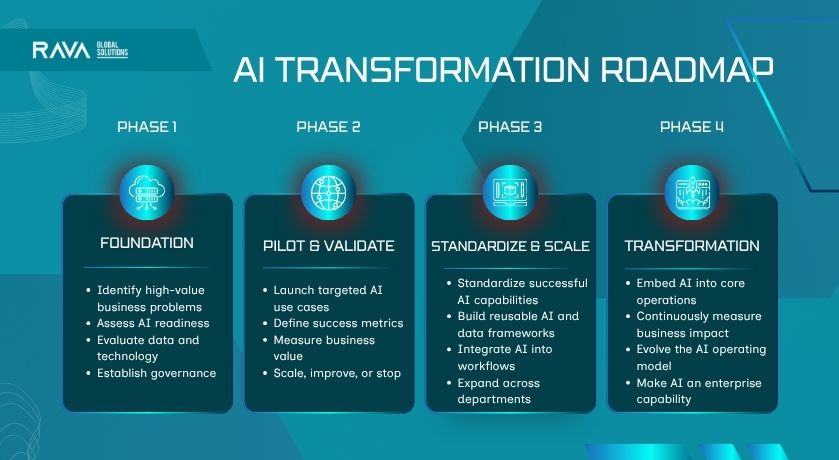
Pilot → Validate → Prepare → Standardize → Scale → Transform
Each stage serves a different purpose.
1.Pilot
Test whether AI can address a specific business problem.
2.Validate
Determine whether the solution produces measurable value.
3.Prepare
Build the data, technology, governance, and organizational foundation required for broader deployment.
4.Standardize
Create repeatable processes, technical patterns, security controls, and governance frameworks.
5.Scale
Extend successful AI capabilities across teams, departments, and business processes.
6.Transform
Make AI an integrated part of how the organization operates and makes decisions.
Not every pilot needs to reach the final stage.
A mature organization should be prepared to scale what works and stop what doesn’t.
Step 1: Start With Business Problems, Not AI Tools
One of the most common mistakes organizations make is starting with technology.
They ask:
“What can we do with generative AI?”
A stronger question is:
“Which business problems could AI help us solve?”
This change in perspective keeps AI investment connected to business priorities.
Potential use cases may include:
- Automating repetitive processes
- Improving customer service
- Supporting sales teams
- Forecasting demand
- Processing documents
- Improving knowledge access
- Supporting employees
- Identifying operational risks
- Improving decision-making
The right use case should have a clearly defined business outcome.
For example, instead of simply saying:
“Deploy an AI customer service assistant.”
define the intended outcome:
“Reduce average customer response time while maintaining or improving customer satisfaction.”
That gives the organization something measurable to manage.
Step 2: Validate the AI Use Case
A technically successful AI pilot is not necessarily a successful business initiative.
Leadership should evaluate the pilot against several questions.
Does it solve a meaningful problem?
A technically impressive solution has little value if the problem itself isn’t important.
Is the benefit measurable?
Possible measures include:
- Reduced processing time
- Lower operational costs
- Improved productivity
- Increased revenue
- Faster customer response
- Reduced errors
- Improved customer satisfaction
Will employees actually use it?
Adoption is a critical part of AI transformation. If employees don’t trust or understand a solution, its technical capabilities will not translate into business value.
Can it operate safely?
Security, privacy, governance, and compliance requirements should be evaluated before scaling.
At this point, leadership should be able to make a clear decision:
Scale, improve, or stop.
Step 3: Assess Enterprise AI Readiness
A successful pilot can expose weaknesses that weren’t visible during experimentation.
The organization may discover that its data is fragmented, its systems aren’t sufficiently integrated, or employees don’t have the skills required to operate the new capability.
This is why an AI readiness assessment should be part of the transformation roadmap.
An assessment can examine:
- Data readiness
- Technology architecture
- Integration capabilities
- AI skills
- Governance
- Security
- Business processes
- Organizational readiness
- Leadership alignment
Before making significant AI investments, organizations should understand where these gaps exist.
Our AI Readiness Assessment can be used as a framework for evaluating the areas that may affect enterprise AI adoption.
Step 4: Build an AI-Ready Enterprise Foundation
Scaling AI requires more than a successful model.
The surrounding enterprise environment must also be prepared.
That includes the architecture supporting:
- Enterprise data
- Applications
- APIs and integrations
- AI models
- Security
- Identity and access
- Monitoring
- Governance
- Business workflows
For example, an AI assistant may initially work with information from one department. Enterprise deployment could require it to securely access information from CRM, ERP, customer service, finance, and other systems.
This is where architecture becomes increasingly important.
A broader discussion of the technology and organizational foundation can be found in Building an AI-Ready Enterprise.
The goal isn’t simply to create an AI platform.
It is to create an environment where AI capabilities can be connected, governed, reused, and scaled.
Step 5: Establish AI Governance Before Scaling
Governance should not be something added after the organization has already deployed dozens of AI applications.
It should evolve alongside AI adoption.
A scalable governance framework should define:
Ownership
Who is accountable for each AI application and its outcomes?
Data Access
What information can the system access, and under what conditions?
Security
How are AI applications, models, APIs, and data protected?
Human Oversight
Which decisions require human review?
Performance Monitoring
How will accuracy, reliability, usage, and business performance be measured?
Risk Management
How will the organization identify and respond to potential AI risks?
Good governance isn’t designed to stop AI experimentation.
It creates the guardrails that allow organizations to experiment and scale responsibly.
Step 6: Standardize What Works
Once a pilot demonstrates value, organizations should avoid rebuilding the same capabilities repeatedly.
Instead, successful patterns should become reusable enterprise standards.
These can include:
AI Development Standards
Guidelines for designing, testing, deploying, and maintaining AI solutions.
Data Standards
Rules for accessing, classifying, validating, and governing enterprise data.
Integration Standards
Consistent approaches for connecting AI applications with existing business systems.
Governance Standards
Common policies for security, privacy, risk, human oversight, and monitoring.
Adoption Standards
Repeatable training and change-management processes for employees.
This changes the organization from:
“We have an AI project.”
to:
“We have a repeatable way to deliver AI.”
That distinction becomes increasingly important as the number of AI initiatives grows.
Step 7: Scale AI Across the Enterprise
Scaling doesn’t necessarily mean deploying one AI solution everywhere.
It means taking proven capabilities and applying them where they can create additional value.
For example, an AI knowledge assistant initially developed for customer service could eventually support:
- Sales
- HR
- Operations
- Finance
- Field teams
- Management
The underlying architecture and governance principles can remain consistent while the application is adapted to each business function.
This approach reduces unnecessary duplication and makes future AI initiatives easier to deploy.
AI Maturity: Where Does Your Organization Stand?
Organizations rarely move from experimentation directly to full transformation.
They typically progress through several levels of AI maturity.
| AI Maturity Stage | What It Looks Like |
|---|---|
| Experimental | Individual teams test AI tools and concepts |
| Emerging | Successful pilots begin demonstrating measurable value |
| Structured | Governance, standards, and repeatable processes emerge |
| Scaled | AI capabilities operate across multiple departments |
| Transformational | AI becomes embedded in core business processes and decisions |
The goal isn’t necessarily to reach the highest maturity level immediately.
The goal is to understand where the organization is today and what capability it needs to build next.
Avoiding the AI Pilot Trap
A growing list of AI pilots can look impressive on an executive dashboard.
But the number of pilots alone does not indicate AI maturity.
An organization can have 50 experiments and still have no enterprise AI capability.
The pilot trap often occurs when organizations:
- Launch too many experiments
- Don’t define success criteria
- Build solutions in isolation
- Ignore integration requirements
- Underestimate data issues
- Lack clear ownership
- Don’t plan for adoption
- Fail to establish a path from pilot to production
A better approach is to manage AI initiatives as a portfolio.
Each initiative should move through a structured process:
Business Problem → Use Case → Success Metrics → Readiness Assessment → Pilot → Validation → Scale Decision
This gives leadership visibility into which initiatives deserve additional investment.
Measuring AI Transformation
AI transformation should be measured through business outcomes, not simply technology deployment.
Instead of reporting:
“We launched 15 AI projects.”
leadership should be able to answer:
“What changed because of those AI projects?”
Useful measures can include:
Productivity
How many hours are saved?
Operational Efficiency
How much time or cost has been removed from a process?
Customer Experience
Are response times, satisfaction, or retention improving?
Revenue
Is AI contributing to additional revenue or protecting existing revenue?
Quality
Are errors, rework, or processing failures declining?
Adoption
Are employees actively using the AI capabilities?
Speed
Are business decisions or processes happening faster?
These measurements connect AI investment directly to business performance.
The People Side of AI Transformation
AI transformation is not solely a technology initiative.
Employees need to understand how AI affects their work.
They should know:
- Why the organization is adopting AI
- Which tasks AI will support
- Which decisions still require human judgment
- How AI-generated information should be reviewed
- What data can and cannot be used
- How their responsibilities may change
This is particularly important when AI affects established workflows.
Employees are more likely to adopt AI when they understand its purpose and can see how it improves their work rather than simply adding another tool.
From AI Projects to an AI Operating Model
The ultimate objective is to move beyond individual AI projects.
A mature organization develops an operating model for how AI is:
- Prioritized
- Developed
- Deployed
- Governed
- Monitored
- Improved
- Scaled
This requires collaboration between business leaders, technology teams, data teams, security, compliance, and employees.
The result is a fundamental shift:
AI as a project → AI as an enterprise capability
This is what separates isolated AI adoption from genuine AI transformation.
What Executives Should Do Next
If your organization already has multiple AI initiatives underway, the next step may not be another pilot.
Instead, leadership should take stock.
Ask five questions:
1.What AI initiatives are currently underway?
Create visibility across departments.
2.Which initiatives have demonstrated measurable business value?
Separate real outcomes from technical demonstrations.
3.What is preventing successful pilots from scaling?
Identify gaps in data, architecture, governance, integration, skills, and adoption.
4.Is the organization ready for enterprise deployment?
Evaluate readiness before making major investments.
5.Which capabilities should become enterprise standards?
Identify the technology, governance, and operating patterns that can be reused.
This turns AI experimentation into a structured transformation program.
Building a Scalable AI Strategy With RAVA Global Solutions
Enterprise AI requires more than selecting an AI platform or launching individual pilots.
It requires a roadmap that connects business objectives, AI adoption, data, architecture, governance, people, and measurable outcomes.
RAVA Global Solutions helps organizations build the foundations needed to move from experimentation toward scalable AI adoption.
Explore AI Automation Services to learn how your organization can build a practical path toward enterprise AI transformation.
Frequently Asked Questions
What is an AI transformation roadmap?
An AI transformation roadmap is a structured plan for moving an organization from AI experimentation to scalable, governed, and measurable enterprise AI adoption. It addresses technology, data, people, processes, governance, and business outcomes.
Why do AI pilots fail to scale?
AI pilots often fail to scale because the organization hasn’t addressed the broader requirements of enterprise deployment. Common barriers include fragmented data, weak integration, insufficient governance, limited infrastructure, employee resistance, and unclear business ownership.
How do you know when an AI pilot is ready to scale?
A pilot should demonstrate measurable business value, acceptable technical performance, user adoption, manageable risk, and the ability to operate within the organization’s architecture and governance requirements.
What is AI maturity?
AI maturity describes an organization’s ability to adopt, govern, deploy, and scale AI effectively. It typically progresses from experimentation through structured adoption and eventually toward enterprise-wide AI capabilities.
Should every AI pilot be scaled?
No. Organizations should scale pilots that demonstrate meaningful business value and meet technical, financial, security, governance, and adoption requirements. Other pilots should be improved or discontinued.
Why is an AI readiness assessment important?
An AI readiness assessment identifies gaps in areas such as data, architecture, governance, skills, processes, and business alignment before significant investment is made. This can help organizations avoid scaling problems later.
What is the difference between AI adoption and AI transformation?
AI adoption means individuals or teams are using AI tools. AI transformation is broader: the organization changes processes, decision-making, technology, and operating models to generate sustained value from AI.