Quick Summary: Why You Need a Salesforce Center of Excellence
A Salesforce Center of Excellence is a centralized governing body that aligns technology investment with business strategy. It unifies business stakeholders, technical architects, and release teams to enforce development standards and data security. Establishing this dedicated framework protects your platform architecture, reduces release friction, and maximizes overall return on software investment.
A Salesforce Center of Excellence is a centralized governing body that aligns technology investment with business strategy. It unifies business stakeholders, technical architects, and release teams to enforce development standards and data security. Establishing this dedicated framework protects your platform architecture, reduces release friction, and maximizes overall return on software investment.
The True Cost of Unchecked CRM Growth
Enterprise business leaders often watch their software investments turn into tangled web environments over time. Different business units request custom fields, rogue automation flows, and third-party tools without central oversight. Consequently, user adoption drops while IT maintenance costs surge across the organization every quarter.
Industry research in 2026 reveals that 67% of large enterprises suffer from severe system bloat due to decentralized customization. Furthermore, uncoordinated system changes cause over 50% of unexpected platform outages during major release cycles. Companies regularly waste capital fixing broken workflows rather than building innovative customer capabilities.
Establishing strong operational governance fixes these systemic execution problems at their root cause. A dedicated governing council aligns your technology roadmaps directly with strategic commercial goals. By enforcing strict architecture standards, teams prevent technical debt while maintaining rapid development momentum.
Long-term platform success relies on continuous management and strategic alignment across all departments. Organizations seeking to stabilize their software footprint often leverage expert Salesforce Consulting Services to design effective governance models. Proper structural planning protects core system integrity while accelerating digital transformation initiatives.
Unifying Business and Technology Architecture
Building a resilient CRM strategy requires bridging the traditional gap between business operations and IT teams. Without unified direction, business leaders demand immediate feature deliveries while IT teams struggle to maintain system stability. This friction slows down project schedules and creates massive operational bottlenecks.
A structured governing framework brings key decision-makers into a single collaborative review committee. Executive sponsors, business unit leads, and technical architects evaluate incoming requests against unified business priorities. This disciplined process eliminates redundant software builds and keeps project budgets under control.
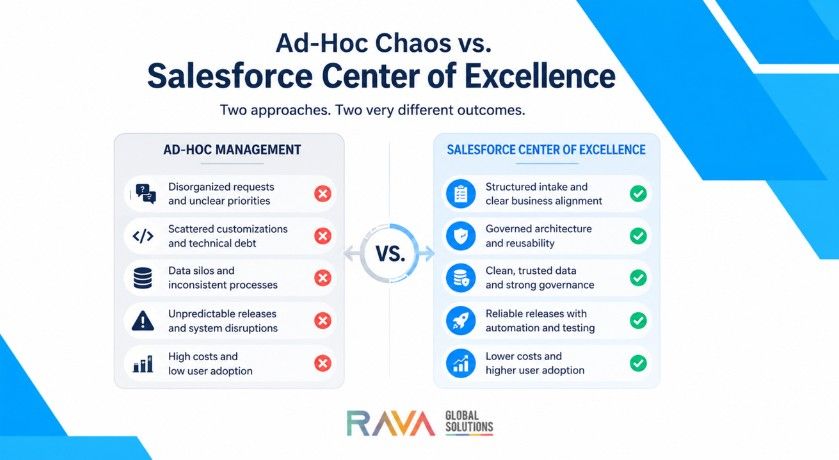
Comparing Governance Models: Ad-Hoc vs CoE Driven
| Strategic Pillar | Ad-Hoc Management | Strategic Salesforce CoE Model |
|---|---|---|
| Change Management | Informal requests executed directly in production environments | Rigorous intake scoring, sandbox testing, and scheduled deployments |
| Architectural Standards | Fragmented custom code, duplicate objects, and broken flows | Standardized design patterns, clean APIs, and low-code prioritization |
| Data Governance | Siloed data entry, duplicate contacts, and loose permissions | Strict validation rules, automated deduplication, and role hierarchy |
| Release Frequency | Unpredictable updates with high risk of user disruption | Continuous integration and release pipelines with zero downtime |
| Resource Allocation | Reactionary firefighting and ballooning vendor costs | Strategic resource allocation based on measurable commercial value |
5 Critical Pillars of a Salesforce CoE
Establishing an effective governing body requires structuring five core functional pillars across your enterprise operations.
- Executive Leadership: C-suite sponsors set strategic vision, resolve organizational roadblocks, and approve primary software budget allocations.
- Business Architecture Alignment: Process owners map cross-departmental requirements to ensure software features support real business outcomes.
- Technical Governance Board: Senior architects enforce coding standards, review integration patterns, and protect environment health.
- Change Management Team: Enablement specialists create training programs, monitor user adoption metrics, and manage organizational transition.
- Operational Release Management: DevOps engineers manage sandbox environments, automate testing procedures, and coordinate production deployments smoothly.
Real-World Scenarios: From System Chaos to Unified Scale
Resolving Multi-Region Process Conflicts
A global financial services firm operated five regional business instances with completely different sales pipelines. Regional teams created conflicting custom fields, making consolidated global reporting virtually impossible for corporate executives. The leadership team established a centralized governing council to standardize global opportunity stages across all operating regions.
Within six months, the organization consolidated its global reporting into real-time executive dashboards. The unified deployment pipeline reduced release errors by 75% across all regional teams. Furthermore, sales managers gained instant visibility into cross-border sales opportunities without manual data reconciliation.
Eliminating Technical Debt in High-Growth Environments
A rapidly expanding healthcare enterprise accumulated years of uncoordinated custom software modifications. System performance degraded significantly, causing page load delays of up to ten seconds for customer support agents. The incoming CIO introduced a dedicated governing framework to audit existing code and streamline system architecture.
The technical review board eliminated 40% of obsolete custom fields and refactored conflicting automation flows. Page load times dropped below one second, instantly improving call center productivity across every location. To prevent similar architecture issues, explore Salesforce Technical Debt: The Hidden Cost of Years of Customization. Clean code governance ensures long-term system health as transactional volumes grow.
4 Steps to Deploy Your Governing Framework
Phase 1: Executive Charter –> Phase 2: Intake Process –> Phase 3: Standards –> Phase 4: Optimization
1.Define the Executive Charter and Leadership Team
Secure C-suite sponsorship and establish a clear organizational mandate for system governance. Define explicit roles, voting rights, and meeting cadences for steering committee members. In our enterprise implementations, we found that securing early executive backing prevents business units from bypassing agreed review protocols.
2.Establish a Centralized Request Intake Process
Create a unified portal for submitting, scoring, and prioritizing all software change requests. Evaluate every incoming project against strategic business value, technical complexity, and regulatory compliance requirements. This structured evaluation ensures engineering teams focus exclusively on high-impact business initiatives.
3.Standardize Technical Rules and Release Pipelines
Publish comprehensive development guidelines covering environment management, code reviews, and testing protocols. Implement automated CI/CD tools to move software changes smoothly from developer sandboxes into production. Establishing strict release guardrails eliminates unexpected downtime and protects daily business operations.
4.Monitor User Adoption and Continuous Metrics
Track platform utilization, data quality scores, and feature adoption across all user groups continuously. Gather direct feedback from operational teams to identify usability friction and training gaps early. Regular performance reviews keep your technology ecosystem aligned with evolving commercial needs over time.
Sustaining continuous innovation requires ongoing expert management and dedicated technical oversight. Learn how external support models keep platform performance optimized in Salesforce Managed Services: The Missing Piece In CRM Success. Dedicated operational support ensures your enterprise stays agile while maintaining strict governance standards.
Frequently Asked Questions
What is the primary role of a Salesforce Center of Excellence?
A Salesforce Center of Excellence aligns business strategy with technical execution across your enterprise. It manages software intake requests, enforces architectural standards, controls release pipelines, and optimizes user adoption to maximize overall platform value.
When should an enterprise establish a governing framework?
Organizations should establish a governing council when expanding across multiple business units, handling high transaction volumes, or managing complex integrations. Implementing governance early prevents technical debt, reduces release friction, and protects your software investment.
How does governance improve user adoption rates?
Structured governance ensures software updates solve genuine user friction rather than creating unnecessary system complexity. By involving business process owners early, teams deliver intuitive tools and targeted training that drive consistent daily usage.
Does a governing board slow down feature delivery?
No, strategic governance actually speeds up feature delivery by removing development bottlenecks and deployment errors. Clear intake rules and automated release pipelines allow engineering teams to ship high-quality updates faster and with far less operational risk.
Who should participate in the governing council?
The council should include executive sponsors, business unit leads, enterprise architects, security officers, and release managers. This cross-functional representation ensures technology decisions balance commercial priorities with technical safety and compliance requirements.
Unlocking Scalable Value Through Governance
Sustaining enterprise growth requires moving beyond reactionary system management toward proactive operational control. Unchecked system modifications create technical debt that eventually slows down commercial execution and frustrates teams. Establishing a dedicated governing council transforms your technology platform into a stable engine for continuous business innovation.
RAVA Global Solutions brings seasoned expertise to help enterprise leaders design, build, and optimize robust governance frameworks. Our senior technical strategists guide your team through complex system transformations with calm authority and proven execution models. Partner with our team today to build a high-performing Salesforce Center of Excellence that drives long-term commercial success.